


Most small businesses do not have a marketing strategy. They have marketing activity: some ads here, a few posts there, and no way to tell what is working. The difference between companies that generate leads on schedule and companies that scramble is planning, not effort. This guide covers how to build a marketing strategy that turns random tactics into predictable results, especially for service businesses.
Understanding Marketing Strategy Fundamentals
A marketing strategy is the plan behind the tactics: who you serve, what problems you solve, where your audience spends time, and how you will measure success. Campaigns come and go. Strategy is the through-line.
Start with the actual business objective. More market share locally? More qualified leads? Better retention? Each goal calls for different tactics and different scoreboards.
Core elements every marketing strategy should address:
- Target audience definition and segmentation
- Unique value proposition and competitive differentiation
- Channel selection based on audience behavior
- Budget allocation across paid, owned, and earned media
- Key performance indicators and tracking systems
- Timeline and milestone planning
Service businesses usually win by going deep on a few channels instead of thin on all of them. A plumbing company might prioritize local SEO in Colorado Springs and Google Local Service Ads over national social campaigns.
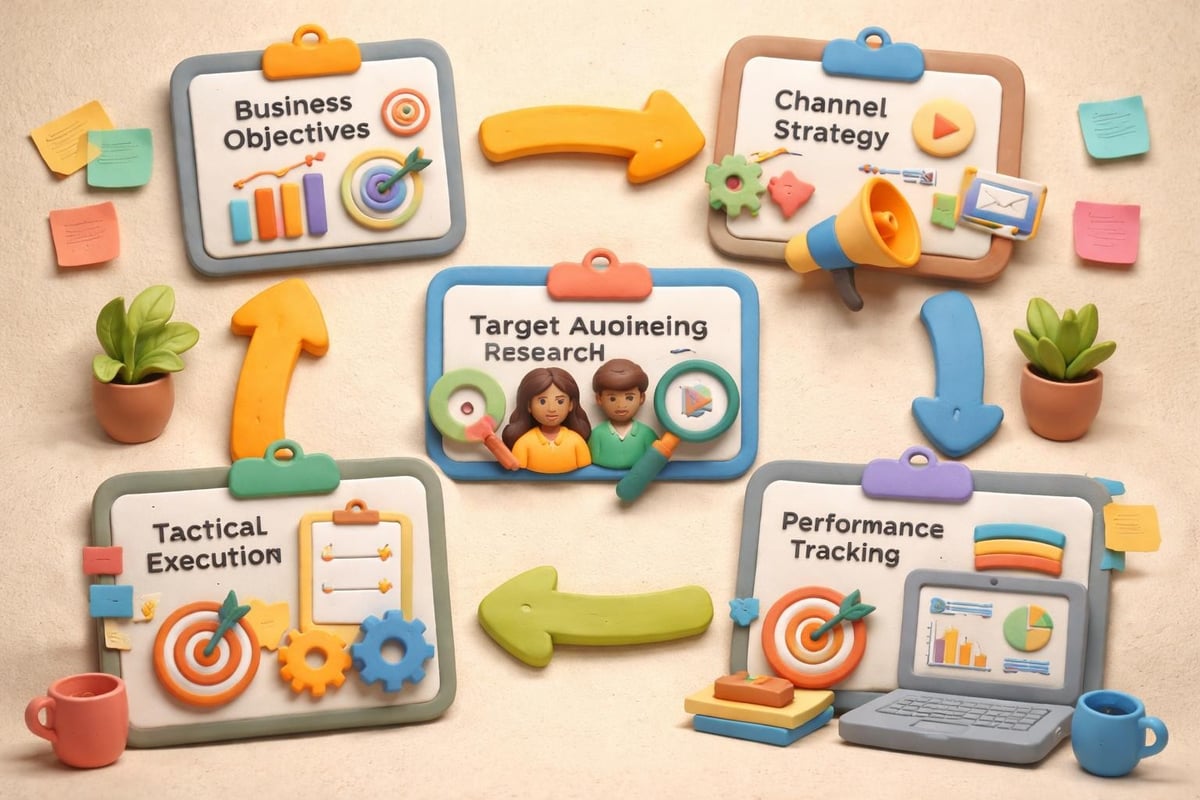
Audience Research and Market Positioning
Audience research goes past demographics. You need the pain points, the decision process, the objections, and the exact words customers type when they search.
The classic small business mistake is trying to serve everyone. Narrow the focus and the messaging sharpens while the budget goes further. An HVAC company might own commercial property management instead of fighting for every furnace job in town.
| Research Method | What It Reveals | Application |
|---|---|---|
| Customer interviews | Pain points, buying triggers | Messaging development |
| Search data analysis | Intent, questions, language | Content topics, SEO strategy |
| Competitor analysis | Market gaps, positioning opportunities | Differentiation angles |
| Website analytics | User behavior, conversion barriers | Landing page optimization |
That research informs everything downstream: ad targeting, content topics, sales conversations. Digital marketing success increasingly depends on matching your touchpoints to where prospects sit in their decision.
Building Multi-Channel Marketing Systems
Good strategy integrates owned media (website, email list), paid media (ads), and earned media (referrals, reviews) into one system instead of separate hobbies.
For service businesses, that usually means building a strong local search foundation, then layering paid ads to accelerate lead generation while the organic rankings mature. Owned properties convert; paid channels control volume.
Local Search and Organic Visibility
Local businesses compete on geography and reputation. Strong local search visibility keeps producing without ongoing ad costs.
The work: optimize your Google Business Profile, build location-specific content, earn local backlinks, and keep your business information consistent everywhere. Search engine optimization agencies know local rankings play by different rules than national SEO.
Essential local SEO components:
- Verified and optimized Google Business Profile
- Location pages targeting specific service areas
- Local citations and directory listings
- Customer reviews and reputation management
- Local content addressing community-specific topics
- Schema markup for business information
Local SEO’s advantage is compounding. Ads stop when the money stops. Rankings hold with consistent upkeep and keep improving.
Paid Advertising for Predictable Lead Flow
Paid advertising covers the gap while organic builds: immediate visibility, controlled volume. Treat ads as a system with lead capture, nurture, and revenue tracking, not a set of one-off campaigns.
Google and Meta do different jobs. Search ads catch people already looking. Social ads reach people before they search. Match each to the goal.
A roofer might run Google Local Service Ads to catch emergency repair calls while Meta campaigns show off finished roofs to homeowners in target neighborhoods. Immediate demand plus long-term brand, covered.
| Channel | Best For | Typical Timeline | Key Metrics |
|---|---|---|---|
| Google Search Ads | Capturing active demand | Immediate | Cost per lead, conversion rate |
| Local Service Ads | Service businesses needing phone calls | Immediate | Cost per call, booking rate |
| Meta Ads | Building awareness, showcasing work | 30-90 days | CPM, engagement, landing page conversions |
| Display Ads | Retargeting, brand visibility | 60-90 days | Click-through rate, assisted conversions |
Allocate by stage. New businesses lean on paid while organic grows. Established companies use paid to push into new service areas or seasonal offers.
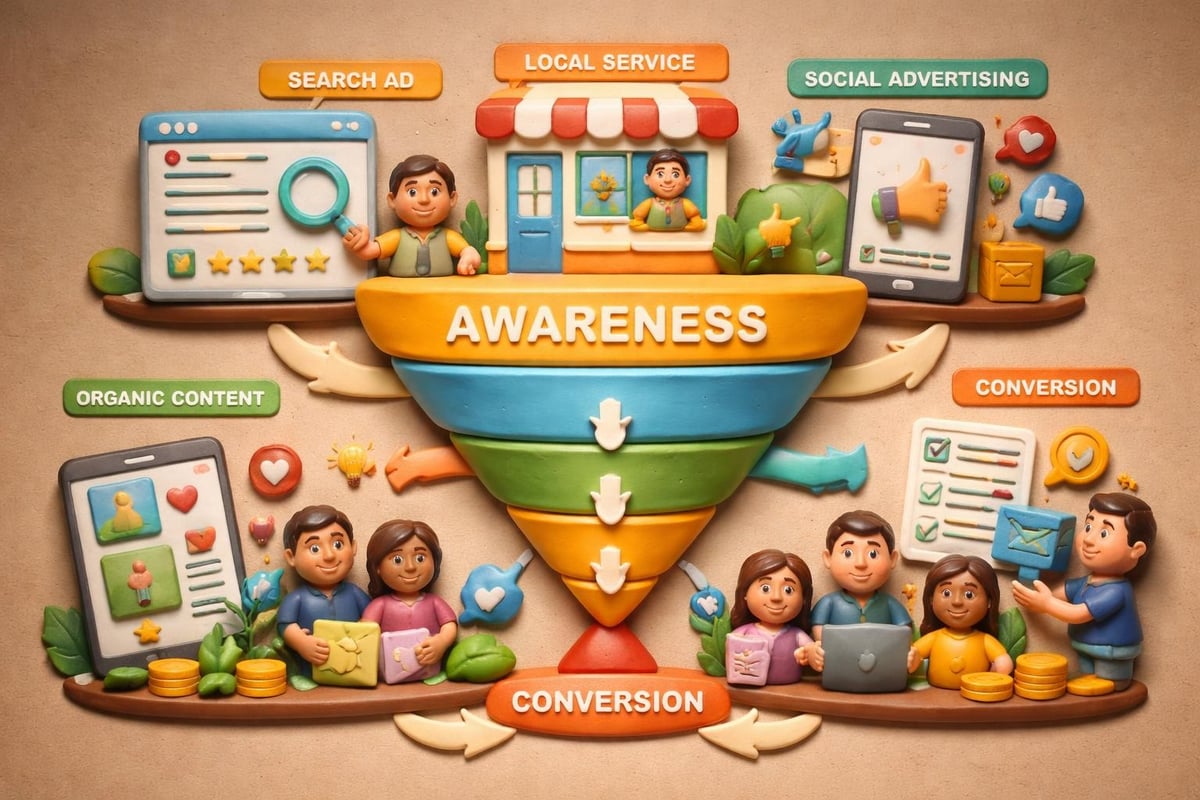
Creating Marketing Automation and Follow-Up Systems
The gap between generating a lead and converting it is where most businesses bleed money. Automation closes it with consistent, instant follow-up that nobody has to remember to do.
Modern marketing strategy bakes in technology that handles the repetitive work, scores leads by behavior, and hands sales the hottest opportunities. That matters most when your whole staff fits in one truck.
CRM Integration and Lead Management
Your CRM is the backbone. Without one properly set up, you cannot answer the basic question: which channels produce the customers?
Real CRM use goes past storing phone numbers: source tracking, automated tasks, pipeline management, and closed-loop reporting that ties activity to revenue.
Critical CRM capabilities for marketing:
- Lead source attribution tracking which campaigns generate inquiries
- Automated assignment routing leads to appropriate team members
- Follow-up automation ensuring no prospect falls through cracks
- Pipeline visibility showing conversion rates at each stage
- Revenue reporting connecting marketing activity to actual sales
AI automation has raised the ceiling. Voice agents handle initial inquiries, qualification, and scheduling. Automated messages keep long sales cycles warm. None of it replaces humans; it makes sure no prospect waits.
Content Marketing and Value-Based Nurturing
Not every lead is ready to buy today. Content keeps you useful and visible during the research phase, so when they are ready, you are the obvious call.
Map content to the journey. Early: how to spot the problem, how to compare options. Late: case studies, process explanations, real outcomes.
Leveraging content marketing for brand growth takes consistent publishing matched to what your audience needs, not whatever you had time for this month. A business-to-business marketing agency might publish weekly industry insights; a martial arts studio might share training tips and student wins.
Then squeeze every piece. One good insight becomes a blog post, social posts, a newsletter, and a video script. That multiplication is where content ROI lives.
Measurement and Performance Optimization
Marketing strategy without measurement is activity without accountability. Set metrics tied to outcomes and review them on a schedule.
Understand how metrics chain together. Traffic that does not convert is a vanity number. Leads that never become customers are, too. Follow the chain to revenue.
Key Performance Indicators by Channel
Every channel has its own scoreboard, but all of them roll up to two numbers: customer acquisition cost and lifetime value. Those decide whether marketing is profitable growth or expensive noise.
| Channel | Primary Metrics | Supporting Indicators |
|---|---|---|
| Local SEO | Organic traffic, rankings for target keywords | Click-through rate, time on site, form submissions |
| Google Ads | Cost per conversion, conversion rate | Quality Score, impression share, click-through rate |
| Meta Ads | Cost per lead, landing page conversion rate | Engagement rate, reach, frequency |
| Open rate, click-through rate, conversions | List growth rate, unsubscribe rate | |
| Content | Organic search rankings, backlinks earned | Time on page, scroll depth, social shares |
Watch attribution too. A prospect might find you on social, search your name later, read a blog post, then convert through an ad. Credit only the ad and you will misread everything.
Testing and Continuous Improvement
The best plans evolve on results, not assumptions. Test messaging, offers, targeting, and creative, and let the data pick winners.
A/B testing keeps it honest: change one variable, hold the rest constant. Headlines, layouts, call-to-action text, subject lines. Small insights stack.
High-impact testing opportunities:
- Landing page headlines and primary value propositions
- Call-to-action buttons (placement, color, text)
- Ad creative and messaging angles
- Offer structures (discounts vs. added value)
- Form length and field requirements
- Follow-up sequence timing and messaging
Small wins multiply. A 10% better landing page conversion plus 10% better ad click-through is 21% more leads from the same budget. Understanding why customer experience should be core to your marketing strategy helps you find where the friction hides.

Strategic Planning for Different Business Models
Marketing strategy has to fit the business model. A law firm with six-month sales cycles plays a different game than a plumber handling burst pipes.
Recurring-revenue businesses should weight retention and referrals alongside acquisition. When a customer is worth years instead of one ticket, the math changes completely.
Service Business Marketing Considerations
Local service businesses get unique advantages: tight geography means precise targeting, and reputation does heavy lifting in buying decisions.
Priorities: build a deep review profile, own the near me searches, systematize referrals, and use local service ads marketing to capture high-intent phone calls. Local visibility compounds as your presence strengthens.
Specialized industries like pawnshop marketing or martial arts marketing come with their own customer psychology and rules. Generic playbooks miss the nuances that decide conversion.
Emotional Connection and Brand Building
Tactics drive this quarter. Brand builds the moat. Emotional branding drives customer loyalty by creating connections that outlast any single transaction.
You do not need a Super Bowl budget for that. Consistent messaging, reliable service, and experiences worth talking about do it. The plumber who leaves the job site cleaner than he found it is building brand.
Pick what you stand for. Not everyone should compete on price. Expertise, speed, convenience, or specialized knowledge all beat being the cheapest.
Integration and Execution
Great strategy dies without execution: clear owners, timelines, content calendars, and workflows that keep activity consistent.
Hybrid models work well: your team owns the business knowledge, outside specialists handle channels like paid advertising or technical SEO where expertise gaps cost real money.
Execution framework elements:
- Clear role assignment for strategy, content creation, campaign management, and analysis
- Content calendars planning topics, formats, and distribution across channels
- Campaign timelines with launch dates, creative deadlines, and review milestones
- Communication protocols ensuring marketing and sales alignment
- Review cadence for performance analysis and optimization decisions
Stay adaptable. Markets shift, competitors move, opportunities pop up. Hold the strategic direction, flex the tactics.
Treat strategy as a process, not a binder on a shelf. Regular reviews of what is working, what is not, and where to shift resources separate steady growers from businesses with sporadic wins.
An effective marketing strategy aligns business goals with customer behavior, picks the channels where your audience actually decides, and builds systems that turn activity into measurable results. Pioneer Marketing helps Colorado Front Range businesses do exactly that, with local SEO, paid advertising, and AI-powered automation that generate predictable lead flow.


