Picking the right business to business marketing agency changes how you generate leads, nurture prospects, and close deals. B2B is a different animal than consumer marketing: longer sales cycles, multiple decision-makers, and buyers who need an ROI case before they sign anything. A good agency brings focused expertise and infrastructure most internal teams can’t build cost-effectively. Here’s what to look for.
What Defines a Business to Business Marketing Agency
A business to business marketing agency helps companies sell to other organizations instead of individual consumers. B2B deals run on rational evaluation, committee approvals, and ROI justification. Nobody impulse-buys a $40,000 software contract.
The core difference is buyer behavior. B2B buyers research heavily, compare vendors systematically, and evaluate long-term partnerships. Good agencies build for that: content that educates, credibility signals that earn trust, and nurture sequences that stay useful through a long buying cycle.
Specialized Services That Drive Results
Modern B2B agencies deliver integrated services rather than generic marketing. The specialization is the point.
Core service offerings typically include:
- Search engine optimization tailored to commercial and transactional keywords
- Pay-per-click advertising on platforms where decision-makers research solutions
- Content marketing that addresses specific pain points at each funnel stage
- Marketing automation systems that score leads and trigger personalized follow-up
- CRM integration that connects marketing activities to sales pipeline metrics
The best firms connect these services instead of running them separately. SEO surfaces high-intent keywords, those inform content, content generates leads that automation captures, and sales gets qualified prospects with full context.

Strategic Approaches That Separate Top Agencies
Methodology determines whether a campaign produces vanity metrics or revenue. Strategic agencies start with your business objectives and work backward to tactics, not the other way around.
One powerful approach targets specific high-value companies instead of broad audience segments. This account-based marketing strategy aligns sales and marketing around shared prospect lists, with personalized campaigns built for each account’s challenges and decision dynamics.
Data-Driven Decision Making
Good agencies build the measurement framework before launching anything: baseline metrics, success criteria, and tracking that ties revenue to specific marketing activities.
| Metric Category | Examples | Business Impact |
|---|---|---|
| Traffic Quality | Organic sessions from target industries, paid click-through rates | Indicates whether the right prospects find your business |
| Engagement Depth | Time on site, pages per session, content downloads | Shows how effectively messaging resonates with visitors |
| Lead Generation | Form submissions, demo requests, consultation bookings | Measures top-of-funnel conversion effectiveness |
| Pipeline Contribution | Marketing-qualified leads, sales-accepted opportunities | Demonstrates marketing’s role in revenue generation |
That quantitative footing lets them optimize continuously. Instead of waiting for a quarterly review, they make weekly or even daily adjustments, moving budget from underperformers to the channels producing qualified leads at acceptable cost.
Technology Infrastructure and Automation
A modern business to business marketing agency also brings a technology stack that would cost you real money to build alone: CRM, marketing automation, analytics, and increasingly AI.
AI-powered tools are transforming B2B marketing by automating ad creation, optimizing bids, and personalizing content based on behavior. These systems spot buying-intent signals across touchpoints and trigger follow-up without anyone lifting a finger.
Automation That Scales Lead Nurturing
Automation platforms let an agency hold personalized conversations with thousands of prospects at once. Someone downloads a whitepaper, and the system enrolls them in a nurture sequence matched to their industry and interest.
Key automation capabilities include:
- Lead scoring that assigns point values based on demographic fit and behavioral engagement
- Segmentation logic that groups prospects by industry, company size, or stage in the buying journey
- Dynamic content that adapts email messaging based on recipient characteristics
- Trigger campaigns that respond to specific actions like website visits or email clicks
- Workflow routing that assigns qualified leads to appropriate sales representatives
These systems run around the clock, so no prospect falls into the gap between marketing and sales. For service businesses, where response time often decides who wins the job, that speed is the whole ballgame.
Agencies specializing in AI automation take it further: voice agents handle initial qualification calls, chatbots answer questions after hours, and automated messages confirm appointments and send follow-ups without staff involvement.

Selecting the Right Agency Partner
Hiring an agency takes more evaluation than flipping through a portfolio. You’re checking strategic fit, cultural fit, and process.
Choosing the right full-service B2B marketing agency means asking whether they understand your industry, have experience with similar business models, and can prove expertise in the channels that actually matter for your goals.
Evaluation Criteria for Agency Selection
Dig into how they build strategy, measure performance, and communicate. Ask for process detail, not surface descriptions.
Critical questions to ask prospective agencies:
- How do you conduct initial research to understand our market and competitive landscape?
- What metrics do you prioritize when measuring campaign success?
- How frequently will we receive performance reports and strategic recommendations?
- What level of access will we have to campaign data and analytics platforms?
- How do you handle underperforming campaigns or channels that aren’t delivering ROI?
Good agencies welcome these questions and answer with specifics. Vague talk about “driving results” and “leveraging best practices” tells you everything you need to know.
Cultural fit matters as much as competence. The agency becomes an extension of your team, so meet the actual people who will run your account, not just the salesperson courting you.
Industry-Specific Expertise and Case Studies
Generic marketing rarely works in B2B, where buyers judge vendors on industry knowledge. An agency that has served similar companies already knows the regulatory quirks, buyer personas, and messaging that lands with your audience.
B2B marketing case studies show how an agency turns strategy into execution. Look for hard numbers: lead volume, cost-per-acquisition, revenue attribution. Skip anyone whose best proof is “enhanced brand awareness.”
Vertical Specialization Advantages
Industry-focused agencies build depth generalists can’t match: seasonal buying patterns, the trade publications that matter, the terminology that earns credibility with knowledgeable prospects.
In niche markets that depth is gold. An agency experienced with professional services understands relationship selling. One focused on manufacturing knows procurement processes and spec requirements cold.
| Specialization Area | Key Differentiators | Typical Results |
|---|---|---|
| Local service providers | Geographic targeting, review management, local search optimization | Increased service area visibility and qualified local leads |
| Professional services | Thought leadership content, industry event marketing, referral programs | Enhanced reputation and warm introductions to target accounts |
| SaaS companies | Product-led growth strategies, free trial optimization, user onboarding | Improved trial-to-paid conversion rates and reduced churn |
| Industrial manufacturing | Technical content creation, trade show strategy, specification documentation | Shortened sales cycles through better-educated prospects |
Companies serving local markets want an agency fluent in geographic targeting and community presence. Businesses operating internationally need multi-market experience and localization instead.
Integration With Sales Processes
The best business to business marketing agency partnerships tear down the wall between marketing and sales. Instead of marketing tossing leads over the fence and sales complaining about quality, both teams share revenue goals and accountability.
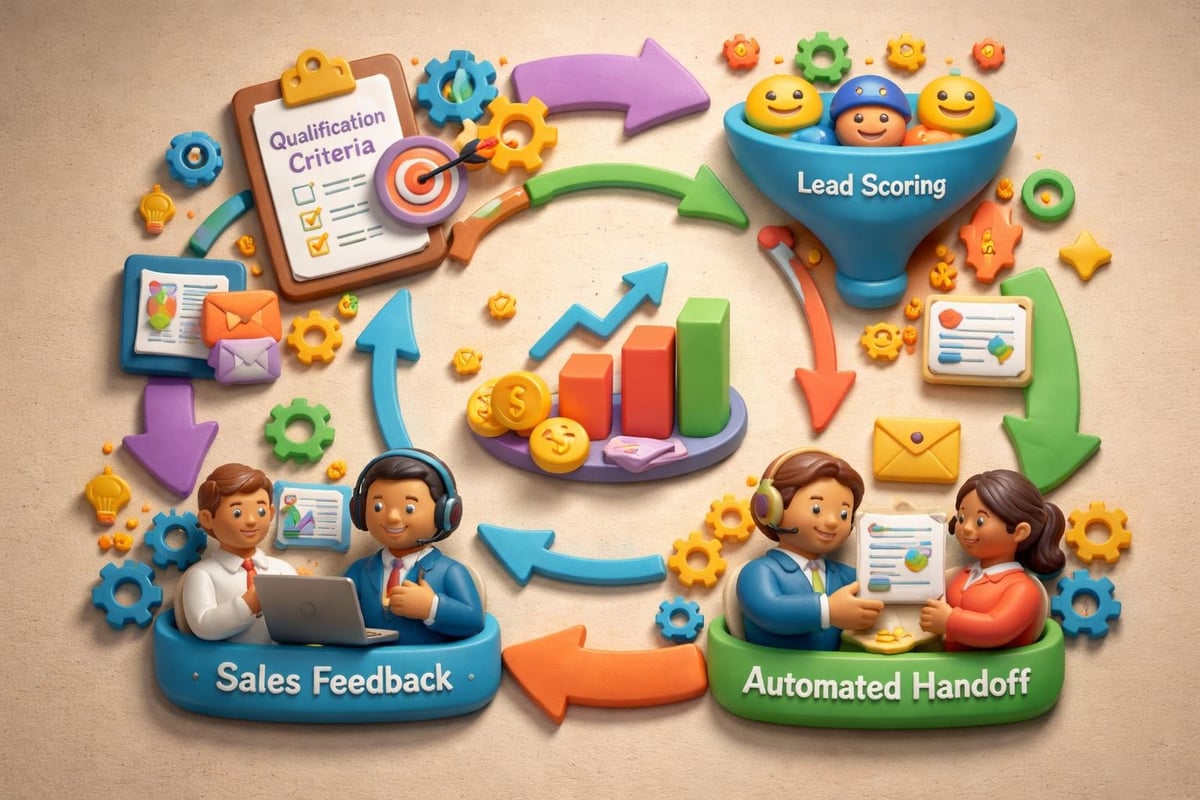
It starts with jointly defining a qualified lead: the demographics, behaviors, and stated needs that separate a real buyer from a casual researcher.
Lead Handoff and Attribution Models
Clear handoff processes track each prospect’s journey: what they read, what they asked, and what they did before requesting a sales conversation.
Effective handoff processes include:
- Automated lead scoring that identifies when prospects reach qualification thresholds
- Real-time notifications that alert sales representatives to high-intent activities
- Comprehensive lead profiles that provide context for initial sales conversations
- Feedback loops where sales teams report lead quality back to marketing
- Attribution models that credit marketing touchpoints contributing to closed revenue
That transparency lets both teams improve. When sales flags lead quality issues, marketing adjusts targeting, messaging, or nurture sequences to fix it.
Content Strategy and Thought Leadership
B2B buyers do most of their homework before ever talking to sales. They read guides, case studies, and comparisons to narrow the field long before requesting a demo.
A sharp agency builds content for every stage of that journey: awareness content that frames the problem, consideration content that compares approaches, and decision content that proves you can deliver.
Multi-Format Content Development
Format matters too. A busy executive wants a two-minute video or a one-page summary. A technical evaluator wants the detailed whitepaper. Serve both.
Content formats that serve different buyer roles:
- Executive summaries highlighting business impact and ROI for C-level decision-makers
- Technical documentation providing implementation details for IT and operations teams
- Case studies demonstrating proven results for procurement professionals evaluating risk
- Comparison guides helping researchers understand differentiators versus alternatives
- Video testimonials building trust through peer validation and social proof
Agencies that excel at B2B content marketing run editorial calendars that answer real audience questions while hitting SEO targets. The content pulls search traffic and helps buyers decide. Both jobs, one asset.
International agencies like DTILE GmbH show how local expertise sharpens content for businesses expanding into new markets, where cultural nuance and local search require native understanding.
Paid Advertising Strategy and Management
Organic builds the long-term engine. Paid buys immediate visibility and controllable lead flow. A good B2B agency runs campaigns wherever your decision-makers actually research: search engines, LinkedIn, industry publications.
The strongest paid strategies stack channels so the message reinforces itself. A prospect clicks your search ad, sees your retargeting on LinkedIn, gets a nurture email, then spots your display ad on a trade site.
Platform-Specific Approaches
Each platform has a job. Search captures active demand. Social builds awareness with targeted job titles and companies.
| Platform | Primary Use Case | Targeting Capabilities | Typical Metrics |
|---|---|---|---|
| Google Ads | Capture active search intent | Keywords, locations, devices | Cost per lead, conversion rate |
| LinkedIn Ads | Reach decision-makers by role | Job titles, companies, industries | Engagement rate, form completions |
| Display Networks | Build awareness at scale | Websites visited, topics, behaviors | Impressions, click-through rate |
| YouTube Ads | Educate through video content | Demographics, interests, placements | View rate, watch time |
Agencies experienced with paid advertising strategies optimize constantly: bids, targeting, creative tests, and budget shifts toward whatever is working.
For service businesses with a defined territory, location targeting keeps ad spend inside the area you can actually serve. No paying for clicks from three states away.
Measurement, Reporting, and Continuous Improvement
Accountability separates real agencies from expensive noise. Expect clear benchmarks, progress tracked against goals, and reporting that connects marketing spend to business outcomes.
Reports should go past impressions and clicks to pipeline and revenue. Multi-touch attribution shows which campaigns actually contributed to closed deals.
Performance Optimization Cycles
Treat marketing like an experiment: test approaches head to head, analyze rigorously, keep the winners, kill the losers.
Continuous improvement activities include:
- A/B testing landing page elements to improve conversion rates
- Keyword expansion and pruning based on search performance data
- Email subject line and content testing to enhance open and click rates
- Ad creative rotation to identify highest-performing messaging and imagery
- Audience segmentation refinement based on conversion behavior patterns
Iteration compounds. Small monthly gains in conversion rate, cost efficiency, and lead quality add up to a massive edge over a campaign that never changes.
Agencies serving small and mid-sized businesses know owners need a straight line from expense to revenue. Good ones build dashboards showing leads by channel, conversion rates, and the revenue those customers produce.
Long-Term Partnership Value
The relationship should mature from tactical execution into strategic partnership. The longer an agency works your market, the more valuable its recommendations get.
That takes commitment on both sides. You share internal knowledge and lead-quality feedback. The agency invests in learning your industry and building institutional knowledge.
Elevating B2B marketing with agency expertise creates advantages an isolated internal team can’t match: specialized talent, proven methods, and infrastructure that would take serious capital to replicate.
Scaling Marketing Infrastructure
Growth multiplies marketing complexity. New product lines need positioning, new territories need localized campaigns, bigger deals need longer nurture.
An agency scales with you without new full-time hires. They add specialists as needs emerge and grow the tech stack as lead volume rises.
Expanding into new services or markets? An experienced partner has seen those launches before and knows where the potholes are.
Businesses exploring AI-powered marketing approaches benefit from an agency already running those tools across many clients. You get the lessons without paying the tuition.
Lead Generation Tactics That Produce Qualified Prospects
A flood of unqualified leads wastes sales time and breeds frustration. Professional agencies build for prospects with real intent and real authority to buy.
Effective B2B lead generation strategies combine inbound tactics that attract researchers with outbound plays that reach decision-makers at target accounts. The right mix depends on your industry, competition, and budget.
Inbound and Outbound Integration
Inbound draws prospects to you through search, social, and referrals. Outbound goes to them through targeted ads, email, and direct outreach.
Integrated lead generation components:
- SEO-optimized content that ranks for commercial keywords prospects use when researching solutions
- Gated resources like industry reports or calculators that capture contact information in exchange for value
- Retargeting campaigns that re-engage website visitors who didn’t convert during initial visits
- LinkedIn outreach to decision-makers at companies matching ideal customer profiles
- Email sequences nurturing prospects through educational content until sales readiness
The best agencies orchestrate all of it. A prospect downloads your whitepaper, enters a nurture sequence, sees retargeting ads, then gets a personal touch from sales at exactly the right moment.
Industry focus shapes tactics here too. Agencies serving local service providers lean on local SEO strategies to win geographic searches, while national players push thought leadership and broader targeting.
The right business to business marketing agency turns lead generation from unpredictable to systematic. Pioneer Marketing does this for service businesses across the Colorado Front Range: local search optimization, intelligent automation, and paid advertising with numbers you can actually check. If you want marketing that connects traffic, leads, and revenue, let’s talk.