Every small business owner I talk to has the same problem: not enough good leads. Plenty of tire-kickers, plenty of spam form fills, not enough people ready to buy.
This guide covers 10 ideas for lead generation for small business owners who want results they can measure, from AI-powered follow-up to referral programs that run themselves.
No theory for theory’s sake. Just tactics that work, and how to start each one.
The Evolving Landscape of Lead Generation for Small Businesses
Buyers changed. Lead generation for small business has to change with them. Here’s what that looks like in practice.

Understanding Modern Buyer Behavior
Your customers do their homework. They research online long before they ever contact a vendor, so by the time someone calls you, they’ve usually compared you to three competitors. Decision cycles are shorter, attention spans are shorter, and the business that responds first usually wins.
So be where your buyers already are: Google and social media. If a roofer in Colorado Springs can fill the schedule from Google alone, so can you.
Key Lead Generation Challenges for Small Businesses
The usual obstacles: a small budget, a small team, and big-brand competitors with deeper pockets. You can’t out-spend them. You have to out-maneuver them.
The quieter lead killers are slow follow-up and no tracking. If you don’t know which channel produced a lead, you can’t double down on it. And if you respond tomorrow, somebody else responded today.
The Role of Technology and Automation
This is where technology earns its keep. AI tools now handle lead capture, qualification, and follow-up automatically. A chatbot on your site collects contact info at 2 a.m. while you sleep.
Hook that automation to your CRM and every lead gets a fast, personal response without you lifting a finger. For a deeper look, explore Marketing automation in digital campaigns. The data these tools produce also shows you exactly which messages and audiences pay off.
Why Innovation Matters in Lead Generation
Trying new tactics early is one of the few edges a small business has over a big one. You can test an AI chatbot this week. A corporate marketing department needs six meetings to approve the idea.
You don’t need to chase every trend. You do need to notice when your customers change how they buy, and adjust before your competitors do.
10 Innovative Ideas for Lead Generation for Small Business 2026
Here are 10 ideas that actually move the needle, mixing technology, creativity, and old-fashioned relationship building.

1. AI-Powered Lead Qualification and Nurturing
AI can identify, score, and nurture your leads while you run your business. AI chatbots talk to website visitors in real time, answer common questions, and collect contact info around the clock.
Connect AI to your CRM and it prioritizes your hottest leads, sends follow-up emails, and personalizes content based on what each visitor did on your site. Nobody falls through the cracks, and nobody waits two days for a reply.
A chatbot catches the lead you would otherwise lose overnight, and scoring puts the ready-to-buy people at the top of your call list instead of the bottom. That’s a serious edge over doing it all by hand.
2. Hyper-Local SEO and Google Business Profile Optimization
When someone searches ‘plumber near me’ or ‘roof repair Colorado Springs,’ your Google Business Profile decides whether they find you or your competitor. For most local businesses, optimizing it is where a little effort tends to return the most.
Use local keywords, keep your name, address, and phone number identical across every directory, and ask happy customers for reviews. Strong ratings move you up the map results. Google Posts and limited-time offers keep the profile active.
A complete, active profile is what puts you in the map pack when someone nearby is ready to call. For actionable steps, see these Local SEO strategies for SMBs. Then check your local search performance monthly and fix what’s slipping.
3. Interactive Content and Personalized Experiences
Quizzes, calculators, and assessments do something a static page can’t: they get visitors to hand over contact info in exchange for a personalized answer. A ‘what will your project cost?’ calculator captures the lead and tells you exactly what they want.
Landing pages that adapt to a visitor’s location or past visits convert better, and follow-up emails based on quiz results feel personal instead of canned.
Interactive content earns the contact info instead of begging for it, and people actually share it. It works especially well in consulting, finance, and education.
4. Video Marketing and Live Streaming for Lead Capture
Video builds trust faster than any block of text. Short clips and live streams let people see your work and hear how you talk before they ever call.
Host live Q&As, demo your product, or film a behind-the-scenes walkthrough. Put a lead capture form right in the video or stream. Post everywhere your customers are: YouTube, Facebook, Instagram, LinkedIn.
Then squeeze more out of every video: cut it into social clips, turn the transcript into a blog post, drop it into your email campaigns. One recording, five assets.
5. Strategic Partnerships and Collaborative Campaigns
Partner with businesses that share your customers but not your services. A roofer and a gutter company. A gym and a physical therapist. Co-host a webinar or a community event and you both walk away with new leads.
Cross-promote each other, run joint giveaways, split the marketing costs. Referral relationships like this compound over time.
The only rule: overlapping audiences, non-competing offers. Get that right and one good partner can feed you leads for years.
6. Automated Referral and Loyalty Programs
Your happiest customers would refer you more often if you made it easy. Referral software tracks referrals, hands out rewards, and sends reminders, all without you managing a spreadsheet.
Tiered incentives and exclusive perks keep people participating. Wire the program into email, SMS, and social so sharing takes one tap. Referred customers tend to stick around longer too, because they arrived already trusting you.
Loyalty programs work the same muscle: they keep current clients coming back and talking about you. Check the numbers quarterly and adjust the rewards.
7. Social Selling and Influencer Micro-Collaborations
Social selling means building relationships on LinkedIn, Facebook, and Instagram before you need them. Train your team to engage like humans, not like a billboard.
Micro-influencers give you access to tight-knit niche communities where a recommendation still reads as a recommendation instead of an ad. Social listening tools surface people already asking for what you sell.
Share useful content, run a contest, join conversations where your customers hang out. This works best if your product photographs well or your community runs deep.
8. Conversion-Optimized Landing Pages and Funnels
Every campaign deserves its own landing page: one offer, one clear call to action, testimonials for trust, and nothing else to click.
A/B test headlines and layouts. Connect the page to your CRM so follow-up happens instantly. Exit-intent popups and chat widgets catch a few extra leads on the way out the door.
And make it fast on phones, because that’s where most of your visitors are. A dedicated page built for one offer beats sending paid traffic to your homepage every time.
9. Omnichannel Paid Advertising (Google, Meta, Local Service Ads)
Coordinated campaigns across Google, Facebook, Instagram, and local platforms beat scattered one-off ads. Precise targeting puts your offer in front of your ideal customer instead of everyone with a pulse.
Retarget people who visited but didn’t convert. Build lookalike audiences from your best customers. Watch the numbers weekly and move budget to whatever’s winning.
For service businesses, Local Services Ads deserve special attention: they catch high-intent searchers at the exact moment of need. Feed everything into your CRM so you know which ads produce revenue, not just clicks.
10. Educational Webinars and Value-Driven Lead Magnets
Webinars position you as the expert people call when they’re ready to spend. Host live sessions or record them for on-demand viewing.
Trade downloadable guides, checklists, or templates for contact info. A good webinar hands you a room of people who already sat through 45 minutes of your thinking, which is a warmer list than any ad will build. Promote through email, social, and your partners.
Follow up with registrants using a short email sequence, then recycle the content into blog posts and clips. One webinar can keep generating leads for months.
Measuring, Optimizing, and Scaling Your Lead Generation Efforts
Setting up campaigns is half of lead generation for small business. The other half: measuring what works, cutting what doesn’t, and scaling the winners.
Setting Up Lead Tracking and Analytics
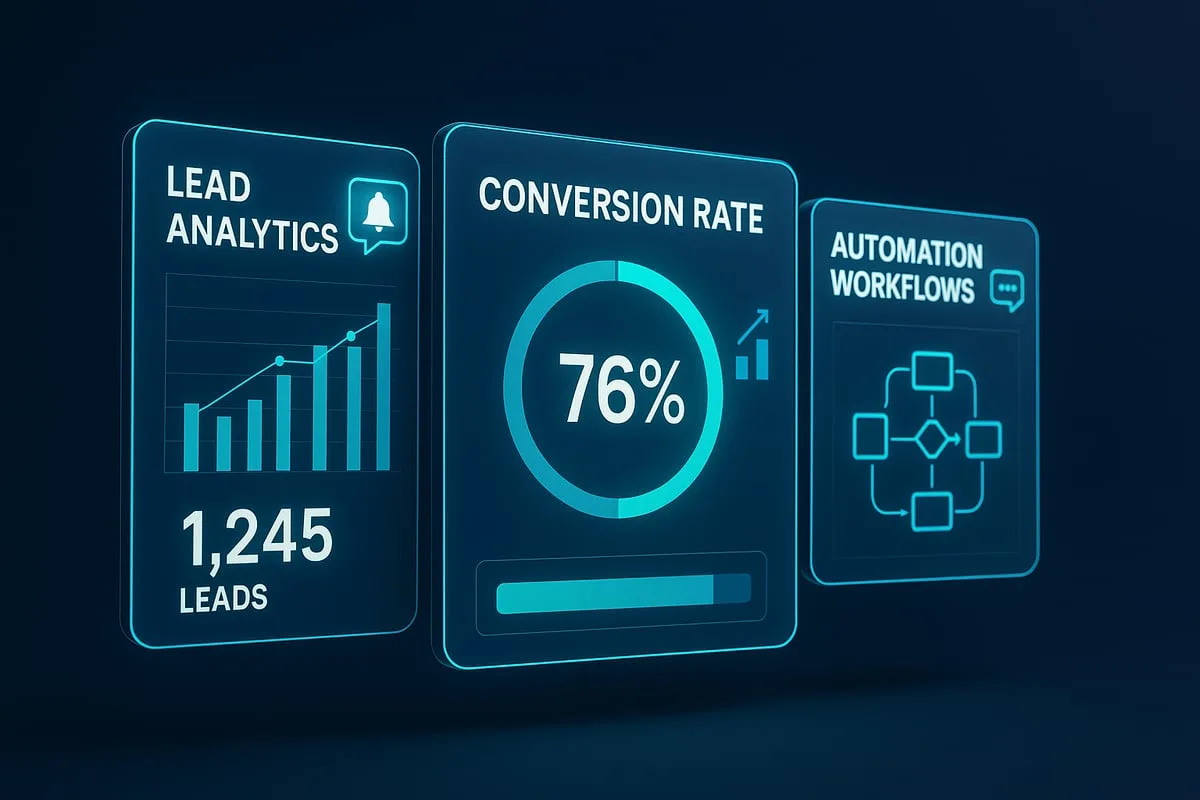
Start with tracking. A CRM captures and organizes every lead so nothing slips through.
UTM parameters tell you which channel each lead came from, and call tracking does the same for phone leads. Without that, every budget decision you make is a guess.
Popular analytics tools include:
- Google Analytics for website traffic and behavior
- CRM dashboards for lead sources and sales pipelines
- Heatmaps to visualize user interaction
For a deeper dive into analytics and channel attribution, explore digital marketing for small business and see how the data changes your decisions.
Conversion Rate Optimization Best Practices
Small tweaks, big swings. Test headlines, calls-to-action, and form length on your landing pages. Change one thing at a time so you know what actually moved the number.
Heatmaps and session recordings show where visitors bail. Sometimes the fix is embarrassing: a button color, a form that’s three fields too long. Changes that small are usually the cheapest lift available to you.
Best practices include:
- Keeping forms concise
- Adding trust signals, like testimonials and badges
- Using clear, actionable CTAs
Review the data monthly, change one thing, measure again. Boring? A little. Effective? Very.
Leveraging Automation for Scalability
A small team can run big-league lead generation if automation does the grunt work. Automate email nurturing, follow-up reminders, and appointment scheduling.
Connect your tools so data flows between them on its own. Automation replies while you are up a ladder or under a sink, and speed wins deals.
Let AI take the repetitive tasks so your team can focus on closing. Handing the repetitive work to software is what frees a small team to spend its hours on the conversations that actually close. Worth thinking about what that could free up in your week.
Continuous Improvement and Staying Ahead of Trends
Buyer behavior will keep shifting. Survey your customers, watch the new platforms, and don’t get comfortable.
Test new channels before your competitors do, and benchmark your results against your industry so you know what good looks like.
Keep an eye on automation and personalization trends, keep improving, and the compounding takes care of itself.
Questions Small Business Owners Ask About Lead Generation
If I only have time for one of these, which one?
Answer the leads you already get, faster. Ten new tactics feed a bucket with a hole in it if calls go to voicemail and forms sit until evening. Fix the response first, then turn on more traffic.
The gap is not small: in the Lead Response Management study (Dr. James Oldroyd, MIT Sloan, with InsideSales.com), calling a new lead within 5 minutes instead of 30 made the odds of reaching that lead 100 times higher, and the odds of qualifying it 21 times higher. That is the cheapest move on this list and the one most owners skip. See AI CRM and automation.
What does lead generation actually cost for a small business?
Ours is published, so you can do the math before you call anyone. There are three month to month plans: Get Found at $2,000 a month, Get Leads at $3,500 a month plus ad spend, and Get Dominant at $5,000 a month plus ad spend. No setup fees, and you can cancel any month.
On the plans that include ads, your ad budget goes straight to Google and Meta and is billed separately at cost, so you always know what you paid for the work and what you paid for the clicks. If you only want one piece rather than a plan, each service page publishes its own price: AI CRM and automation, local SEO, Meta ads and websites.
How many leads will this get me?
Nobody can honestly tell you that up front, and it is worth being careful with anyone who does. Your trade, your area and your season all move the number. What can be promised is that the system does its job: it answers, qualifies, books and follows up, and you see every number behind it.
Most of my work comes from word of mouth. Do I still need any of this?
Word of mouth still ends in a search. Someone gets your name, looks you up, and decides from whatever they find whether you look like the real thing. That is also where your Google Business Profile and any ads have to send people, so the site is not a separate project from everything else on this list. Start there before you spend on traffic. See websites.
Ready to put these ideas to work? Get My Free AI Growth Audit and we’ll pinpoint the biggest leak in your lead flow, then hand you the fix in two business days. No jargon, no fluff, just a plan you can act on.