
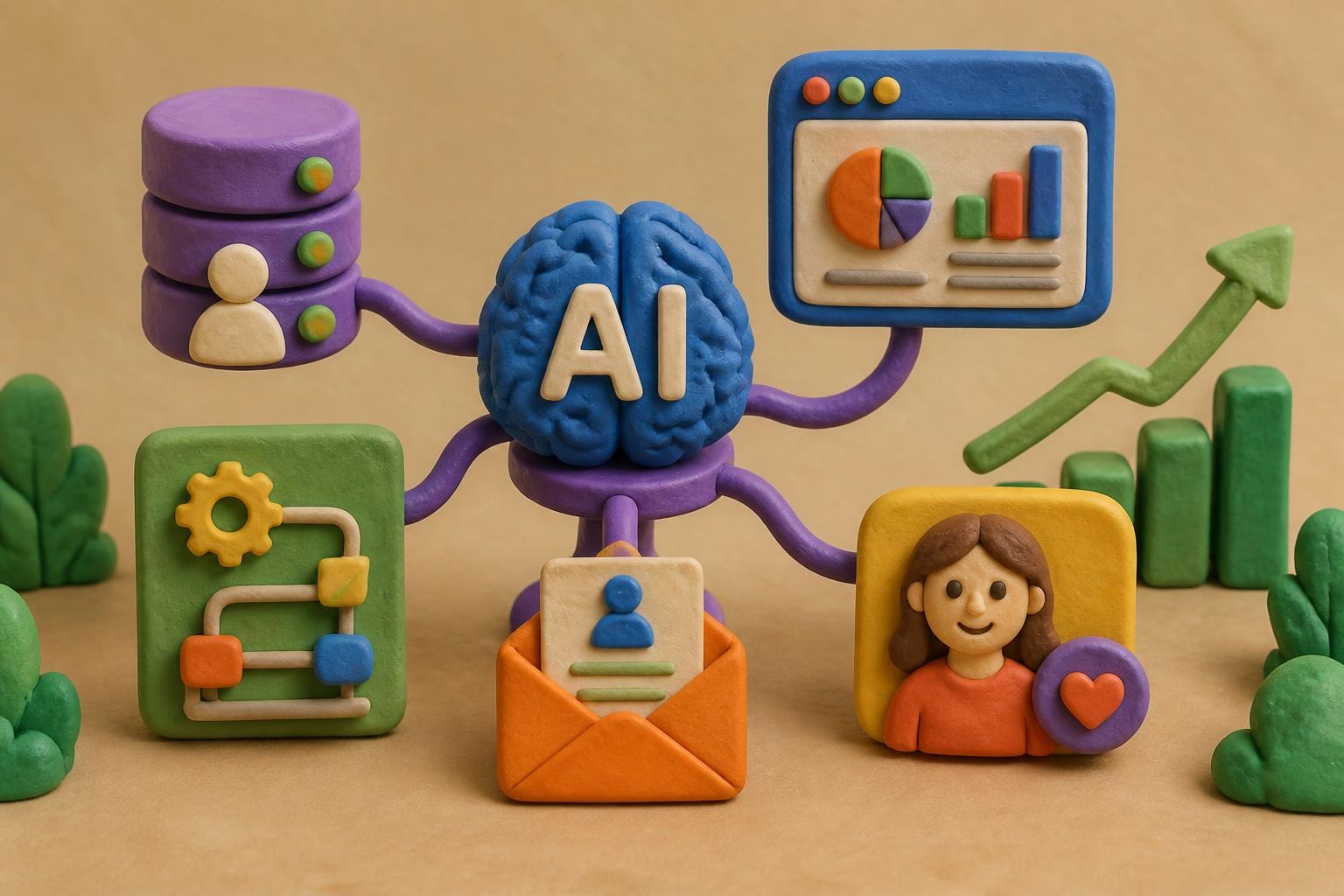
AI has moved from marketing buzzword to everyday tool. Small businesses now compete with companies ten times their size by using AI to analyze customer behavior, automate the busywork, and adjust campaigns in real time. This guide covers where AI in digital marketing actually earns its keep: segmentation, content, lead scoring, and reporting, plus how to roll it out without wasting money.
What AI in Digital Marketing Actually Means
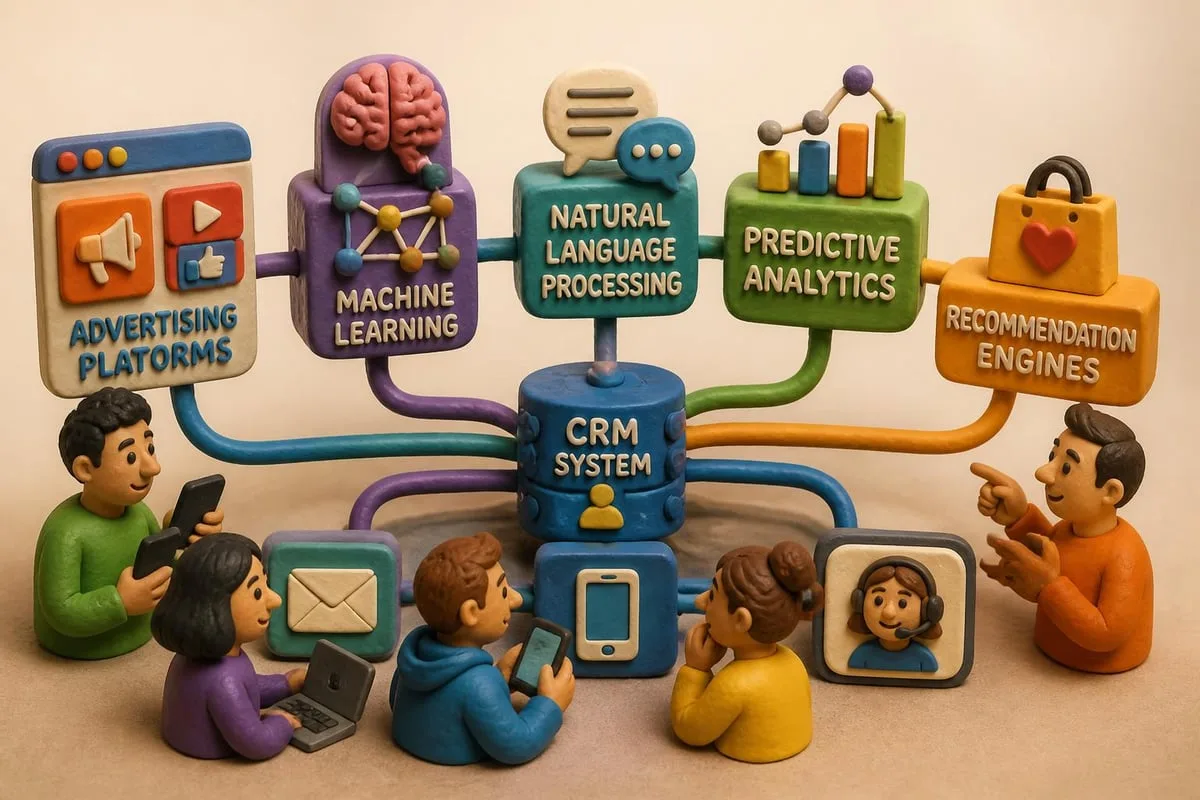
AI in digital marketing means using machine learning, natural language processing, and predictive models to make marketing decisions automatically. In plain terms: software that spots patterns in your customer data faster than any human could, then acts on them.
The applications run across the whole funnel: keyword research, ad bidding, chatbots, email timing. According to Salesforce’s comprehensive guide on AI in digital marketing, businesses using AI see measurable gains in campaign performance and customer engagement.
Core Technologies Driving Marketing AI
Several foundational technologies power modern marketing automation:
- Machine learning algorithms that improve campaign performance through continuous testing
- Natural language processing for content analysis, sentiment tracking, and chatbot interactions
- Predictive analytics that forecast customer behavior and lifetime value
- Computer vision for image recognition in social media monitoring and visual search
- Recommendation engines that personalize product suggestions and content delivery
Together, these systems run around the clock, optimizing campaigns while you focus on strategy and creative. The IBM article on AI in marketing is a good primer on how they fit into an existing marketing stack.
Customer Segmentation and Personalization
AI turns generic marketing into personal marketing. Traditional segmentation sorts your audience into broad buckets. AI builds segments of one, adjusting the message based on what each person actually does.
Dynamic segmentation updates profiles automatically. When a prospect visits your pricing page, downloads a guide, or opens three emails about the same topic, AI adjusts what they see next. No manual list management required.
| Traditional Segmentation | AI-Powered Segmentation |
|---|---|
| Static demographic groups | Dynamic behavioral clusters |
| Manual list updates | Real-time profile adjustments |
| Broad messaging assumptions | Personalized content delivery |
| Quarterly review cycles | Continuous optimization |
| Limited data points | Hundreds of behavioral signals |
In practice, AI in digital marketing means the right message hits the right person at the right time. A roofing company can send appointment reminders by text while cold leads get a slow drip of useful emails, all triggered by behavior.
Predictive Lead Scoring
AI scores leads by weighing dozens of behavioral signals at once. Manual lead scoring assigns points based on guesses. AI models learn which behaviors actually predict a sale, and they update themselves as patterns change.
That focus pays off fast. If you run PPC advertising campaigns, predictive scoring pushes budget toward the audiences showing real buying intent, which does good things for your return on ad spend.
Campaign Optimization and Media Buying
Automated bidding now manages most paid ad budgets. The algorithms adjust bids in real time based on conversion probability, time of day, device, location, and dozens of other variables no human can juggle at once.
Google’s Smart Bidding optimizes toward a target cost per acquisition or return on ad spend, using historical data plus auction-time signals to set each individual bid. Facebook’s campaign budget optimization works the same way.
The gains compound as the algorithm collects more conversion data. Campaigns that needed daily babysitting become self-tuning. One caution: AI-driven advertising platforms can also scale fraud as fast as they scale results, so keep a human watching the numbers.
Creative Testing and Optimization
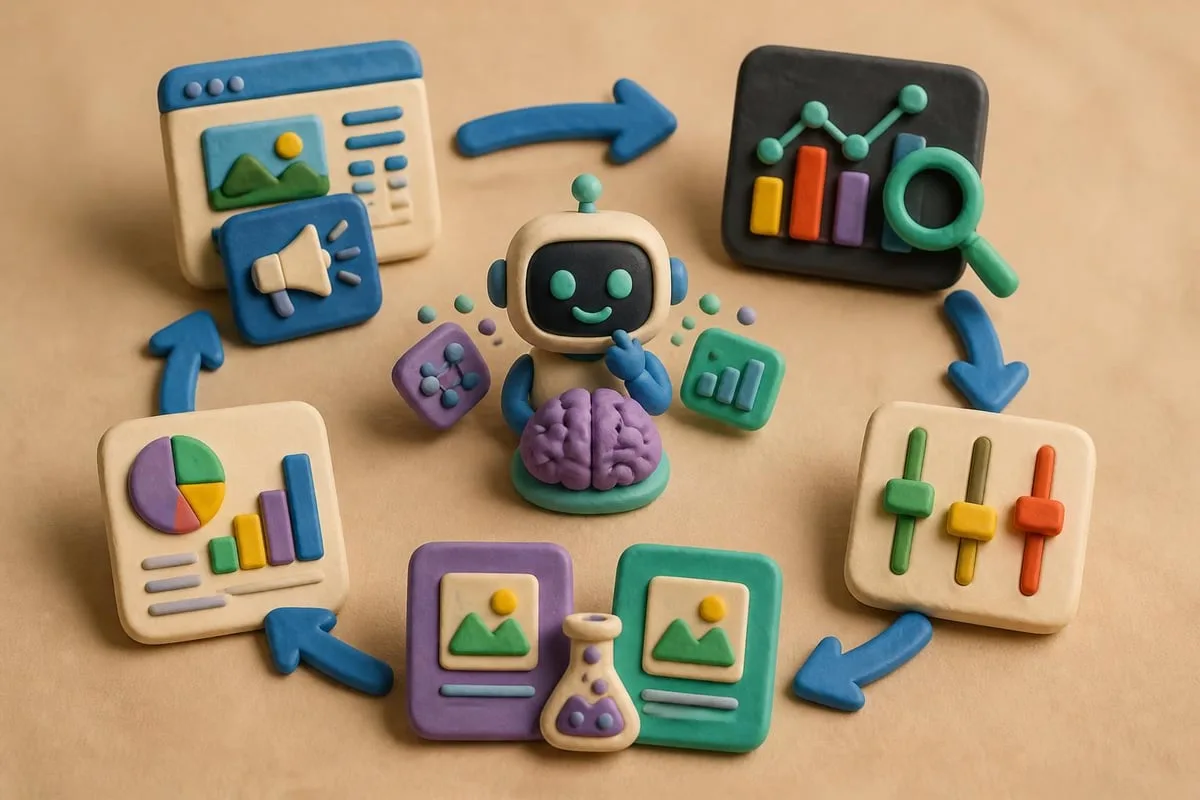
AI speeds up creative testing by generating ad variations and shifting budget to the winners. Dynamic creative optimization mixes headlines, images, and calls to action into thousands of combinations and tests them all at once.
For a small business without a design team, that is a big deal. Testing that used to require an enterprise budget now runs on autopilot, and the results show which creative elements actually work for each audience.
- Auto-generated ad copy variations based on performance data
- Image and video testing across audience segments
- Headline optimization using natural language processing
- Call-to-action button testing and placement refinement
- Landing page element testing and personalization
Research shows generative AI is revolutionizing video ad creation, with nearly 90 percent of advertisers planning to use it in their video production workflows.
Content Creation and SEO Automation
AI has also moved deep into content and SEO. Natural language tools crank out blog drafts, product descriptions, and social posts at scale. The catch: someone still has to check quality and keep the brand voice human.
Writing assistants are best at getting you past the blank page. Grammarly’s guide on AI in digital marketing covers where these tools shine: outlines, first drafts, and readability cleanup.
SEO and Keyword Intelligence
AI-powered SEO platforms analyze search intent, spot content gaps, and flag optimization opportunities faster than manual research. They track algorithm updates and competitor rankings so you do not have to.
If you depend on local customers, this matters. AI tools built around local SEO strategies spot local search patterns, tune your Google Business Profile, and track rankings neighborhood by neighborhood. That is how you win the ‘near me’ searches.
Keyword tools powered by machine learning cluster related terms, estimate traffic, and gauge ranking difficulty better than the last generation of tools. Use that intelligence for both paid and organic, and tie it to revenue, not vanity metrics.
Marketing Automation and Customer Journey Orchestration
Behavior-triggered workflows are the highest-value use of AI in digital marketing for most small businesses. They nurture leads through sequences that adapt to engagement, moving people from first click to purchase without anyone touching a keyboard.
Journey orchestration maps every touchpoint: email, SMS, social, web. AI picks the next step for each contact. Someone downloads a guide? They get an educational sequence. Someone keeps visiting your pricing page? Sales gets an alert and the prospect gets a booking link.
For Front Range businesses, platforms like the Trailblazer CRM & Lead Tracking automate follow-ups, track attribution from first click to closed sale, and keep prospects warm through the long sales cycles typical of service work.
| Manual Follow-Up | AI-Automated Nurture |
|---|---|
| 5-8% contact rate | 40-60% engagement rate |
| Business hours only | 24/7 responsiveness |
| Generic messaging | Behavior-triggered personalization |
| Frequent missed opportunities | Zero missed follow-ups |
| High staff time requirement | Minimal ongoing management |
The revenue impact is direct. Most conversion gains from automation come from one simple thing: follow-up that actually happens, every time, even during your busy season.
Chatbots and Conversational AI
Chatbots handle first inquiries, qualify leads, and book appointments without a human. Modern conversational AI understands plain language, keeps track of the conversation, and hands the hard questions to a person.
They also work at 2 a.m. For an HVAC company, that means capturing the emergency call your competitor’s voicemail just lost. Bots book appointments straight into your calendar and collect the details your team needs before the call.
Every conversation makes the bot better at handling the next one. Pair chatbots with SMS and email marketing automation and you have a customer acquisition system that runs itself.

Analytics, Attribution, and Reporting
AI turns raw data into decisions. Instead of drowning in dashboards from five platforms, you get unified reporting that surfaces trends, anomalies, and opportunities on its own.
Predictive analytics forecast campaign performance, estimate lifetime value, and flag churn risks before they become cancellations. Research on AI techniques in consumer interaction shows how machine learning reads engagement patterns to predict what customers do next.
Machine learning attribution assigns credit across touchpoints far more accurately than last-click rules. Knowing which channels actually drive sales changes how you spend.
Automated Reporting and Insight Generation
AI-generated reports summarize performance and recommend next steps without anyone compiling spreadsheets. Plain-English summaries mean your whole team can read the data, not just the analyst.
If you run campaigns across Google Ads, Facebook, local SEO, and digital marketing websites, automated reporting pulls everything into one view tied to outcomes that matter: revenue, appointments, qualified leads.
The time savings stack up monthly. Hours that went into building reports go back to strategy. And automated anomaly detection flags problems the day they happen, not at the monthly review.
Implementation Considerations for Small Businesses
Adopting AI in digital marketing takes a plan, not a shopping spree. Start with high-impact, low-complexity tools and expand from there.
Begin with a marketing automation platform that combines email, SMS, CRM, and basics like send-time optimization. You get immediate value from the workflows while building the data foundation for more advanced tools later.
A sensible first project is the one you already know you drop: the after-hours inquiry, the quote that never got a second email, the review request nobody sent. Automate that single step, run it for 30 days, and compare the numbers to the month before. If it pays, add the next step. If it does not, you have lost a few hours, not a budget.
Judge tools on integration, ease of use, and support, not feature lists. The most powerful platform on earth is worthless if your team cannot run it. For Colorado businesses, tools that handle local search and Google Business Profile management earn their keep fastest.
Data Quality and Privacy Compliance
AI is only as good as the data you feed it. Clean tracking, consistent tagging, and basic data hygiene are the unglamorous work that makes the predictions accurate.
Privacy rules like GDPR and CCPA require careful consent management. AI systems have to respect opt-outs and keep data secure. Build it compliant from day one; retrofitting is expensive.
For businesses figuring out how to automate their digital marketing, clean data practices and honest consent workflows make automation possible without burning customer trust.
The Human Element in AI-Driven Marketing
AI does not replace judgment. It is great at optimization and execution. It is lousy at empathy, creativity, and strategy. Those stay your job.
The best setups split the work: machines handle repetitive tasks, data crunching, and real-time optimization. People handle positioning, messaging, and the relationships that actually close deals.
- Strategic planning and goal setting guided by business objectives
- Creative direction and brand voice development
- Customer relationship building and high-value account management
- Ethical oversight of AI decisions and bias detection
- Innovation and testing of new channels and approaches
The pattern holds across platforms: AI handles production and delivery while the founder keeps creative control and strategic direction.
Research introducing MindFuse, an explainable generative AI framework points the same direction: AI as a strategic partner, not just an execution tool, with humans keeping decision authority.
Measuring ROI and Performance
Measuring the ROI of AI in digital marketing means tracking both efficiency and revenue. Time saved is nice. Revenue gained is the point.
Watch cost per acquisition, conversion rate, customer lifetime value, and operational costs. Compare before and after. That is your actual return.
For paid ads, compare automated bidding against your old manual numbers on cost per lead and return on ad spend. For automation, measure engagement lift, shorter sales cycles, and conversions from nurture sequences.
| Metric Category | Before AI | After AI Implementation | Improvement |
|---|---|---|---|
| Cost per Lead | $85 | $52 | 39% reduction |
| Email Open Rate | 18% | 34% | 89% increase |
| Conversion Rate | 2.1% | 3.8% | 81% increase |
| Sales Team Hours Saved | 0 | 120/month | New capacity |
| Customer Response Time | 4-6 hours | 2 minutes | 98% faster |
Document your baseline before you switch anything on. That data proves the value later. Most small businesses find the tools pay for themselves inside 90 days.
Future Developments and Emerging Trends
The pace is not slowing. Google’s experimental Pomelli AI tool previews the next generation of automation built for small businesses: campaign creation that stays on brand without an agency retainer.
Voice search will keep reshaping local search as smart speakers and in-car assistants become the default. Businesses that optimize for conversational queries will capture that traffic.
AI-generated video at scale, augmented reality ads, and context-based personalization are all headed from experimental to standard. Adopt them as they mature, not before.
Privacy-preserving personalization gets more important as third-party cookies disappear. First-party data plus privacy-safe machine learning is the sustainable path.
For Front Range businesses, the fundamentals still win: know your audience, deliver value, build relationships. The tools change every quarter. The principles do not.
AI in digital marketing lets small businesses automate the busywork and compete with much bigger budgets. The trick is adopting it strategically instead of chasing every shiny tool. If you want AI-driven automation, local SEO, and intelligent campaign management working for your business, Pioneer Marketing builds those systems for companies across the Colorado Front Range.
Find The One Leak Costing You Jobs
We call your business like a customer would and check where you rank. You get a short video and a one page fix list, yours either way.