Nobody stumbles onto your business online anymore. Organic builds a foundation over time, but when you need traffic, leads, and revenue this month, you pay for placement. That’s paid media: putting your message in front of the right audience on search, social, and display, on purpose. For small businesses in competitive local markets, it’s the difference between waiting six months for SEO and booking qualified leads this week.
Understanding Paid Media in the Digital Marketing Ecosystem
Paid channels are anything you pay for placement or visibility on. Earned media is press coverage and organic shares. Owned media is your website and email list. Paid gets you immediate access to an audience in exchange for budget.
The most common paid channels:
- Search advertising (Google Ads, Bing Ads)
- Social media advertising (Facebook, Instagram, LinkedIn, TikTok)
- Display advertising (banner ads across networks)
- Video advertising (YouTube, streaming platforms)
- Native advertising (sponsored content on publications)
- Local Service Ads (Google’s pay-per-lead platform)
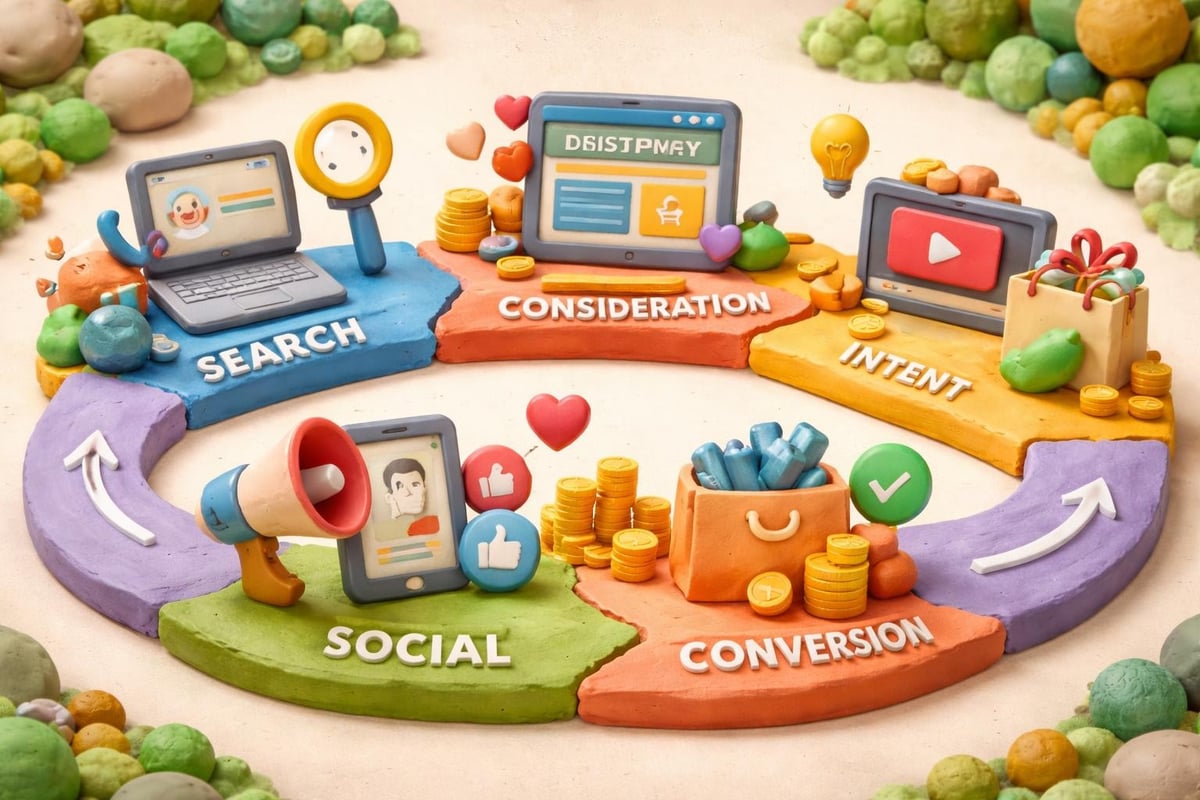
Each channel plays a different position. Search ads catch people actively hunting for a solution. Social ads build awareness with specific demographics. Display keeps your brand visible around the web. Pick the channels that match your business model and how your customers actually buy.
Why Paid Media Matters for Small Businesses
Service businesses have a timing problem: they need leads now, and organic visibility takes months. Paid advertising fixes the timing.
Take an HVAC company in Colorado Springs. AC repair demand explodes in summer. Waiting on SEO rankings means missing the whole season. A well-built campaign captures that demand the day it turns on.
Precision is the other advantage. Modern platforms let you target by:
- Geographic location down to zip code or radius
- Demographics including age, income, homeownership status
- Behavior patterns like recent searches or website visits
- Life events such as moving, marriage, or starting a business
- Custom audiences built from your existing customer data
That precision makes every dollar work harder. You reach the people most likely to buy instead of broadcasting to everyone and hoping.
Selecting the Right Paid Media Platforms
Platforms aren’t interchangeable. The right one depends on where your customers spend time, how they decide, and what you need them to do.
Search Advertising for High-Intent Prospects
Google Ads owns demand capture. Someone searching ’emergency plumber Colorado Springs’ has a problem right now, and your ad can be the answer.
Search is pull, not push. You’re answering an explicit request instead of interrupting a feed, which is why search usually converts better and costs less per acquisition than interruptive formats.
Regulated industries are a special case. Pawn, firearms, CBD, financial services: Google suspends accounts in these categories over structural mistakes. If that’s you, work with someone who knows the compliance playbook before the suspension, not after.
| Platform | Best For | Typical Cost | Conversion Timeline |
|---|---|---|---|
| Google Search Ads | High-intent leads, local services | $2-50+ per click | Immediate |
| Facebook/Instagram Ads | Awareness, retargeting, local events | $0.50-3 per click | 7-30 days |
| LinkedIn Ads | B2B services, professional services | $5-12 per click | 30-90 days |
| Google Display Network | Brand awareness, remarketing | $0.25-1 per click | 30-60 days |
Social Media Advertising for Audience Building
Social platforms shine at building awareness with defined audiences and nurturing interest over time. Paid social best practices emphasize audience segmentation, creative testing, and multi-touch attribution.
Facebook and Instagram suit businesses with visual appeal or longer consideration cycles. A martial arts studio promoting summer camps can target parents of kids six to twelve within five miles, then retarget site visitors with deadlines and testimonials.
The tracking follows prospects from first impression through website visit, form fill, and sale. That visibility lets you fund the ads that drive revenue, not the ones that just collect likes.
Video Advertising for Attention and Recall
YouTube, streaming platforms, and social feeds all sell video placements, and video holds attention in ways a static image can’t. But the length of the ad has to match what you’re asking the viewer to do.
A six-second bumper can’t tell a story. Use it to repeat your name until it sticks, the way a roofing company might run bumpers through storm season so theirs is the first name a homeowner remembers when a shingle blows off. Fifteen to thirty seconds is the standard spot length: time enough to state the problem, make the offer, and tell people what to do next. Go longer only after you’ve proven your audience will watch that long.
Pick the length based on where the viewer sits in your funnel. Bumpers work on people who already know your name. Longer spots have to do the convincing for everyone else.
Building Profitable Paid Media Campaigns
Profitable campaigns don’t happen by accident. They follow structure that ties spending to measurable outcomes.
Establishing Clear Campaign Objectives
Every campaign gets one measurable primary objective. The usual candidates:
- Lead generation: capturing contact information from qualified prospects
- Direct sales: driving immediate transactions or bookings
- Brand awareness: reaching new audiences at scale
- Retargeting: converting previous website visitors
- Event promotion: filling registrations or attendance
The objective drives everything else: platform, format, bidding, and how you judge success. Measure an awareness campaign against direct-sales benchmarks and it will always look like a failure.
Effective paid media management means setting objectives up front and building structure to match: the right campaign types, logically organized ad groups, and conversion tracking that connects clicks to actual business results.
Budget Allocation and Bidding Strategy
Small budgets need discipline. A simple three-bucket framework works:
Testing budget (20%): experiment with new platforms, audiences, formats, and messages before committing real money.
Core budget (60%): run the proven campaigns that reliably deliver leads at an acceptable cost per acquisition.
Scaling budget (20%): pour extra fuel on top performers during high-demand periods or when you have capacity to fill.
This keeps you from spreading budget across a dozen experiments, or betting everything on one campaign that could stop working without warning.
Match bidding to campaign maturity. Start with manual cost-per-click while conversion data accumulates. Once you pass roughly 30 conversions a month, automated strategies like target CPA or target ROAS usually out-optimize a human.

Optimizing Campaign Performance Over Time
Launch is the starting gun, not the finish line. Ongoing optimization is what separates profit from waste. If you’re exploring paid advertising strategies, plan for the optimization cycle from day one.
Monitoring the Right Metrics
Impressions, clicks, and cost-per-click tell incomplete stories. Watch the numbers that touch revenue:
- Cost per lead: Total ad spend divided by leads generated
- Lead-to-customer conversion rate: Percentage of leads that become paying customers
- Customer acquisition cost: Total marketing investment to acquire one customer
- Return on ad spend: Revenue generated per dollar spent on advertising
- Lifetime value to CAC ratio: Long-term customer value compared to acquisition cost
Tracking these requires wiring your ad platforms to your CRM. Most businesses stop tracking at the form fill and never learn which campaigns produce actual paying customers.
The Google Ads Management service closes that gap with conversion tracking that runs from click to closed revenue, so optimization decisions come from data instead of hunches.
Testing Variables Systematically
Improve campaigns by testing one variable at a time while holding the rest steady:
- Ad copy variations: headlines, descriptions, calls-to-action
- Audience segments: demographics, interests, behaviors, custom lists
- Landing page designs: layouts, offers, forms, trust elements
- Bidding strategies: manual versus automated, different target metrics
- Ad placements: search versus display, specific websites or apps
- Schedule adjustments: day-parting, seasonal changes
Valid tests take patience and enough traffic. Change five things at once and you’ll never know what worked. Case studies from successful paid media campaigns show the same pattern: small, disciplined tests compound into big gains.
Integrating Paid Media with Broader Marketing Strategy
Paid works best wired into the rest of your marketing, not running off in a corner. Paid plus organic grows faster than either alone.
Supporting Local SEO Efforts
Ads buy traffic today while local SEO strategies build tomorrow’s free traffic. Once organic rankings take hold, you can shift ad spend toward new markets or higher-funnel awareness.
Paid traffic is also a research lab. The keywords, offers, and messages that win in ads should show up on your website and service pages. The ad platform just told you what your market responds to. Use it.
Powering Marketing Automation Systems
A lead that arrives at 9 p.m. Saturday expects a response at 9:01. Not Monday morning, after they’ve already called three competitors.
Connecting ad platforms to your CRM enables automated follow-up across email, SMS, and AI voice agents. These systems can:
- Send immediate confirmation messages acknowledging form submissions
- Deliver relevant content based on which ad or landing page generated the lead
- Schedule automated follow-up sequences that maintain engagement
- Alert sales teams to high-priority prospects based on behavior or demographics
- Track attribution so you know exactly which campaigns drive revenue
For small businesses implementing marketing systems, this connection turns lead generation into a complete customer acquisition engine instead of a pile of unanswered form fills.
Retargeting Website Visitors
Most visitors leave without converting the first time. Retargeting brings them back when they’re ready. A tracking pixel lets you show ads specifically to people who visited key pages and stalled.
Segment retargeting by behavior:
| Audience Segment | Ad Message | Campaign Goal |
|---|---|---|
| Viewed service page, didn’t submit form | Offer free consultation or limited-time discount | Drive form submission |
| Submitted form, hasn’t scheduled appointment | Highlight customer testimonials and easy booking | Complete scheduling |
| Visited pricing page multiple times | Address common objections, showcase guarantees | Remove purchase barriers |
| Abandoned checkout or application | Simplified process, urgency messaging | Complete transaction |
Warm traffic converts at multiples of cold traffic, because these people already raised a hand. Successful paid media case studies regularly show retargeting as the highest-ROI piece of the whole program.
Avoiding Common Paid Media Mistakes
Even experienced marketers step in the same potholes. Here are the expensive ones.
Neglecting Landing Page Quality
Sending ad clicks to your homepage torches conversion rates. Every campaign deserves a dedicated landing page built to convert that specific click.
The high converters share these elements:
- Message match: Headline and offer directly reflect the ad copy
- Single clear call-to-action: One primary goal without competing navigation
- Trust signals: Testimonials, reviews, credentials, guarantees
- Mobile optimization: Fast loading and easy form completion on smartphones
- Minimal friction: Short forms requesting only essential information
An optimized landing page can double or triple conversions on the same ad spend. It’s the cheapest performance upgrade in advertising.
Ignoring Negative Keywords
Negative keywords keep your ads away from searches that will never convert. Skip them and your budget leaks.
A quality-focused HVAC contractor doesn’t want clicks from ‘DIY air conditioner repair’ or ‘cheapest HVAC service.’ Negatives like ‘DIY,’ ‘cheap,’ ‘free,’ and ‘jobs’ stop the bleeding.
Review your search term reports regularly and add negatives as patterns emerge. Cost per lead drops while lead volume holds.
Setting and Forgetting Campaigns
Platforms change. Competitors change. Audiences get bored of your creative. A campaign that prints money in March can quietly rot by June.
Set a review rhythm and keep it:
- Daily: Check for major spending anomalies or disapproved ads
- Weekly: Review performance metrics and pause underperforming elements
- Monthly: Conduct comprehensive analysis and implement strategic adjustments
- Quarterly: Evaluate overall strategy and test new platforms or approaches
That steady attention keeps campaigns profitable instead of slowly decaying while the budget keeps flowing.
Measuring True Business Impact
Clicks and leads are means, not ends. The real question: does the spending produce profitable customers? Answering it takes proper attribution and analytics infrastructure.
Implementing Multi-Touch Attribution
Customers rarely convert on one touch. They see a Facebook ad, visit, leave, Google your name later, come back through an email, and convert. Who gets the credit?
Multi-touch attribution spreads the credit instead of handing it all to the last click. Common models:
- Linear attribution: Equal credit to all touchpoints
- Time decay attribution: More credit to recent interactions
- Position-based attribution: Extra credit to first and last touchpoints
- Data-driven attribution: Algorithm-determined credit based on conversion patterns
Knowing which channels contribute at which stage changes budget decisions. Facebook might rarely close deals directly while quietly introducing the prospects your search ads finish.
Calculating Customer Lifetime Value
Judge campaigns against lifetime value, not first-transaction value. A $200 acquisition cost looks bad against a $300 job and great against a $2,000 lifetime customer.
Strong lifetime value lets you outbid competitors and still profit. That advantage compounds as your customer base grows and referrals stack up.
Connecting Paid Media to Business Goals
Tie campaigns to specific business objectives:
- Revenue targets: How many customers at what average value?
- Capacity utilization: Fill service calendar during slow periods
- Geographic expansion: Enter new markets before establishing organic presence
- Product launches: Drive awareness and early adoption
- Competitive defense: Maintain visibility against aggressive competitors
That alignment keeps ad spend serving strategy instead of just generating activity. For frameworks that connect tactics to outcomes, small business marketing resources are a good place to start.
Protecting Your Targeting Data as Privacy Rules Tighten
Cookie deprecation and new privacy laws keep narrowing what ad platforms can track for you. A campaign built entirely on third-party tracking loses ground every time one of those rules changes.
Your own data doesn’t have that problem. The list of people who visited your website, opened your emails, or already paid you for a job is yours. Google and Meta can change their rules; that list doesn’t move.
Upload it back into your ad accounts and build lookalike audiences and retargeting campaigns that keep working after the next tracking update. Ask for consent honestly and say plainly what you collect and why. Customers who trust you with their information keep giving you more of it, and that list is worth more than anything you could rent from a platform.

Platform-Specific Strategies for Maximum ROI
Each platform rewards different behavior. Learn the house rules.
Google Ads Best Practices
Google Search campaigns work best with tightly themed ad groups: closely related keywords, same intent, matching ad copy. Tight themes raise quality scores and lower your cost per click.
Account structure example:
- Campaign: Emergency Plumbing Services
- Ad Group: Burst Pipes (keywords: burst pipe repair, emergency pipe repair, frozen pipe service)
- Ad Group: Water Heater Emergency (keywords: water heater not working, emergency water heater repair, same-day water heater)
- Ad Group: Drain Backup (keywords: emergency drain cleaning, backed up drain, clogged drain service)
Each ad group’s ads name the specific service, which lifts relevance and click-through rates. The landing page matches too, so the thread from keyword to ad to page never breaks.
Meta Advertising Optimization
Meta is a different game. You’re interrupting someone’s scroll, so the creative has to stop thumbs and the value proposition has to justify the interruption.
Key optimization tactics include:
- Creative variety: Test multiple image and video variations simultaneously
- Audience layering: Combine demographics with interests and behaviors for precision
- Campaign budget optimization: Let Facebook allocate budget across ad sets automatically
- Conversion window adjustments: Account for longer consideration cycles in attribution
- Lookalike audience expansion: Scale successful campaigns to similar prospects
Social platforms are also strong for hyperlocal targeting. Case studies of effective paid media campaigns often feature neighborhood-level social strategies that build community awareness and drive foot traffic.
Done strategically, paid advertising compresses years of growth into months: immediate visibility, precise targeting, measurable results. If you want campaigns that produce qualified leads and provable ROI across the Colorado Front Range, Pioneer Marketing pairs platform expertise with local market knowledge to grow your business predictably.