Every service business owner I talk to on the Colorado Front Range has the same problem: not enough good leads. Plenty of tire-kickers, plenty of spam form fills, not enough people ready to buy. Real lead generation is a system: attract the right prospects, qualify them fast, follow up before they call someone else. And modern tools let a small shop run that system as well as any big competitor.
Understanding Modern Lead Generation Fundamentals
Lead generation covers the whole journey: attracting strangers, turning them into interested prospects, and nurturing them until they’re ready to talk price. Done right, it pulls buyers toward you instead of interrupting people who never asked to hear from you.
It starts with being genuinely useful. Helpful content, a strong local presence, and well-aimed ads give prospects multiple ways to find you. Recent lead generation statistics show that 91% of marketers call this their most important goal. They’re not wrong.
The Evolution of Lead Qualification
Not every inquiry deserves the same energy. Sorting purchase-ready buyers from casual browsers decides whether your sales time gets spent well or wasted on dead ends.
Lead scoring helps you prioritize based on:
- Behavioral signals (website visits, content downloads, email engagement)
- Demographic fit (company size, industry, location)
- Explicit interest indicators (form submissions, phone calls, chat conversations)
- Budget and timeline readiness
Companies with a structured qualification process convert prospects about 50% better than those treating every inquiry the same. Build a system that tracks engagement and surfaces the hottest opportunities automatically.

Local SEO as a Lead Generation Engine
If you serve a specific area, local search is a lead machine that never clocks out. When someone searches ‘water heater replacement near me’ at 9 p.m., showing up in the map pack puts you in front of them at the exact moment they need help.
Several pieces work together here. Your Google Business Profile needs accurate info, real photos, and a steady stream of reviews. Location-specific content answers the questions your market actually asks while telling Google where you operate.
| Local SEO Component | Lead Generation Impact | Implementation Priority |
|---|---|---|
| Google Business Profile | Direct calls, direction requests, website visits | Critical |
| Location-based content | Organic traffic from specific service queries | High |
| Local citations | Authority signals, additional discovery channels | Medium |
| Review acquisition | Trust building, conversion rate improvement | Critical |
Our approach to local SEO in Colorado Springs shows how geographic targeting builds durable lead flow. Service businesses that own their local search results typically pull 30-40% of their leads from organic visibility alone.
Converting Local Visibility Into Qualified Leads
Ranking is half the battle. What prospects find after they click decides whether that visibility becomes an actual lead.
Landing pages built for local search traffic should include:
- Clear value propositions addressing local customer needs
- Prominent phone numbers and contact forms
- Trust indicators (years in business, local credentials, customer testimonials)
- Specific service area information
Mobile matters most here: 76% of people who search for something nearby visit a business within 24 hours. If your phone number isn’t tap-to-call on a smartphone, those leads go to the next result.
Paid Advertising for Immediate Lead Flow
Organic builds over months. Paid ads deliver visibility today. Pairing paid advertising strategies with organic work gives you short-term pipeline and a long-term asset at the same time.
Google Ads puts you in front of people already searching for what you do. That’s intent you can’t fake. The platform lets you control:
- Keyword match types controlling search query relevance
- Geographic boundaries ensuring local service capacity
- Scheduling aligned with business availability
- Budget allocation optimizing cost per acquisition
Meta ads on Facebook and Instagram do a different job. They reach people who fit your customer profile but aren’t searching yet. Interest targeting, lookalike audiences, and retargeting keep your funnel fed from the top.
Optimizing Advertising for Lead Quality
A high click-through rate means nothing if the inquiries can’t buy. Research on B2B lead generation strategies makes the same point: quality beats volume every time growth is the goal.
Campaign optimization focuses on:
- Negative keywords filtering out irrelevant searches
- Ad copy qualification language (pricing indicators, service specifics)
- Landing page message match preventing disconnect
- Form fields balancing conversion rates with information needs
The best advertisers track leads past the form fill to see which campaigns produce paying customers. That closed loop reveals your real cost per acquisition and keeps you from optimizing for vanity metrics.
Marketing Automation and AI-Driven Follow-Up
Capturing contact info is just the start. Most prospects need several touchpoints before they buy, and manual follow-up leaks opportunities through slow responses and forgotten callbacks.
AI-driven automation systems change the math. Someone fills out a form or calls, an automated sequence responds instantly with something useful, and your team saves its energy for the conversations that need a human.
Modern automation capabilities include:
- Instant response mechanisms acknowledging inquiries within seconds
- Intelligent lead routing connecting prospects with appropriate team members
- Personalized email sequences delivering value based on interest signals
- SMS follow-up campaigns maintaining engagement through preferred channels
- Appointment scheduling automation reducing friction in the booking process

AI Voice Agents and Conversational Marketing
Contact forms create friction. Lots of prospects want an answer now, not a callback on Tuesday. AI voice agents and chatbots fill that gap with real-time conversation.
They answer common questions, qualify needs, and either resolve things on the spot or book a human follow-up when it gets complicated. And they keep getting better at it.
Implementation considerations include:
- Training AI systems on your specific services and policies
- Defining escalation triggers requiring human intervention
- Maintaining conversational tone matching your brand voice
- Integrating with CRM systems for seamless data flow
Businesses using conversational tools typically see 25-35% more conversions from the same traffic. Nobody bounces because your team was at lunch.
Content Marketing That Attracts Qualified Prospects
Content does several jobs at once: it builds authority, earns search visibility, and gives prospects value before they ever talk to sales.
Map content to the buyer journey. Educational pieces catch people just discovering the problem. Comparison content helps them weigh options. Bottom-funnel content knocks down objections and shows what makes you different.
| Content Type | Journey Stage | Lead Generation Function |
|---|---|---|
| Educational blog posts | Awareness | SEO traffic, social shares, authority building |
| Comparison guides | Consideration | Competitive differentiation, decision support |
| Case studies | Decision | Proof points, objection handling, trust building |
| Video demonstrations | Multiple stages | Engagement, explanation of complex concepts |
Distribution matters as much as creation. A great guide nobody sees generates nothing. According to comprehensive lead generation research, 70% of marketers invest in content marketing, so you have to work to cut through the noise.
Converting Content Consumption Into Lead Capture
Every piece of content needs a next step. Lead magnets, resources worth trading an email address for, turn passive readers into named prospects.
Effective lead magnet formats include:
- Industry-specific checklists and templates
- Downloadable guides addressing common challenges
- Calculators and assessment tools
- Email courses delivering value over time
- Exclusive webinars and training sessions
Specific beats generic. A ‘winter roof inspection checklist for Colorado homes’ pulls fewer downloads than a generic marketing guide, but the people who grab it are worth ten times more to a roofer.
CRM Systems and Lead Management Infrastructure
Without an organized way to track prospects, even great tactics underperform. A CRM is the infrastructure that keeps leads from falling through the cracks.
The CRM features that matter most for lead management:
- Centralized contact databases consolidating information across channels
- Activity tracking documenting every prospect interaction
- Pipeline visualization showing deal stages and conversion likelihood
- Task automation ensuring consistent follow-up cadences
- Reporting dashboards revealing bottlenecks and opportunities
Connect the CRM to every lead source: website forms, ad platforms, phone, email. When someone calls or submits a form, their info should land in your system automatically with full context attached, no manual entry.
Data-Driven Lead Generation Optimization
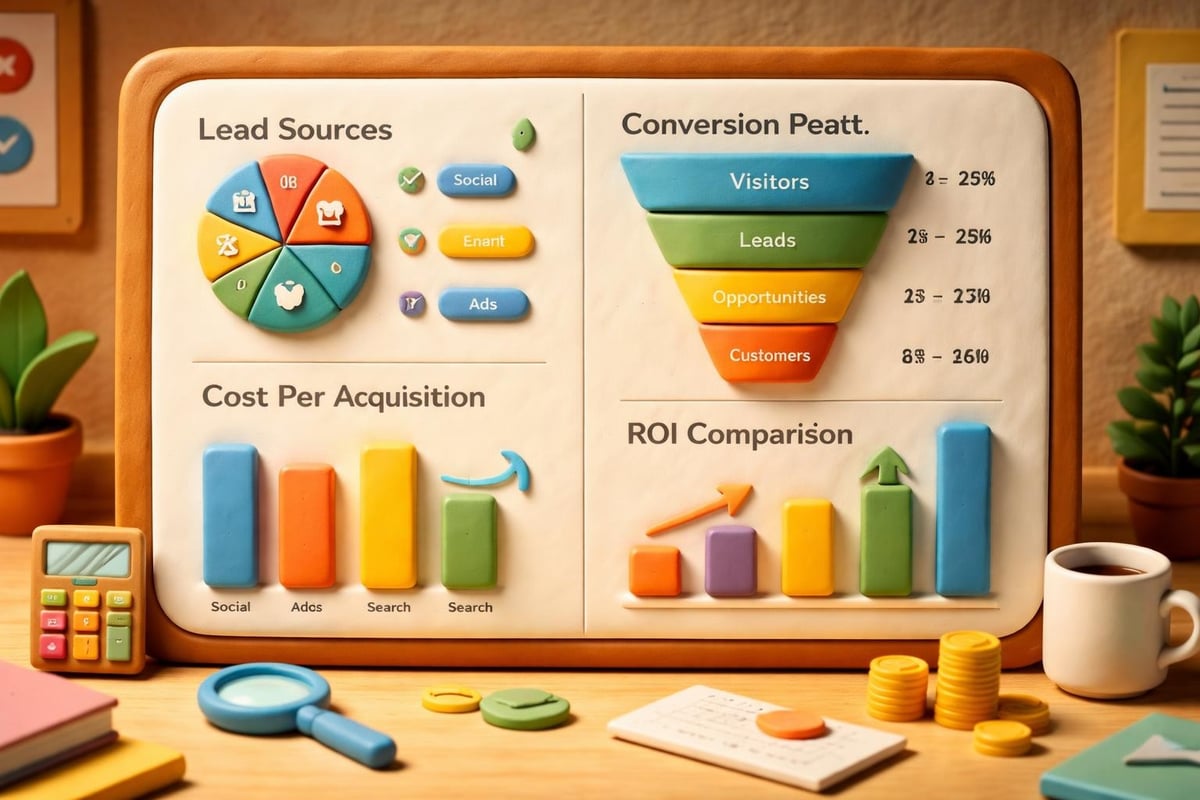
The best operators treat this as ongoing optimization, not a set-it-and-forget-it campaign. Regular analysis of which sources and offers produce quality prospects drives steady improvement.
Key performance indicators worth monitoring include:
- Lead volume by source and campaign
- Conversion rates at each funnel stage
- Cost per lead across different channels
- Lead-to-customer conversion percentages
- Average customer acquisition cost
- Customer lifetime value by acquisition source
This data shows which investments actually return money and which quietly drain the budget. Statistics on lead generation performance confirm it: companies that measure outperform companies that guess.
Emerging Trends Reshaping Lead Generation
Buyer behavior keeps shifting, and tactics that worked a few years ago have quietly stopped working. Staying current is a real competitive advantage.
Intent-driven targeting is the big shift. Instead of relying on demographic profiles alone, modern platforms read behavioral signals: someone comparing vendors or visiting pricing pages is telling you they’re ready. Time your outreach accordingly.
Conversational marketing keeps gaining ground. People prefer instant answers over email ping-pong, and live chat and messaging deliver exactly that.
Privacy rules and tracking limits are pushing everyone toward first-party data. Your email list and SMS subscribers are assets no algorithm change can take away.
Implementing Integrated Lead Generation Systems
These tactics work best as one system. Paid ads drive traffic now, SEO and content build momentum, automation follows up, and the CRM makes sure nothing slips.
For a Front Range service business, that stack looks like:
- Local SEO foundation establishing visibility for high-intent searches
- Targeted advertising campaigns filling immediate pipeline needs
- Conversion-optimized landing pages maximizing inquiry rates
- AI-powered follow-up sequences engaging prospects automatically
- CRM infrastructure organizing and tracking every opportunity
Small business marketing success depends on the system, not on sporadic bursts of effort. Businesses that grow predictably build infrastructure that generates, qualifies, and tracks leads on autopilot.
Measuring Return on Lead Generation Investment
Your marketing budget deserves the same scrutiny as any other expense. Track prospects from first contact through to customer and lifetime value.
Simple formulas provide clarity:
- Cost per lead = Total marketing spend ÷ Number of leads generated
- Customer acquisition cost = Total marketing and sales costs ÷ Number of new customers
- Marketing ROI = (Revenue from marketing minus Marketing costs) ÷ Marketing costs
These numbers tell you which channels earn their keep. According to best practices for effective lead generation, businesses that track them rigorously allocate budgets better and grow faster.
What counts as acceptable varies. A business with a $10,000 average customer can stomach a much higher acquisition cost than one selling $500 jobs. The only question that matters: does each dollar you put in come back as several?
Predictable growth comes from making local visibility, paid ads, content, and automation pull in the same direction. If you’d rather not build all that yourself, Pioneer Marketing builds these integrated systems for service businesses across Colorado: local SEO, automation infrastructure, and performance marketing that ties your spend directly to revenue.