
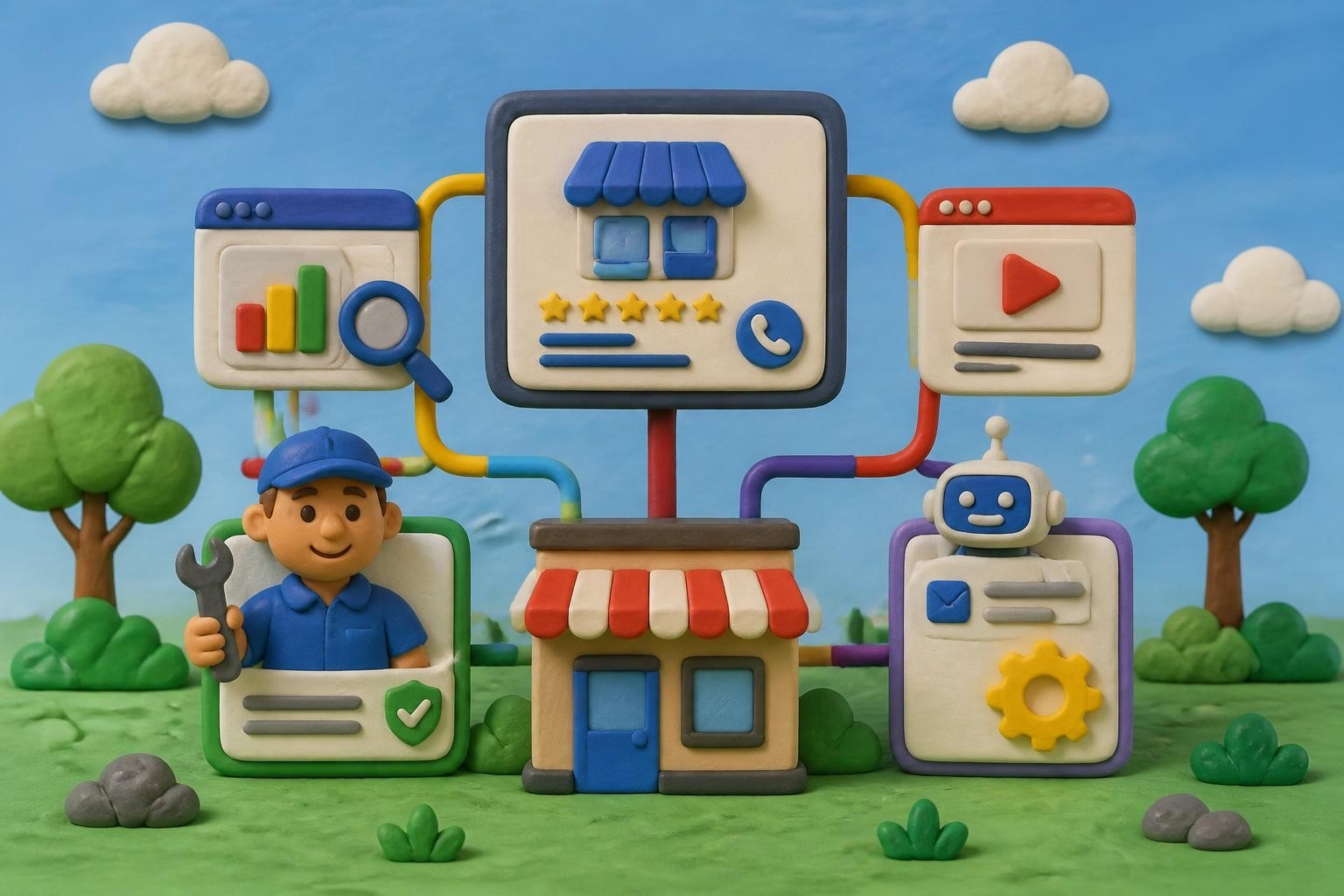
Google business marketing has evolved from simple business listings into a sophisticated ecosystem that drives measurable revenue for local and service-based companies. With over 8.5 billion searches conducted daily on Google, businesses that master this platform gain access to customers actively searching for their services. The integration of Google Business Profile, paid advertising, automation tools, and AI-driven features creates opportunities for small and mid-sized businesses to compete effectively in local markets while scaling their customer acquisition systematically.
Understanding the Google Business Marketing Ecosystem
Google business marketing encompasses multiple interconnected platforms designed to help businesses capture attention, generate leads, and convert prospects into customers. Google’s suite of online marketing services includes Business Profile (formerly Google My Business), Google Ads, Local Services Ads, YouTube advertising, and Merchant Center, each serving distinct functions within a comprehensive marketing strategy.
The foundation starts with your Google Business Profile, which controls how your company appears in local search results, Google Maps, and the coveted local pack. This free tool provides the essential digital storefront that potential customers encounter when searching for services in your area. Beyond the profile itself, Google Ads extends your reach through paid search campaigns, display advertising, and remarketing, while Local Services Ads offer pay-per-lead options for verified service providers.
The Strategic Advantage of Integrated Google Marketing
Businesses that integrate multiple Google marketing channels create compounding advantages that isolated tactics cannot match. When your Google Business Profile ranks well organically and you simultaneously run targeted Google Ads campaigns, you dominate both paid and organic real estate on search results pages. This dual presence dramatically increases click-through rates and establishes brand authority that single-channel approaches miss.
Recent policy changes have made integration even more critical. Google now requires businesses to maintain a verified Google Business Profile to run Local Services ads, affecting millions of small businesses and reinforcing the need for comprehensive profile optimization as the foundation of any google business marketing strategy.

Optimizing Your Google Business Profile for Maximum Visibility
Your Google Business Profile serves as the cornerstone of local google business marketing efforts. Complete optimization requires attention to every available field, category selection, attribute configuration, and content updates that signal relevance and authority to Google's algorithms.
Critical Profile Components That Drive Rankings
Primary optimization elements include:
- Business name, address, and phone number (NAP) consistency across all online directories
- Accurate primary and secondary category selection matching your core services
- Complete business description utilizing relevant keywords naturally
- High-quality photos including exterior, interior, team, and product images
- Service area definitions for businesses serving customers at their locations
- Business hours with special hours for holidays and events
- Attributes highlighting accessibility, amenities, and service offerings
The description field deserves particular attention, allowing 750 characters to communicate your unique value proposition, service areas, and specializations. Businesses that maximize this space with keyword-rich, customer-focused content outperform competitors who leave it incomplete or generic.
| Profile Element | Impact on Rankings | Update Frequency |
|---|---|---|
| NAP Consistency | High | Verify monthly |
| Category Selection | Very High | Review quarterly |
| Photos | Medium-High | Add weekly |
| Posts | Medium | Publish 2-3x weekly |
| Reviews | Very High | Monitor daily |
| Q&A | Medium | Check weekly |
For businesses focused on local SEO strategies, maintaining profile accuracy and freshness signals active business operations to Google, improving local pack placement and map visibility.
Review Generation and Reputation Management
Reviews function as the most influential ranking factor for local search results and the primary trust signal for potential customers. Businesses with higher review quantities, recent activity, and strong ratings consistently outrank competitors with fewer or older reviews.
Implementing systematic review generation processes transforms happy customers into ongoing marketing assets. Automated review request systems that trigger after service completion, project milestones, or positive interactions capture feedback while satisfaction remains high. The timing matters significantly, with requests sent within 24-48 hours of service completion generating response rates 3-4 times higher than delayed requests.
Response protocols matter equally to review acquisition. Businesses that respond to all reviews, both positive and negative, demonstrate customer commitment that builds trust with prospects reading those reviews. Negative review responses handled professionally often convert critics into advocates while reassuring other potential customers that concerns receive attention.
Building High-Converting Google Ads Campaigns
Google Ads represents the paid component of google business marketing, offering immediate visibility for businesses competing in crowded markets or launching new services. The platform provides multiple campaign types, each suited to different business objectives, customer journeys, and conversion goals.
Search Campaigns for Intent-Based Leads
Search campaigns target users actively searching for specific services, products, or solutions. These high-intent prospects generate the highest conversion rates because they demonstrate immediate need through their search behavior. Effective search campaigns require thorough keyword research identifying the exact phrases your ideal customers use when ready to buy.
Campaign structure best practices:
- Organize campaigns by service category or product line
- Create tightly themed ad groups containing 5-15 related keywords
- Write multiple responsive search ads per ad group testing different value propositions
- Implement negative keywords preventing wasted spend on irrelevant searches
- Set up conversion tracking measuring leads, calls, and sales accurately
- Optimize bids based on actual conversion data rather than clicks alone
The combination of well-structured campaigns and landing pages designed for conversion creates systems that generate predictable lead flow. Professional Google Ads management typically delivers 3-5x return on ad spend for service-based businesses when campaigns align with conversion-focused infrastructure.

Local Services Ads for Service Professionals
Local Services Ads operate on a pay-per-lead model rather than pay-per-click, making them attractive for service businesses where qualified calls justify higher per-lead costs. Available for contractors, legal professionals, financial services, and select home service providers, these ads appear above traditional search results with Google Guaranteed or Google Screened badges.
The verification process requires background checks, license verification, and insurance documentation, creating barriers that reduce competition while building consumer trust. Businesses that complete verification and maintain high ratings access premium placement that generates qualified leads without the complexity of traditional campaign management.
Integration between your Google Business Profile and Local Services Ads creates synergistic effects. Businesses with optimized profiles, strong review counts, and complete information convert Local Services leads at higher rates because prospects see consistent, professional information across touchpoints.
Leveraging Automation and AI in Google Business Marketing
Automation tools transform google business marketing from manual, time-intensive work into scalable systems that run continuously without constant oversight. The integration of AI-powered features within Google's platforms and third-party automation tools creates competitive advantages for businesses that implement them strategically.
Smart Bidding and Campaign Optimization
Google's machine learning algorithms analyze billions of signals to optimize bids in real-time, adjusting for device, location, time of day, audience characteristics, and contextual factors human managers cannot process. Smart Bidding strategies like Target CPA (cost per acquisition) and Target ROAS (return on ad spend) continuously improve as they accumulate conversion data.
The key to successful Smart Bidding lies in conversion tracking accuracy and sufficient data volume. Campaigns need at least 30-50 conversions monthly for machine learning to optimize effectively. Businesses below these thresholds benefit from manual bidding or maximizing conversions until data volume supports automated strategies.
Google’s experimental AI marketing tool Pomelli demonstrates the platform's direction toward AI-assisted campaign creation, targeting, and optimization designed specifically for small and medium-sized businesses lacking dedicated marketing teams.
Automated Customer Engagement and Follow-Up
The gap between lead generation and conversion widens when businesses lack systematic follow-up processes. Automation bridges this gap through immediate response systems, scheduled touchpoints, and multi-channel nurturing that keeps businesses top-of-mind without manual effort.
Automation opportunities in the customer journey:
- Instant email or SMS acknowledgment when prospects complete contact forms
- Automated appointment booking linked to calendar availability
- Follow-up sequences for leads who don't convert immediately
- Review requests triggered after service completion
- Re-engagement campaigns for dormant leads or past customers
Businesses implementing comprehensive automation report 30-40% increases in conversion rates simply by eliminating response delays and ensuring no lead falls through communication gaps. The combination of AI-driven marketing automation and google business marketing creates systems where traffic converts predictably into revenue.
Creating Content That Supports Google Business Marketing
Content strategy amplifies every other google business marketing tactic by providing value that attracts links, builds authority, and answers customer questions at various stages of the buying journey. Google rewards businesses that demonstrate expertise through comprehensive, helpful content addressing user intent.
Google Business Profile Posts and Updates
Regular posting through your Google Business Profile keeps your listing fresh while communicating current offers, events, and valuable information. Posts appear directly in your Business Profile and can include calls-to-action directing prospects to specific pages, offers, or contact methods.
Effective post types include:
- What's New posts announcing services, team additions, or business updates
- Event posts promoting webinars, open houses, or community participation
- Offer posts highlighting limited-time discounts or seasonal promotions
- Product posts showcasing specific items or service packages
Consistency matters more than volume. Businesses posting 2-3 times weekly maintain visibility and engagement without overwhelming followers or appearing spammy. Each post should include relevant keywords naturally, high-quality images, and clear calls-to-action aligned with business goals.
Blog Content and Video Marketing
Long-form content published on your website supports google business marketing by targeting informational keywords, building topical authority, and creating resources that earn backlinks. Service businesses benefit particularly from how-to guides, comparison articles, and local area content that establishes community connections.
Video content serves dual purposes, working effectively on YouTube (the second-largest search engine) while enhancing website engagement and profile completeness. Creating a digital marketing plan that incorporates video content addressing common customer questions builds trust while improving overall visibility across Google's properties.
Businesses serving specific industries should develop content libraries addressing the unique concerns and questions their ideal customers search for regularly. This approach positions them as trusted authorities while capturing traffic at awareness and consideration stages before prospects actively seek services.

Tracking Performance and Attribution Across Google Channels
Measurement separates effective google business marketing from wasted effort. Comprehensive tracking reveals which channels, campaigns, and content drive actual business results rather than vanity metrics that don't correlate with revenue.
Essential Metrics and Reporting Infrastructure
Key performance indicators by channel:
| Channel | Primary Metrics | Success Indicators |
|---|---|---|
| Google Business Profile | Profile views, search queries, calls, direction requests | Month-over-month growth >15%, click-to-call rate >5% |
| Google Ads | Conversion rate, cost per acquisition, ROAS | CPA below customer lifetime value, ROAS >300% |
| Local Services Ads | Lead volume, lead quality, booking rate | Lead cost justified by conversion rate, >40% booking rate |
| Organic Search | Rankings, organic traffic, conversion rate | Top 3 rankings for priority keywords, >3% conversion rate |
Google Analytics 4 provides the foundation for cross-channel attribution, connecting website behavior to business outcomes. Proper implementation requires conversion event setup, enhanced measurement configuration, and integration with Google Ads for closed-loop reporting from click to customer.
Call tracking systems add critical visibility for businesses where phone calls represent primary conversion actions. Dynamic number insertion attributes calls to specific campaigns, keywords, and traffic sources, revealing the true ROI of google business marketing efforts that drive offline conversions.
Data-Driven Optimization Processes
Regular performance review cycles identify winning strategies worthy of increased investment and underperforming tactics requiring adjustment or elimination. Monthly analysis should examine:
- Conversion trends across all channels
- Cost efficiency changes and budget allocation effectiveness
- Keyword and ad performance within campaigns
- Landing page conversion rates and user behavior patterns
- Competitor activity and market share shifts
Businesses that establish systematic optimization processes compound improvements over time. Small incremental gains across multiple channels create significant competitive advantages as test results inform strategy adjustments that continuously improve performance.
Compliance and Policy Considerations for Google Marketing
Google enforces strict policies governing business information accuracy, advertising content, and industry-specific restrictions. Policy violations result in account suspensions, ad disapprovals, or Business Profile penalties that damage visibility and interrupt lead flow.
Common Compliance Challenges and Solutions
Service businesses face particular scrutiny around service area definitions, business name accuracy, and category appropriateness. Google prohibits keyword stuffing in business names, requires accurate service area boundaries, and restricts categories to services actually provided rather than aspirational offerings.
Advertising policies vary significantly by industry. Businesses in regulated sectors including financial services, healthcare, legal services, and certain home services encounter additional requirements around licensing disclosure, qualification statements, and restricted claims. Understanding these requirements before launching campaigns prevents wasted creative work and approval delays.
Businesses advertising in complex or restricted categories benefit from agencies experienced in navigating policy requirements. Professional management of Google Ads includes policy compliance expertise that keeps campaigns running while competitors struggle with disapprovals and account suspensions.
Maintaining Quality and Trust Signals
Google increasingly prioritizes quality signals that demonstrate legitimate business operations and customer satisfaction. Verified Business Profiles, consistent NAP information across the web, authentic reviews, and professional website presence all contribute to overall trust scores affecting visibility.
The E-E-A-T framework (Experience, Expertise, Authoritativeness, Trustworthiness) governs both paid and organic visibility. Businesses that demonstrate these qualities through credentials, certifications, case studies, and transparent operations outperform competitors with minimal trust signals.
Integration Strategies That Maximize Google Business Marketing ROI
Individual tactics deliver results, but integrated strategies create exponential returns by combining channels that reinforce each other. The most successful google business marketing approaches align paid advertising, organic visibility, content marketing, and automation into cohesive systems.
Paid and Organic Synergy
Running Google Ads campaigns while simultaneously optimizing for organic visibility creates testing opportunities that improve both channels. Ads provide immediate keyword performance data revealing which terms drive conversions, informing organic content strategy and prioritization. Conversely, organic rankings for branded terms reduce paid advertising costs while improving Quality Scores for non-branded campaigns.
Businesses dominating both paid and organic results for their priority keywords capture 50-60% of total clicks, drastically reducing competitor visibility. This dual presence also builds brand recognition that improves performance across all marketing channels as prospects encounter your business repeatedly.
CRM Integration and Lead Nurturing
Connecting google business marketing channels to robust CRM systems ensures leads receive systematic follow-up regardless of source. Integration allows automated lead assignment, task creation, and nurturing sequence enrollment that prevents manual errors and communication gaps.
Advanced integration connects offline conversions back to Google Ads, enabling optimization based on actual sales rather than just form submissions or calls. This closed-loop attribution reveals true campaign performance and supports Smart Bidding strategies that optimize for revenue rather than proxy metrics.
The Trailblazer CRM platform exemplifies this integration approach, connecting Google advertising channels with automated follow-up sequences, appointment scheduling, and attribution reporting that tracks revenue back to specific campaigns and keywords.
Multi-Location and Franchise Strategies
Businesses operating multiple locations or franchise systems require specialized google business marketing approaches that maintain brand consistency while allowing local optimization. Each location needs its own optimized Google Business Profile with unique content, local photos, and area-specific information.
Centralized campaign management with location-based bid adjustments and ad customizers allows efficient scaling while maintaining local relevance. Dynamic location insertion in ad copy, location-specific landing pages, and phone numbers that route to appropriate offices create seamless experiences for prospects across different markets.
Advanced Tactics for Competitive Markets
Highly competitive markets require sophisticated strategies beyond basic optimization and standard campaign structures. Businesses competing in saturated local markets or against established competitors need differentiation through advanced tactics and strategic positioning.
Competitive Intelligence and Gap Analysis
Understanding competitor strategies reveals opportunities for differentiation and areas where superior execution creates advantages. Regular competitive analysis should examine:
- Competitor ad copy, offers, and positioning strategies
- Keyword gaps where competitors rank but you don't
- Review quantities, ratings, and response patterns
- Service offerings and pricing structures
- Website conversion elements and user experience quality
Tools like Google Ads Auction Insights reveal impression share data showing how often competitors appear for your target keywords. This visibility informs budget allocation decisions and identifies priority keywords worth aggressive bidding strategies.
Hyper-Local Targeting and Neighborhood Dominance
Rather than competing across entire metropolitan areas, strategic businesses identify specific neighborhoods, zip codes, or geographic clusters where they can dominate completely. This hyper-local focus concentrates marketing resources for maximum impact in defined areas.
Service area businesses should analyze customer data to identify highest-value geographic clusters, then intensify marketing efforts in those specific areas. Creating neighborhood-specific landing pages, running geo-targeted ad campaigns, and pursuing local sponsorships and partnerships builds concentrated visibility that general competitors cannot match.
This approach works particularly well for home services marketing where proximity influences buying decisions and businesses can establish dominant local presence more easily than broad regional visibility.
Google business marketing success requires integrating multiple channels, maintaining consistent optimization, and implementing automation that scales your customer acquisition systematically. Whether you're just starting with Google Business Profile optimization or running sophisticated multi-channel campaigns, the fundamentals remain the same: deliver value to your ideal customers, track what drives revenue, and continuously improve based on performance data. Pioneer Marketing helps Colorado Front Range businesses build these integrated systems, combining local SEO, Google advertising, and AI-driven automation to create predictable lead flow and measurable growth. If you're ready to transform your google business marketing from scattered tactics into revenue-generating systems, reach out for a strategy consultation.