AI has rewritten the rules of paid advertising: campaign creation, targeting, bidding, and optimization all work differently now. The good news for small businesses on the Colorado Front Range is that AI advertising puts tools that used to be enterprise-only within reach of any budget, and the return on ad spend improvements are real. The businesses that learn these tools generate consistent leads. The ones that ignore them pay more for less.
The Evolution of Automated Campaign Management
Modern platforms have moved past simple automation into systems that learn and adapt on their own. They chew through millions of data points, from user behavior to seasonal trends, and make real-time adjustments no human could match at scale.
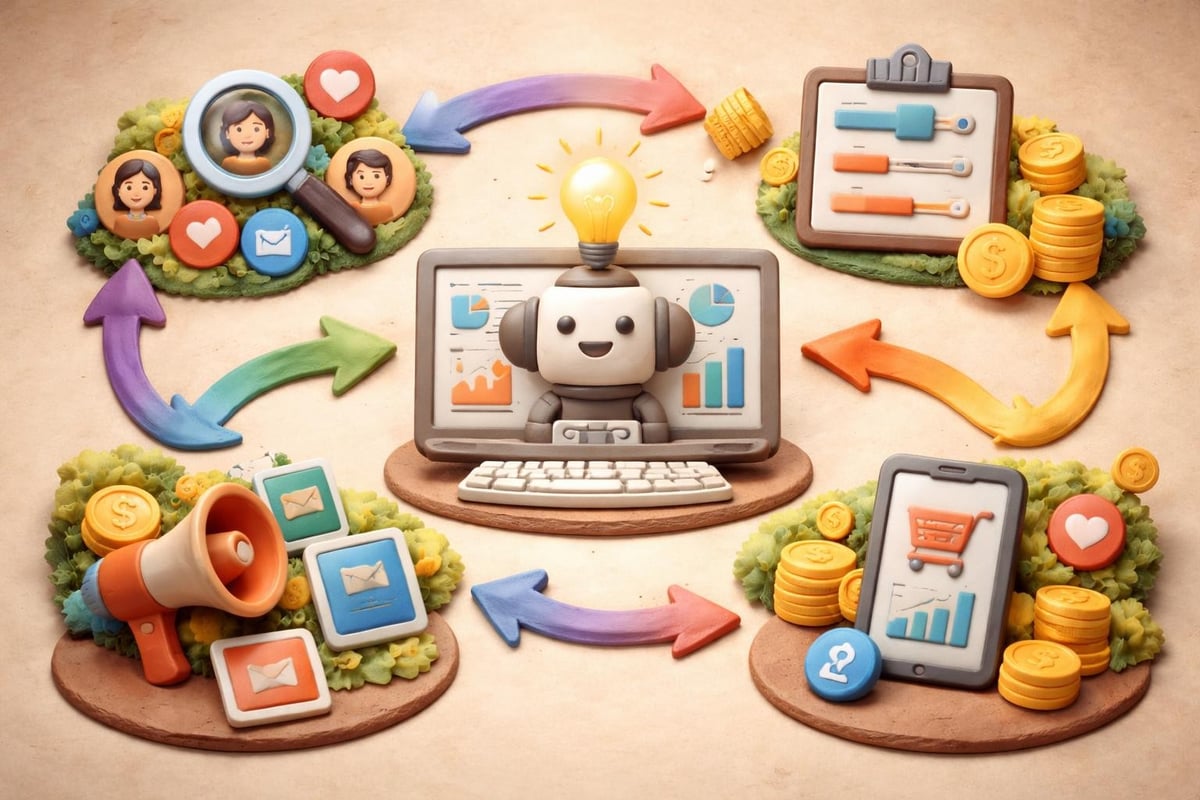
Machine learning algorithms now handle critical campaign functions:
- Dynamic bid adjustments based on conversion probability
- Automated audience segmentation using behavioral signals
- Creative testing and rotation based on engagement patterns
- Budget allocation across channels and ad sets
- Fraud detection and invalid click filtering
The implications for digital advertisers are big. According to research from the Interactive Advertising Bureau, over half of marketers now use generative AI for content creation and audience targeting, and adoption keeps accelerating.
Predictive Analytics and Audience Intelligence
AI advertising platforms spot patterns people cannot see. By crunching historical conversion data alongside demographic and behavioral signals, they predict who is likely to convert before the ad is even clicked.
That changes targeting entirely. Instead of broad demographic guesses, you reach people based on purchase intent signals, browsing patterns, and lookalike models built from your proven customers.
| Traditional Targeting | AI-Powered Targeting |
|---|---|
| Demographics and interests | Behavioral intent signals |
| Manual audience creation | Automated lookalike discovery |
| Periodic performance review | Continuous optimization |
| Static bid strategies | Dynamic probability-based bidding |
Automation handles the repetitive analysis. Your job shifts to the parts machines are bad at: creative strategy, messaging, and customer journey design.
Creative Development and Content Generation
Generative AI changed how ad creative gets made. Nearly 90 percent of advertisers will use generative AI to build video ads, and projections put AI-generated content at 40% of video ads by the end of 2026.
For service businesses in Colorado Springs and across the Front Range, that knocks down the old barriers. A roofing company can now produce professional video, test a dozen ad variations, and personalize messaging without a production budget.
Dynamic Creative Optimization at Scale
The platforms generate and test hundreds of creative combinations automatically: headlines, images, calls-to-action, offers. Winning combinations surface faster than any traditional A/B test could find them.
Key advantages of AI-driven creative optimization:
- Rapid iteration cycles that test dozens of variations simultaneously
- Personalized messaging adapted to audience segments and user context
- Performance prediction that identifies likely winners before full deployment
- Automated asset generation for display, social, and video formats
- Cross-channel consistency maintained while optimizing for platform-specific performance
That said, authenticity remains critical in AI-generated advertising. Sloppy campaigns with no clear intent or brand voice create fatigue and cost you credibility. The best AI advertising pairs automated production with human creative direction.
Platform-Specific AI Capabilities
Each major platform has its own AI system with its own strengths. Knowing the differences helps you put budget where it works.
Google Ads Smart Bidding and Performance Max
Google’s AI optimizes bids across search, display, shopping, and video. Performance Max campaigns combine automated bidding, targeting, and creative optimization across Google’s whole ecosystem.
Smart Bidding reads auction-time signals like device, location, time of day, and search query to set the right bid for each impression. Hand it good conversion data and it will usually beat manual bidding on both cost and volume.
For businesses running Google Ads Management campaigns, knowing when to keep manual control matters. Regulated industries often do best with a hybrid: AI efficiency plus human judgment on messaging and targeting.
Meta’s Advantage+ and Machine Learning Optimization
Meta’s Advantage+ automates creative testing, audience expansion, and placement across Facebook and Instagram, learning continuously from user interactions.
Meta’s particular strength is lookalike audiences: finding new people who resemble your existing customers without manual prospecting. Its visual recognition also matches creative to user preferences.
Meta AI advertising features include:
- Automated audience targeting beyond initial seed parameters
- Dynamic creative assembly that personalizes ad components
- Cross-platform placement optimization
- Automated budget distribution across ad sets
- Conversion prediction and bid optimization
Implementation Strategies for Small and Mid-Sized Businesses
Turning on the automated features is the easy part. Successful AI advertising needs proper tracking infrastructure, clear conversion goals, and enough data for the algorithms to learn from.
Data Foundation and Conversion Tracking
The platforms learn from your conversion data, so it has to be accurate. Set up tracking through Google Tag Manager, Meta Pixel, and CRM integration so the algorithms see what success actually looks like.
| Tracking Component | Purpose | Implementation Priority |
|---|---|---|
| Conversion pixels | Track completed actions | Critical |
| Enhanced conversions | Improve match rates | High |
| Offline conversion import | Connect online leads to closed sales | High |
| Custom event tracking | Measure micro-conversions | Medium |
| Cross-domain tracking | Follow user journeys | Medium |
According to research on marketing ROI from generative AI, 93% of CMOs and 83% of marketing teams see clear ROI from AI. The common thread is data infrastructure that feeds accurate signals to the algorithms.
Learning Phases and Algorithm Training
Every AI campaign needs a learning period before it hits stride. Panic-pausing or constantly fiddling during that phase resets the learning and delays results.
Best practices for algorithm training:
- Maintain consistent budgets during learning phases
- Allow sufficient conversion volume before optimization changes
- Resist the urge to pause underperforming campaigns prematurely
- Set realistic expectations for initial performance
- Track performance trends rather than daily fluctuations
Businesses exploring branding and marketing strategies have to balance brand building against direct response. AI is excellent at driving measurable actions, but you must tell it which outcomes matter.
The Human Element in AI-Driven Campaigns
Automation runs the tactics; strategy stays with you. Research on AI in advertising makes the point directly: AI tools enhance strategic thinking rather than replacing it.
Humans still supply the context algorithms cannot: brand voice, competitive positioning, seasonal dynamics, and messaging that actually lands emotionally.
Quality Control and Brand Safety
Automated generation needs guardrails. Google’s efforts to combat AI-generated spam show how ad quality becomes harder to police as automation ramps up production volume.
Businesses should implement review processes that catch potential issues before they reach audiences:
- Regular creative audits to ensure brand alignment
- Placement exclusion lists for inappropriate sites
- Negative keyword management to prevent irrelevant traffic
- Conversion quality analysis beyond volume metrics
- Customer feedback monitoring for message resonance
Performance Measurement and Attribution
AI advertising platforms also measure better. They track user journeys across touchpoints, which tells you what your campaigns really did instead of what last-click says they did.
Multi-Touch Attribution and Customer Journeys
Buyers see several ads across several channels before they act. AI attribution models spread the credit across that journey rather than handing it all to the final click.
That full-funnel view improves budget decisions. You learn which channels create awareness, which nurture, and which close, then invest accordingly.
Advanced attribution capabilities:
- Cross-device tracking that follows users across mobile and desktop
- View-through conversion measurement for display advertising impact
- Position-based models that credit first and last touchpoints
- Data-driven attribution using machine learning to weight touchpoints
- Incrementality testing to measure true advertising impact
Wiring advertising data into your CRM closes the loop from spend to revenue. That visibility is essential for marketing growth strategies that prioritize ROI over vanity metrics.
Emerging Trends and Future Developments
The AI advertising landscape moves fast, and the advantage goes to whoever adopts useful capabilities before everyone else has them.
Industry research indicates that 96% of advertisers expect significant industry changes within the year, mostly around efficiency and faster content production. Early movers get the head start.
Voice and Conversational AI Integration
Voice is the next frontier. As people talk to assistants and chatbots instead of scrolling, ad formats have to fit conversations rather than screens.
If you already run AI voice agents for customer service, extending them toward sponsored responses and conversational product discovery is a natural next step.
Privacy-First Targeting and Contextual Intelligence
Privacy rules and the death of third-party cookies push platforms toward contextual targeting: analyzing page content to place relevant ads without following individuals around the web.
That shift actually helps businesses built on local SEO strategies. First-party data, real customer relationships, and local relevance beat surveillance-based tracking, and they are yours to keep.
Practical Implementation for Service Businesses
Service businesses on the Front Range can use AI advertising for consistent lead flow without a big budget or a marketing department. Automate the high-impact work, keep your hands on the strategy.
Starting Small and Scaling Systematically
Start with one channel. Establish baseline performance before you spread across platforms. Focused spend produces cleaner learning signals than budget scattered across five simultaneous experiments.
Recommended implementation sequence:
- Establish conversion tracking and measurement infrastructure
- Launch single-platform campaign with clear conversion goal
- Allow learning phase completion and baseline performance establishment
- Analyze results and identify optimization opportunities
- Scale successful campaigns before adding new channels
- Integrate cross-channel data for holistic attribution view
Once you run multiple channels, centralize the reporting. One view across platforms prevents channel silos and makes reallocation obvious.
AI advertising changes how customers get acquired: intelligent automation, predictive targeting, and creative optimization that produces measurable results. The winning combination is automated efficiency plus human judgment, good data, and clear goals. Pioneer Marketing helps Colorado Front Range businesses put AI-driven advertising to work, generating qualified leads and predictable revenue growth through data-driven campaign management and intelligent marketing automation.