The foundation of sustainable business growth rests on a company's ability to consistently attract and convert qualified prospects. Marketing and lead generation work together as complementary disciplines that drive revenue through strategic visibility, targeted messaging, and systematic conversion processes. Understanding how these systems integrate creates opportunities for businesses to build predictable growth while reducing manual effort and capitalizing on emerging technologies that streamline customer acquisition.
Understanding Marketing and Lead Generation Fundamentals
Marketing encompasses all activities that build awareness, establish authority, and create interest in your products or services. Lead generation represents the specific process of converting that interest into actionable opportunities by capturing prospect information and qualifying their fit for your business.
The relationship between these functions determines success or failure. Marketing without lead generation builds awareness without capturing value. Lead generation without marketing attempts to convert an audience that doesn't exist or lacks proper nurturing.
Modern approaches integrate both disciplines through coordinated campaigns where content marketing drives traffic, landing pages capture information, and automation systems qualify and nurture prospects until they're ready for sales engagement. This integrated methodology has become the lifeblood of modern business, particularly for companies competing in local markets where visibility and credibility directly impact customer decisions.

The Evolution of Customer Acquisition
Traditional outbound methods relied on interruption and volume. Businesses purchased lists, made cold calls, and deployed broad advertising hoping to reach qualified prospects within larger audiences. This approach generated inconsistent results and poor return on investment.
Digital transformation shifted the paradigm toward inbound methodology where businesses attract prospects through valuable content, optimized search presence, and targeted advertising. This evolution improved efficiency but introduced complexity as channels multiplied and customer expectations increased.
Current best practices combine inbound and outbound strategies through multi-channel orchestration. Businesses leverage local search optimization, paid advertising, content marketing, social media engagement, and automated follow-up to create comprehensive systems that meet prospects wherever they research and make decisions.
Building Effective Marketing Channels
Channel selection determines the quality and cost of leads your business generates. Service-based businesses benefit most from channels where intent signals and local targeting capabilities align with their ideal customer profile.
Local Search Optimization
Search engine optimization remains foundational for businesses serving specific geographic areas. When executed properly, local SEO generates high-quality inbound leads from prospects actively seeking your services within your service area.
Effective local SEO strategies require:
- Complete and optimized Google Business Profile with accurate service areas, hours, and contact information
- Location-specific content that addresses customer questions and demonstrates local expertise
- Citation consistency across directories and local business listings
- Customer reviews that build trust and improve search rankings
- Mobile-optimized website with clear conversion paths
The advantage of local search lies in intent quality. Prospects searching for "HVAC repair Colorado Springs" demonstrate immediate need and geographic relevance, making them more valuable than cold contacts or general awareness-stage visitors.
Research from Entrepreneur provides detailed guidance on local keyword research that helps businesses identify the exact terms their customers use when searching for services.
Paid Advertising Campaigns
While organic visibility builds over time, paid advertising generates immediate traffic and allows precise targeting based on demographics, behaviors, and search intent. Google Ads and Meta advertising provide different advantages depending on business goals and customer behaviors.
Google Ads captures high-intent prospects actively searching for solutions. These campaigns excel when:
- Service demand exists within your market
- Conversion value justifies cost-per-click rates
- Landing pages effectively convert traffic to leads
- Tracking systems accurately measure campaign performance
Meta advertising builds awareness and generates demand among audiences who match your ideal customer profile but may not be actively searching. This approach works particularly well for businesses with longer sales cycles or those introducing new services to their market.
| Channel Type | Best Use Case | Average Timeline | Intent Level |
|---|---|---|---|
| Google Search | Immediate need capture | 2-4 weeks setup | High |
| Meta Advertising | Awareness and demand generation | 4-6 weeks optimization | Medium |
| Local SEO | Long-term organic visibility | 3-6 months for results | High |
| Content Marketing | Authority building | 6-12 months for traction | Variable |
Successful paid advertising strategies require continuous optimization based on performance data, regular testing of ad creative and targeting parameters, and alignment between campaign messaging and landing page content.
Lead Generation Infrastructure
Converting traffic into qualified leads requires purpose-built systems designed to reduce friction, capture information, and initiate nurturing sequences. Marketing and lead generation infrastructure includes landing pages, forms, tracking mechanisms, and CRM integration that work together to maximize conversion rates.
Conversion-Focused Landing Pages
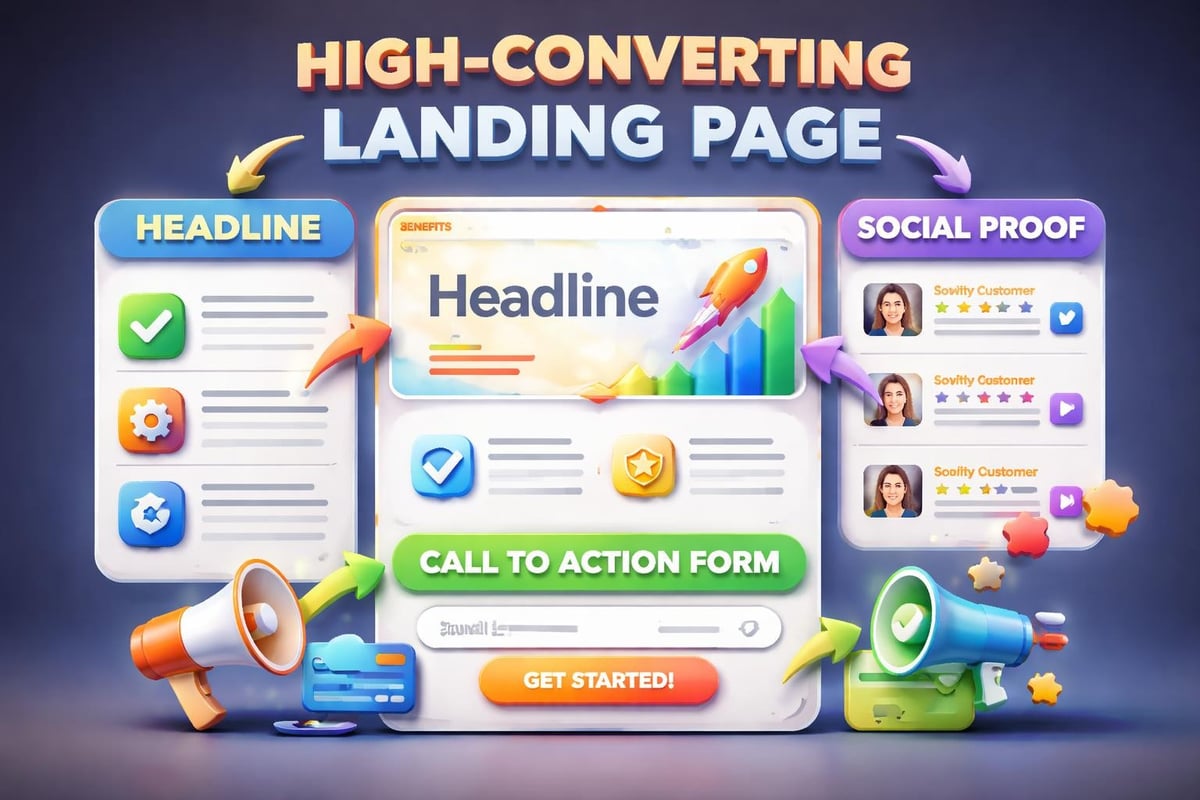
Generic website pages convert poorly because they offer too many options and fail to address specific visitor intent. Dedicated landing pages improve conversion by maintaining message match between advertising or content and the page destination while removing navigation and alternative calls-to-action that create decision fatigue.
Effective landing pages include:
- Headlines that directly address the visitor's search query or ad promise
- Benefit-focused copy that explains value rather than listing features
- Social proof through testimonials, reviews, or case study results
- Single, clear call-to-action with minimal form fields
- Mobile-responsive design that loads quickly and displays properly on all devices
Testing different page elements reveals which combinations produce optimal results for your specific audience. Variables worth testing include headline phrasing, form length, button color and text, testimonial placement, and the amount of information provided before requesting contact details.
Lead Qualification Systems
Not all leads provide equal value. Businesses waste resources pursuing prospects who lack budget, authority, need, or timeline fit. Qualification systems identify which leads warrant immediate attention and which require additional nurturing before sales engagement.
Lead scoring assigns point values based on demographic information and behavioral signals. A prospect who downloads a service guide, visits pricing pages multiple times, and matches your ideal customer profile receives a higher score than someone who visited once and consumed no content.
Progressive profiling gathers information gradually across multiple interactions rather than requesting comprehensive details upfront. Initial forms capture minimal information to reduce friction, while subsequent content offers request additional qualifying data.
Automation rules based on lead scores trigger appropriate responses. High-scoring leads receive immediate sales notifications or appointment booking invitations. Medium-scoring leads enter nurturing sequences with relevant content. Low-scoring leads receive periodic check-ins without consuming sales resources.
Automation and Artificial Intelligence Integration
Manual follow-up processes create inconsistent prospect experiences and lost opportunities when leads aren't contacted promptly. Automation systems ensure every lead receives timely, relevant communication regardless of when they convert or how busy your team becomes.
Automated Follow-Up Sequences
Email and SMS automation delivers scheduled messages that educate prospects, address common objections, and move them toward purchase decisions. Effective sequences balance value delivery with conversion encouragement through carefully crafted message progression.
Typical sequence structure includes:
- Immediate confirmation and resource delivery
- Educational content addressing common questions
- Social proof showcasing customer success
- Limited-time incentives encouraging action
- Re-engagement messages for inactive prospects
Response triggers adjust sequences based on prospect behavior. Someone who clicks pricing links receives different follow-up than someone who opens educational content, allowing personalization at scale without manual intervention.
AI automation capabilities now extend beyond basic email sequences to include conversational interfaces, voice agents that handle initial inquiries, and intelligent routing that connects prospects with appropriate team members based on their questions and qualification status.
CRM and Tracking Implementation
Customer relationship management systems serve as the operational hub for marketing and lead generation activities. Proper CRM implementation provides visibility into lead sources, campaign performance, conversion rates, and revenue attribution that inform optimization decisions.
Essential CRM functions include:
- Centralized contact database with complete interaction history
- Lead source tracking connecting prospects to specific campaigns
- Pipeline management showing deal progression and forecast revenue
- Task automation ensuring follow-up consistency
- Reporting dashboards measuring key performance indicators
Integration between marketing platforms and CRM systems enables closed-loop reporting where businesses track leads from initial contact through conversion and attribute revenue to specific campaigns. This visibility identifies which marketing investments generate positive returns and which consume budget without producing results.
Content Marketing for Lead Generation
Strategic content creation attracts prospects during research phases, establishes expertise that builds trust, and provides assets for nurturing sequences that convert interest into action. The most effective content addresses specific questions prospects ask while searching for solutions.
Topical Authority Development
Search engines reward websites that comprehensively cover topics relevant to their business. Rather than creating isolated articles, businesses benefit from building content clusters that thoroughly address subject areas important to their target audience.
A case study from Moz demonstrates how building topical authority improves search rankings and drives qualified traffic by establishing comprehensive coverage of interconnected topics that prospects care about.
Content clusters organize around pillar pages that provide broad topic overviews with links to supporting articles covering specific subtopics in detail. This structure improves user experience while signaling search engines about your depth of expertise.
| Content Type | Primary Purpose | Lead Generation Value | Production Effort |
|---|---|---|---|
| Blog Articles | Traffic and authority | Medium | Low-Medium |
| Service Pages | Conversion and local SEO | High | Medium |
| Video Content | Engagement and trust | Medium-High | High |
| Case Studies | Social proof and conversion | High | Medium-High |
| Guides and eBooks | Lead capture and qualification | High | High |
Lead Magnets and Gated Content
Offering valuable resources in exchange for contact information bridges the gap between anonymous website visitors and qualified leads. Effective lead magnets provide immediate, actionable value that addresses specific prospect pain points.
High-performing lead magnet formats include:
- Checklists that simplify complex processes
- Templates that provide starting frameworks
- Calculators that help prospects quantify problems or solutions
- Guides that educate on important decisions
- Assessments that identify gaps or opportunities
The quality threshold for gated content exceeds standard blog content. Prospects only provide contact information when they perceive the offered resource as genuinely valuable and immediately useful to their situation.
Measuring Marketing and Lead Generation Performance
Analytics transform marketing from guesswork into science by revealing which activities drive results and where resources should be allocated or reallocated. Effective measurement requires tracking both leading indicators that predict future performance and lagging indicators that confirm actual results.
Key Performance Indicators
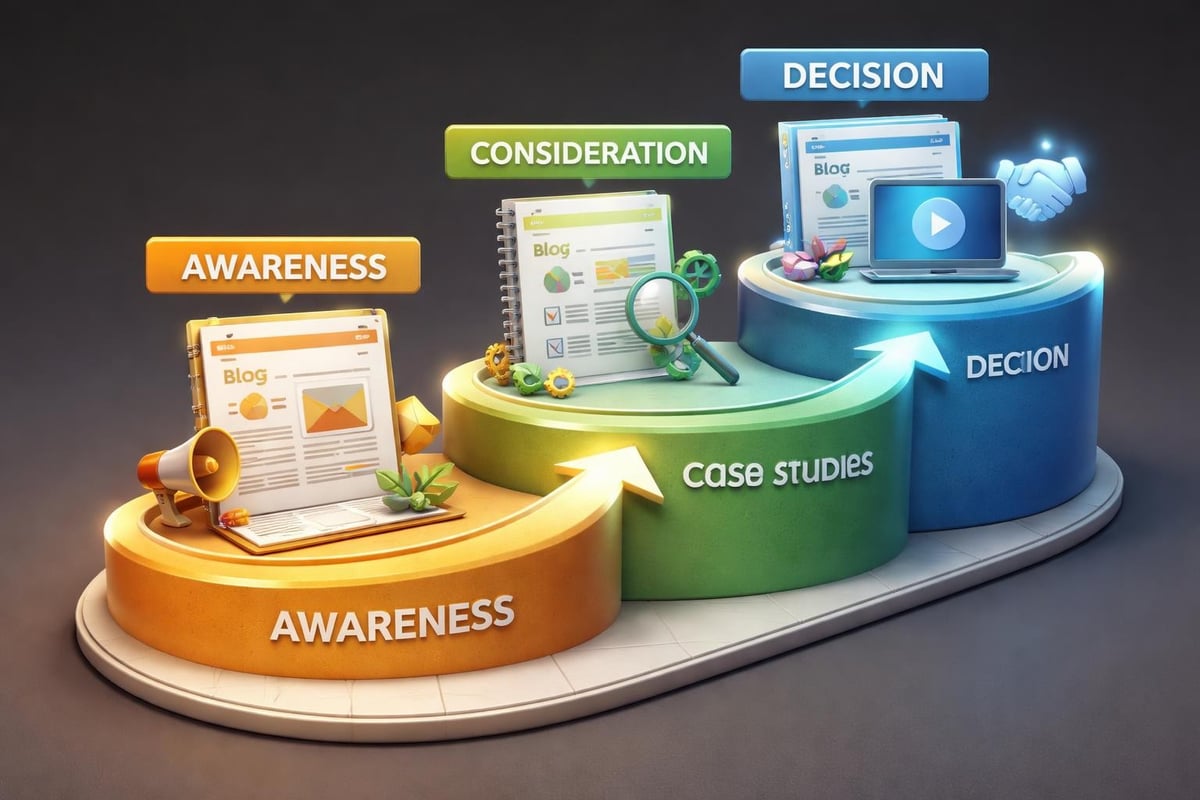
Different metrics matter at different funnel stages. Traffic metrics indicate marketing reach, while conversion metrics reveal how effectively that reach translates into opportunities, and close rates determine actual revenue generation.
Top-of-funnel metrics include:
- Website traffic volume and sources
- Keyword rankings for target search terms
- Social media reach and engagement
- Content consumption and time on site
Middle-of-funnel metrics include:
- Landing page conversion rates
- Lead magnet downloads
- Email list growth and engagement
- Lead quality scores
Bottom-of-funnel metrics include:
- Sales-qualified lead percentage
- Opportunity-to-close conversion rate
- Customer acquisition cost
- Revenue per lead source
According to research from MarketingSherpa, certain lead sources consistently produce higher-quality leads than others, making source tracking essential for optimization.
Attribution and ROI Calculation
Multi-touch attribution acknowledges that prospects typically interact with multiple marketing channels before converting. Simple last-click attribution undervalues early-stage awareness activities that initiated the relationship.
Attribution models to consider:
- First-touch: Credits the initial interaction that introduced the prospect
- Last-touch: Credits the final interaction before conversion
- Linear: Distributes credit equally across all touchpoints
- Time-decay: Gives more credit to recent interactions
- Position-based: Credits first and last touches most heavily
No single model perfectly captures reality, but comparing results across different attribution approaches reveals patterns about which channels initiate relationships versus which close deals.
ROI calculation connects marketing investment to revenue generation. For each campaign or channel, track total costs including advertising spend, platform fees, content creation, and management time, then compare against revenue generated from leads attributed to that source.
Optimizing Lead Quality and Conversion Rates
Volume without quality creates work without profit. Optimization focuses on improving the caliber of leads generated and increasing the percentage that convert into customers rather than simply increasing top-of-funnel numbers.
Audience Targeting Refinement
Analyzing which prospects convert most readily and generate highest lifetime value reveals patterns that inform targeting improvements. Demographic commonalities, behavioral indicators, and firmographic characteristics of best customers guide campaign optimization.
Refinement strategies include:
- Excluding poor-fit audiences from advertising campaigns
- Creating content addressing specific industry or role questions
- Developing service packages tailored to ideal customer segments
- Adjusting messaging to emphasize benefits most valued by best customers
Geographic targeting deserves particular attention for service-based businesses. Expanding beyond ideal service areas generates inquiries from prospects you cannot serve, wasting budget and creating poor customer experiences.
Conversion Rate Optimization Testing
Systematic testing identifies which page elements, form designs, and messaging approaches produce optimal conversion. Rather than relying on assumptions, testing reveals what actually works with your specific audience.
Elements worth testing systematically:
- Form length and required versus optional fields
- Headline phrasing and benefit emphasis
- Button text, color, and placement
- Amount of information provided before requesting contact
- Social proof type and positioning
- Page length and content organization
Tools like SalesHandy provide comprehensive frameworks for lead generation that include testing methodologies and optimization best practices.
Testing requires sufficient traffic volume to reach statistical significance. Low-traffic pages need longer test periods or more dramatic variations to identify meaningful differences between versions.
Emerging Trends in Marketing and Lead Generation
Technology advancement continuously creates new opportunities and challenges for businesses seeking efficient customer acquisition. Staying current with emerging marketing trends ensures competitive positioning as prospect behaviors and platform capabilities evolve.
Conversational Marketing
Live chat, chatbots, and AI-powered conversation interfaces enable real-time prospect engagement that answers questions and qualifies interest while visitors actively research on your website. This immediacy reduces friction and captures leads who might otherwise leave without converting.
Modern conversational tools combine rule-based logic for handling common questions with AI understanding that interprets intent and routes complex inquiries appropriately. Voice capabilities extend engagement beyond text-only interactions.
Implementation considerations include:
- Response time expectations and coverage hours
- Qualification question sequences that gather necessary information
- Escalation triggers connecting qualified prospects with sales representatives
- Integration with CRM systems capturing conversation data
- Mobile optimization ensuring functionality across devices
Social Media Lead Extraction
Social platforms provide extensive prospect data for businesses willing to invest in extraction and engagement processes. Methods for scraping leads from social media range from manual research to automated tools that identify prospects based on profile information and activity patterns.
Effective social lead generation requires:
- Clear ideal customer profile defining target characteristics
- Consistent engagement building relationships before pitching
- Value-first content demonstrating expertise
- Compliant data collection respecting platform terms
- Systematic follow-up converting connections into conversations
AI-Driven Personalization
Artificial intelligence enables personalization at scales previously requiring massive teams. AI marketing tools analyze prospect behavior, predict interests, and customize content, offers, and communication timing for individual recipients.
Applications include:
- Dynamic website content adjusting based on visitor characteristics
- Predictive lead scoring identifying high-probability prospects
- Automated content recommendations matching prospect interests
- Send-time optimization delivering messages when recipients most likely engage
- Conversation simulation preparing sales teams for objections and questions
Building Sustainable Growth Systems
Short-term tactics generate temporary results. Sustainable growth requires building systems that consistently attract, convert, and retain customers through repeatable processes that improve over time.
Process Documentation and Refinement
Documenting your marketing and lead generation processes creates consistency, enables team training, and provides baselines for improvement measurement. Written procedures ensure quality standards persist regardless of staff changes or workload fluctuations.
Document these core processes:
- Campaign setup and launch procedures
- Lead intake and initial qualification steps
- Nurturing sequence triggers and message content
- Sales handoff criteria and communication protocols
- Reporting schedules and performance review processes
Regular review sessions identify process bottlenecks, conversion obstacles, and opportunities for automation or simplification that improve efficiency without sacrificing quality.
Technology Stack Optimization
Marketing technology should simplify operations rather than adding complexity. The optimal stack integrates seamlessly, eliminates duplicate data entry, and provides visibility across the entire lead lifecycle from initial contact through customer retention.
Core platform categories include:
- Website and hosting infrastructure
- CRM and contact management
- Email marketing and automation
- Advertising management and tracking
- Analytics and reporting
- Content creation and management
Integration capabilities determine whether platforms work together smoothly or create data silos requiring manual reconciliation. API connections, native integrations, and third-party middleware like Zapier enable information flow between systems.
Budget constraints require prioritization. Start with foundational elements (website, CRM, basic automation) and add specialized tools as specific needs emerge and resources allow expansion.
Building effective marketing and lead generation systems requires coordinating multiple channels, technologies, and processes into cohesive frameworks that attract qualified prospects and convert them efficiently. The integration of local search visibility, paid advertising, content marketing, and intelligent automation creates predictable growth for service-based businesses willing to invest in proper infrastructure and continuous optimization. Pioneer Marketing helps Colorado Front Range businesses implement these integrated systems through local SEO, AI-driven automation, and data-focused campaign management that connects marketing investment directly to revenue results.