Marketing and advertising form the backbone of business growth, serving as the primary channels through which companies connect with customers, build brand awareness, and generate revenue. For small and mid-sized businesses, understanding the distinction between these interconnected disciplines and leveraging them strategically can mean the difference between stagnant growth and sustainable expansion. Today's digital landscape demands an integrated approach that combines traditional marketing principles with modern advertising techniques, automation tools, and data-driven decision-making to create predictable, measurable results.
The Foundation of Marketing and Advertising
Marketing encompasses the broader strategic framework that guides how businesses identify, reach, and retain customers. It includes market research, brand positioning, content creation, customer relationship management, and the overall strategy that connects a business with its ideal audience.
Advertising, by contrast, represents the tactical execution of paid promotional messages across specific channels. It's the amplification mechanism that accelerates visibility and drives immediate action.
The most successful businesses recognize that marketing and advertising work in tandem. Marketing establishes the foundation-who you serve, what problems you solve, and how you differentiate from competitors. Advertising then amplifies that message to the right people at the right time.
Building a Strategic Marketing Framework
Before launching any advertising campaign, businesses need a solid marketing foundation. This includes:
- Clear audience definition with detailed buyer personas
- Value proposition development that articulates specific benefits
- Competitive positioning that highlights unique advantages
- Measurable goals tied to revenue and growth metrics
- Content strategy that educates and nurtures prospects
According to The Marketing Accountability Standards Board, establishing clear metrics and accountability standards improves marketing performance and financial outcomes. Without this foundation, advertising dollars get wasted on poorly targeted campaigns that generate clicks but not customers.

Local SEO as Marketing Infrastructure
For service-based businesses serving specific geographic markets, local SEO strategies create the infrastructure that makes all other marketing and advertising efforts more effective. Local search optimization ensures your business appears when potential customers search for your services in your area.
Key Components of Local Search Marketing
Local SEO operates differently from traditional organic search optimization. It prioritizes proximity, relevance, and prominence within a specific geographic area.
Google Business Profile optimization serves as the cornerstone of local visibility. This free tool allows businesses to manage how they appear in Google Search and Maps, displaying critical information including:
| Element | Purpose | Impact |
|---|---|---|
| Business hours | Sets customer expectations | Reduces friction in contact process |
| Service areas | Defines geographic reach | Improves targeting accuracy |
| Photos and videos | Builds trust and credibility | Increases engagement rates |
| Customer reviews | Provides social proof | Influences purchase decisions |
| Posts and updates | Maintains fresh content | Signals business activity |
Citation consistency across online directories ensures search engines can verify your business information. Inconsistent NAP (Name, Address, Phone) data creates confusion and damages local rankings.
Location-specific content targeting neighborhood keywords and local search intent captures customers at the bottom of the funnel. When someone searches "emergency plumber Colorado Springs" or "martial arts studio near me," they're ready to take action.
The integration of local SEO with broader marketing and advertising strategies creates a compounding effect. Paid advertising drives immediate visibility while SEO builds long-term organic presence. Together, they dominate both paid and organic search results.
Paid Advertising for Immediate Results
While organic marketing builds momentum over time, paid advertising delivers immediate visibility and traffic. Modern paid advertising strategies leverage sophisticated targeting, automation, and optimization to maximize return on ad spend.
Google Ads for Intent-Based Targeting
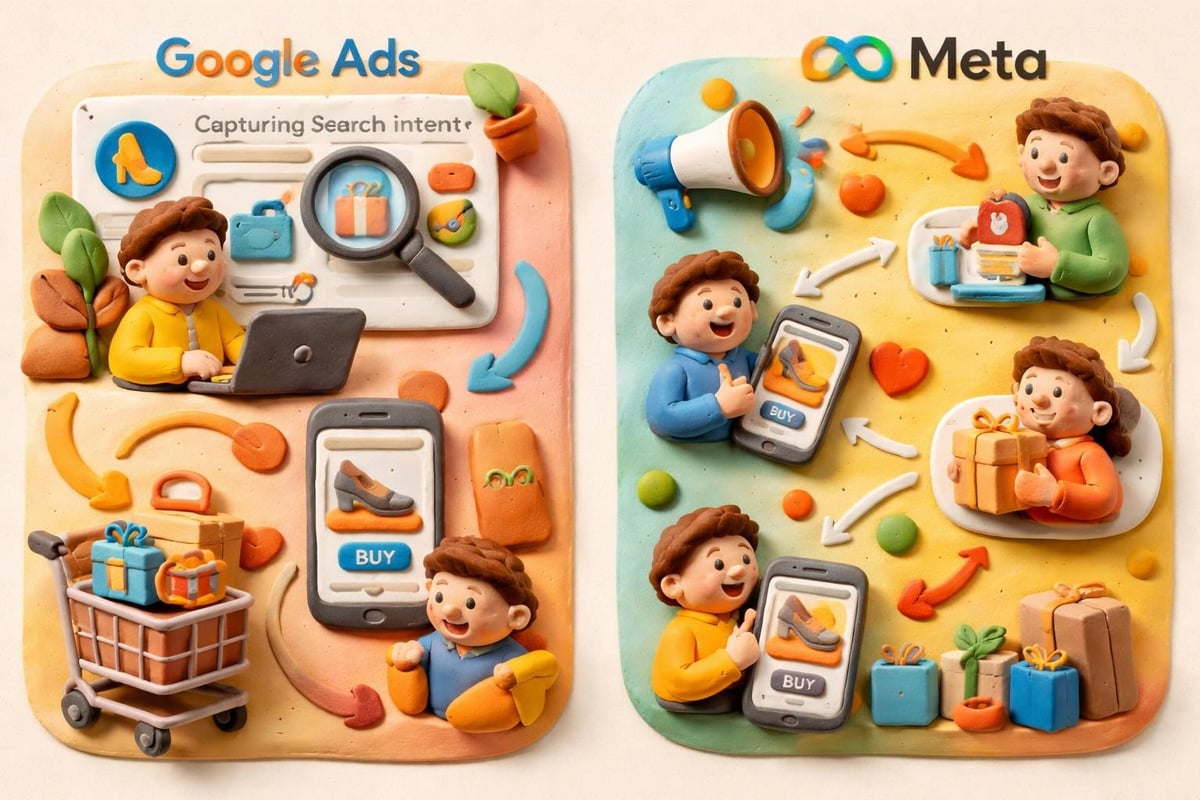
Search advertising through Google Ads captures customers actively looking for solutions. Unlike passive advertising that interrupts, search ads respond to expressed intent.
The structure of effective Google Ads campaigns follows this hierarchy:
- Campaign-level settings define budget, geographic targeting, and scheduling
- Ad group organization groups related keywords and creates relevant ad variations
- Keyword selection balances search volume, competition, and commercial intent
- Ad copy creation matches search intent and highlights unique value
- Landing page optimization continues the message and drives conversions
Negative keywords prevent wasted spend on irrelevant searches. A personal injury attorney doesn't want clicks from people searching for "free legal advice" or "law school admission."
Ad extensions increase visibility and click-through rates by displaying additional information like phone numbers, location, sitelinks, and callouts directly in the ad.
Meta Advertising for Awareness and Retargeting
Facebook and Instagram advertising excels at building awareness, targeting specific demographics and interests, and retargeting website visitors who didn't convert initially.
Meta's advertising platform offers unique advantages:
- Detailed demographic targeting based on age, income, education, and life events
- Interest and behavior targeting reaching people based on activities and preferences
- Custom audiences uploading customer lists or website visitors for precise targeting
- Lookalike audiences finding new prospects similar to existing customers
- Dynamic creative optimization automatically testing ad variations to find top performers
The combination of Google Ads and Meta advertising creates comprehensive coverage. Search ads capture high-intent prospects actively looking for solutions. Social ads build awareness with people who match your customer profile but haven't yet recognized their need.
Marketing Automation and AI Integration
Marketing and advertising effectiveness multiply when combined with intelligent automation. AI-driven marketing automation handles repetitive tasks, ensures consistent follow-up, and personalizes communication at scale.
Automating Lead Management
The most expensive marketing mistake is generating leads and failing to follow up quickly or consistently. Automation solves this problem by creating systematic processes that never miss opportunities.
Automated lead response ensures every inquiry receives immediate acknowledgment. Research shows that responding to leads within five minutes increases conversion rates by 900% compared to waiting 30 minutes.
Intelligent lead routing assigns prospects to the right team member based on service type, location, or other criteria. This eliminates confusion and ensures expertise matches customer needs.
Follow-up sequences nurture prospects over time with valuable content, educational resources, and timely offers. Most sales require multiple touchpoints, but manual follow-up fails consistently.
AI Voice Agents and Conversational Marketing
Voice AI technology now handles phone inquiries, qualifies leads, books appointments, and answers common questions without human intervention. These systems work 24/7, never miss calls, and maintain consistent quality.
AI voice agents integrate with CRM systems to:
- Answer frequently asked questions about services, pricing, and availability
- Qualify leads by asking predetermined questions
- Schedule appointments directly into calendars
- Transfer high-value prospects to human team members
- Follow up with missed calls automatically
Chatbots and messaging automation handle similar functions through website chat, SMS, and social media messaging. They provide instant responses, capture lead information, and escalate conversations when human expertise is needed.
According to Advertising Age, marketing automation and AI integration represent the fastest-growing segment of marketing technology spending, as businesses recognize the efficiency and revenue gains these tools provide.
Content Marketing as Advertising Amplification
Content marketing creates the assets that make marketing and advertising more effective. Quality content serves multiple purposes: educating prospects, building authority, supporting SEO rankings, and providing material for advertising campaigns.
Strategic Content Development
Effective content marketing aligns with customer journey stages and business objectives.
Top-of-funnel content attracts broad audiences searching for information and education. Blog posts, guides, and educational videos answer questions and establish expertise.
Middle-of-funnel content helps prospects evaluate solutions and compare options. Case studies, comparison guides, and detailed service explanations build confidence.
Bottom-of-funnel content facilitates purchase decisions. Pricing information, testimonials, guarantees, and strong calls-to-action convert interested prospects into customers.
The relationship between content and advertising works bidirectionally:
- Content provides targeting opportunities for advertising (retargeting blog readers with service ads)
- Advertising drives traffic to content that educates and converts
- Content assets become advertising creative (turning blog insights into ad copy)
- Performance data from ads informs content development priorities
MarketingProfs research demonstrates that businesses publishing consistent, valuable content generate 67% more leads than those without active content programs.
Measuring Marketing and Advertising Performance
Data-driven decision-making separates effective marketing and advertising from wasteful spending. Measurement connects activities to outcomes, revealing what drives revenue and what drains budgets.
Essential Marketing Metrics
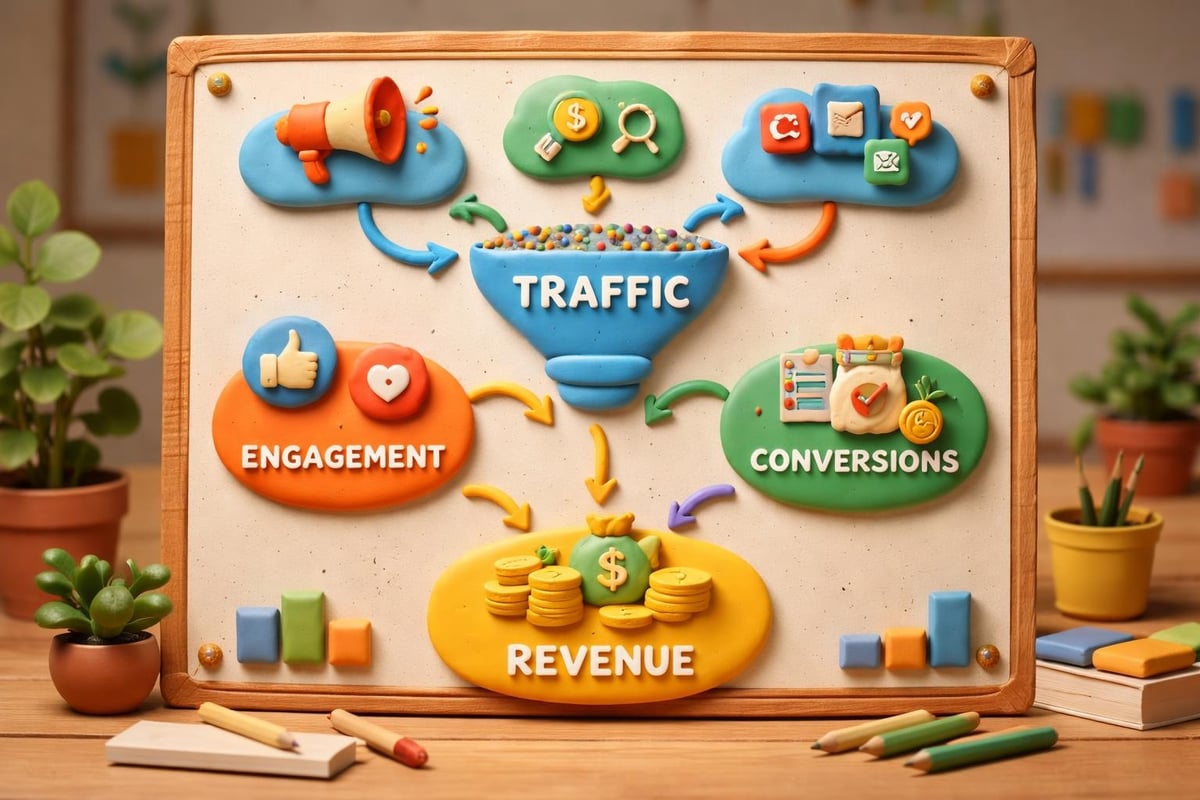
Different channels require different measurement approaches, but all should connect to business outcomes.
| Metric Category | Key Indicators | Business Impact |
|---|---|---|
| Traffic metrics | Sessions, users, page views | Awareness and reach |
| Engagement metrics | Time on page, bounce rate, pages per session | Content relevance and quality |
| Conversion metrics | Form submissions, calls, appointments | Lead generation effectiveness |
| Revenue metrics | Cost per acquisition, customer lifetime value, ROI | Profitability and growth |
| Efficiency metrics | Click-through rate, conversion rate, cost per click | Campaign optimization opportunities |
Attribution modeling determines which touchpoints deserve credit for conversions. Most customer journeys involve multiple interactions across channels. Simple "last-click" attribution misleads by crediting only the final touchpoint while ignoring the marketing and advertising that created awareness and interest.
A/B testing provides empirical answers about what works. Testing headlines, offers, images, and calls-to-action reveals optimization opportunities that incremental improvements compound into significant performance gains.
Integrated Marketing and Advertising Strategies
The most successful businesses don't treat marketing and advertising as separate functions. They create integrated strategies where each element reinforces others.
Building Cohesive Campaigns
Integration means coordinating messages, timing, and targeting across channels to create consistent, reinforcing customer experiences.
Message consistency ensures customers encounter the same core value proposition whether they see a Google ad, visit your website, read your content, or receive a follow-up email. Visual branding, tone, and key benefits align across touchpoints.
Retargeting coordination creates sequential messaging that guides prospects through decision stages. Someone who visits your pricing page sees different ads than someone who only read a blog post.
Multi-channel presence increases effectiveness through repetition and reach. Prospects might ignore a social ad but click a search ad. Or they see both, creating reinforcement that builds familiarity and trust.
For businesses exploring digital marketing strategies, the integration challenge often stems from using disconnected tools and platforms. Unified systems that share data across marketing automation, advertising platforms, and CRM create the visibility needed for true integration.
Practical Implementation for Service Businesses
Service-based businesses face unique marketing and advertising challenges. They sell expertise and relationships rather than products, often serve limited geographic areas, and depend on trust and reputation.
Service Business Marketing Priorities
Focus areas for service providers include:
Reputation management through active review generation and response. Online reviews influence 93% of consumer decisions. Systematic processes for requesting reviews from satisfied customers and addressing concerns from unhappy ones protect and enhance reputation.
Educational content that demonstrates expertise builds authority. A plumber explaining how to prevent frozen pipes or an attorney outlining estate planning steps shows knowledge while attracting prospects researching solutions.
Local community involvement creates visibility and goodwill. Sponsoring youth sports, participating in chamber events, and supporting local causes generates awareness and positive associations.
Partnership development with complementary businesses creates referral networks. A landscaping company partnering with real estate agents or a martial arts studio collaborating with schools expands reach without advertising costs.
According to The International Advertising Association, service businesses that combine community presence with digital marketing and advertising achieve significantly higher customer acquisition efficiency than those relying solely on paid media.
Budget Allocation and Resource Management
Determining how much to spend on marketing and advertising and where to allocate those dollars challenges every business. Strategic budget development balances immediate needs with long-term growth.
Strategic Budget Development
Industry benchmarks provide starting points. Most small businesses allocate 7-8% of revenue to marketing and advertising, though newer businesses or those in competitive markets often invest 15-20% during growth phases.
Channel performance should drive allocation decisions. Channels delivering strong ROI deserve increased investment. Underperforming channels need optimization or replacement.
Testing budgets allow experimentation without excessive risk. Allocating 10-15% of marketing budgets to testing new channels, messages, or tactics creates opportunities for discovery while limiting downside.
Consider this allocation framework for service businesses:
- Local SEO and organic content: 25-30% (long-term foundation)
- Paid search advertising: 30-40% (immediate lead generation)
- Social media advertising: 15-20% (awareness and retargeting)
- Marketing automation and tools: 10-15% (efficiency and scaling)
- Testing and innovation: 10-15% (growth opportunities)
The Alliance for Audited Media provides verified data on advertising effectiveness across channels, helping businesses make informed allocation decisions based on industry standards and performance benchmarks.
Crisis Response and Reputation Protection
Marketing and advertising strategy must account for crisis situations and reputation threats. Proactive planning prevents reactive scrambling when problems arise.
Reputation Protection Strategies
Monitoring systems alert businesses to negative reviews, social media mentions, or news coverage quickly. Early awareness enables fast response before issues escalate.
Response protocols establish who responds, how quickly, and what messages are appropriate for different situations. Consistency and speed matter during crises.
Positive content development creates favorable search results that push negative content lower in rankings. When someone searches your business name, you want your website, positive reviews, and favorable content dominating page one.
Transparency and authenticity in crisis communication build trust. Attempting to hide problems or deflect blame amplifies damage. Acknowledging issues and explaining solutions demonstrates integrity.
For businesses seeking comprehensive digital marketing support, having partners who understand both proactive marketing and defensive reputation management provides crucial protection.
Future Trends in Marketing and Advertising
The marketing and advertising landscape continues evolving rapidly. Staying ahead of trends positions businesses for sustained competitive advantage.
Emerging Developments
AI-generated content will increase in quality and accessibility, enabling businesses to produce more content faster. The challenge becomes maintaining authenticity and expertise that generic AI content lacks.
Voice search optimization grows in importance as smart speakers and voice assistants handle more searches. Conversational keywords and direct answer formats become more critical.
Privacy-first advertising adapts to declining cookie availability and increasing privacy regulations. First-party data collection, contextual targeting, and relationship-based marketing replace behavioral tracking.
Video content dominance continues expanding across platforms. Short-form video, live streaming, and interactive video formats capture attention and engagement more effectively than static content.
Hyper-personalization leverages AI and data to create individualized experiences at scale. Generic mass marketing gives way to customized messages, offers, and experiences based on individual behavior and preferences.
Adweek coverage of industry trends highlights how leading brands continuously adapt their marketing and advertising strategies to leverage emerging technologies while maintaining human connection and authenticity.
Effective marketing and advertising require strategic planning, consistent execution, and continuous optimization based on performance data. Service businesses that build strong foundations in local SEO, combine paid advertising with organic marketing, and leverage automation to scale their efforts create predictable lead flow and sustainable growth. Pioneer Marketing specializes in helping Colorado Front Range businesses implement these integrated strategies through local SEO, paid advertising management, and AI-driven automation that connects traffic to revenue. If you're ready to build a marketing system that generates qualified leads consistently, reach out to discover how data-driven strategies can transform your business growth.