Anyone can call themselves a digital marketer. That’s the problem. As businesses lean harder on data-driven strategy and automated systems, the gap between self-taught dabblers and trained professionals keeps widening. A certified digital marketer brings verified skills and proven competency to work that directly affects your revenue. For small and mid-sized businesses, that difference shows up fast: scattered effort versus systematic, measurable results.
What Defines a Certified Digital Marketer
A certified digital marketer has completed structured training and passed exams that verify knowledge across the core disciplines. Unlike self-study, certification programs use standardized frameworks covering SEO, paid ads, content strategy, analytics, and conversion optimization.
Core Competencies Measured by Certification Programs
Certification bodies test skills that map directly to business outcomes:
- Search engine optimization and local search visibility
- Paid media management across Google, Facebook, and display networks
- Marketing automation and customer relationship management
- Analytics and attribution to connect marketing spend with revenue
- Conversion rate optimization for landing pages and sales funnels
- Content strategy aligned with buyer journey stages
Most serious programs require passing exams at 70 to 80% accuracy, which demands working knowledge, not just familiarity. The American Marketing Association offers Professional Certified Marketer credentials that cover digital marketing alongside broader marketing management, giving practitioners dual credibility.
Industry Recognition and Professional Standards
Credentials buy credibility with employers, clients, and partners. Recognized certifications signal professional commitment and adherence to industry standards.
The Digital Marketing Association outlines requirements, including eight course modules totaling 16 hours of training within a two-year window. That structure keeps knowledge current in an industry where the rules change quarterly.

Types of Digital Marketing Certifications
Not all credentials carry equal weight. Programs differ in specialization, depth, cost, and how much the market actually respects them.
| Certification | Focus Area | Duration | Best For |
|---|---|---|---|
| PCM Digital Marketing | Comprehensive digital strategy | Self-paced, 3-6 months | Agency professionals and consultants |
| CDM Program | Multi-channel campaign execution | 16 hours over 2 years | Small business owners |
| CDMP | Job-ready technical skills | 3-4 months intensive | Career changers |
| Legal Digital Marketer | Legal industry specialization | Variable | Law firms and legal marketers |
Comprehensive Marketing Credentials
The AMA’s Digital Marketing Pro program, developed with the Digital Marketing Institute, produces dual certification: Professional Certified Marketer in Digital Marketing plus Certified Digital Marketing Professional. Employers looking for strategists who can also execute pay attention to that combination.
These programs typically cover:
- Digital marketing strategy and planning frameworks
- Search optimization for organic and local visibility
- Paid search and social advertising with budget management
- Content marketing and distribution strategies
- Email and automation workflows
- Analytics and reporting with ROI measurement
For businesses investing in automation and digital marketing, certified professionals get the systems built right the first time. No expensive rebuilds, no missed opportunities.
Specialized and Platform-Specific Programs
Specialized credentials cover specific industries and technical domains. The Certified Legal Digital Marketer program validates expertise in ad restrictions, client confidentiality, and the ethics rules unique to legal marketing.
Platform certifications from Google, Meta, and HubSpot prove technical skill with individual tools. They don’t replace broad marketing knowledge, but they do mean faster campaign deployment.
The Business Value of Certification
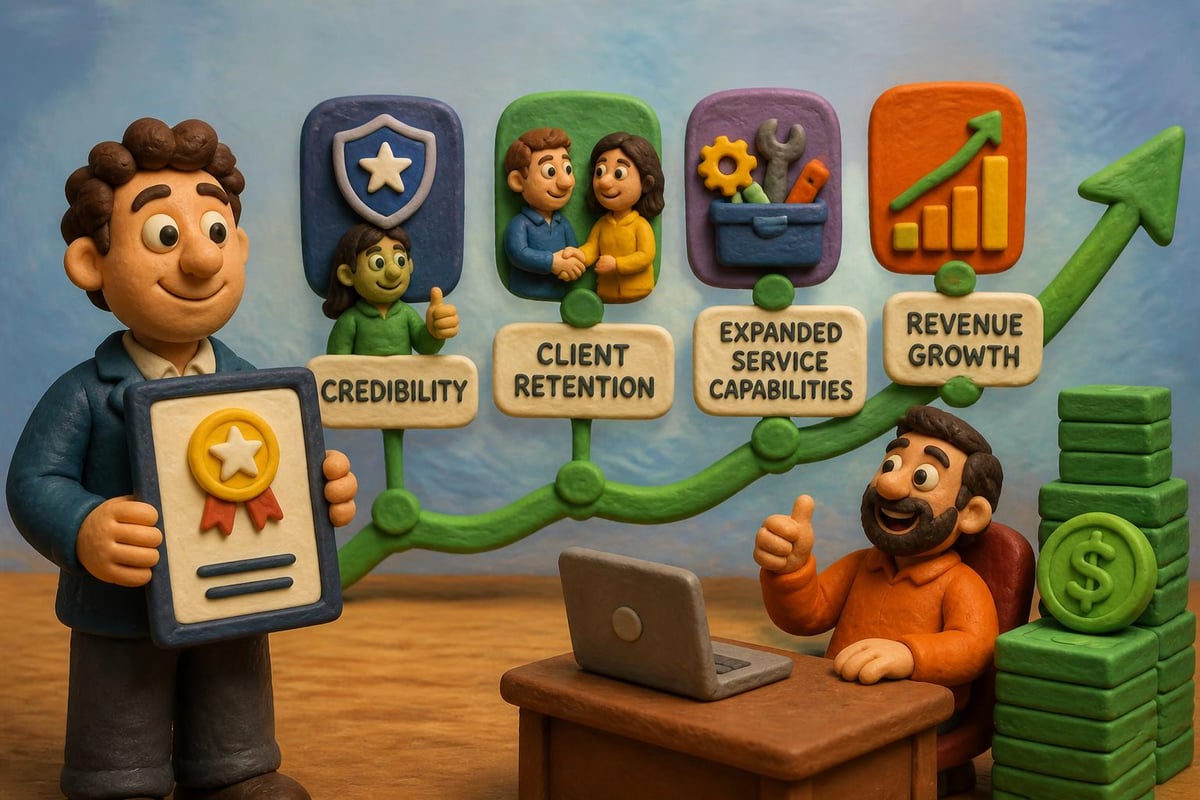
Credentials affect earning power, client acquisition, and campaign results. A certified digital marketer commands higher rates and wins more proposals because certification lowers the buyer’s risk.
Measurable ROI for Professionals
Certified professionals earn roughly 15 to 30% more than non-certified peers in similar roles. The market knows they need less training, make fewer expensive mistakes, and produce results sooner.
According to Credly’s professional badge data, professionals who complete comprehensive digital marketing certifications report:
- Higher client retention rates due to demonstrated expertise
- Faster advancement into strategic and leadership roles
- Greater confidence when presenting recommendations to stakeholders
- Expanded service offerings supported by verified knowledge
Impact on Agency and Consultant Credibility
For agencies serving clients across digital marketing channels, certification separates your team from competitors running on experience claims alone. Credentials on your site, proposals, and LinkedIn give decision-makers third-party proof.
Small business owners researching local SEO agencies or paid advertising partners usually can’t evaluate technical capability themselves. Certification works as a quality signal that cuts buyer uncertainty and shortens sales cycles.
Selecting the Right Certification Program
Picking a credential means weighing your skill level, goals, budget, and time. There’s no universal right answer.
Assessment Criteria for Certification Programs
Start by identifying your primary objective. Are you seeking:
- Career entry into digital marketing roles
- Skill validation for current capabilities
- Specialization in a specific channel or industry
- Agency credibility to win larger contracts
- Business ownership knowledge to manage marketing internally
Once your goal is clear, evaluate programs based on these factors:
| Criteria | Why It Matters | Questions to Ask |
|---|---|---|
| Industry Recognition | Employer and client acceptance | Do hiring managers and procurement teams recognize this credential? |
| Curriculum Depth | Practical application vs. theory | Does training include hands-on projects and real campaign work? |
| Update Frequency | Current best practices | How often is content refreshed to reflect platform changes? |
| Assessment Rigor | Credential integrity | What percentage of candidates pass exams on first attempt? |
| Cost vs. Value | Return on investment | Will increased earnings or client acquisition offset program fees? |
Global vs. Regional Certifications
EC-Council’s Certified Digital Marketer program offers instructor-led training focused on planning, executing, and measuring campaigns. Good fit if you learn better in a structured classroom than on your own schedule.
Regional programs like the Certified Digital Marketer in Asia Pacific address market-specific platforms and regulations. If you operate in North America, make sure the content matches Google, Meta, and the search behavior of your actual audience.
Certification as a Foundation for Continuous Learning
A credential is the starting line, not the finish. This field moves too fast for one-and-done education.
Maintaining Current Knowledge
Reputable certification bodies require continuing education or recertification every 2 to 3 years, which keeps certified professionals current on algorithm updates, new platform features, and shifting consumer behavior.
The Australian Certified Practising Marketer designation designation works this way: ongoing learning points from courses, conferences, and published work keep the status active.
Practical strategies for staying current include:
- Subscribing to official platform blogs (Google Search Central, Meta for Business)
- Participating in professional marketing associations with local chapters
- Testing new features in controlled campaigns before full deployment
- Attending quarterly webinars from certification providers
- Contributing to marketing communities and knowledge-sharing forums
For businesses in markets like Colorado Springs digital marketing, knowing local dynamics and seasonal patterns adds an edge no certificate provides on its own.
Advanced Specializations and Stacking Credentials
After the foundational credential, many professionals stack specialized ones: automation, conversion optimization, industry-specific marketing. Stacked credentials signal deep expertise.
A certified digital marketer might add:
- Google Analytics Individual Qualification for advanced measurement
- HubSpot Marketing Software Certification for automation platforms
- Facebook Blueprint Certification for Meta advertising mastery
- Industry-specific programs for healthcare, legal, or financial services marketing
That lets you charge premium rates for the specialty while the comprehensive certification vouches for your overall strategy skills.

Building Expertise Through Certification and Application
Knowledge without application is trivia. The valuable certified digital marketers turn credentials into measurable outcomes through systematic implementation and testing.
From Theory to Campaign Execution
Programs teach frameworks. Expertise comes from running real campaigns. Small businesses get the most from certified professionals who pair the training with experience across many client situations.
For companies exploring paid advertising management, certified professionals launch campaigns with proper tracking, compliant creative, and strategic bidding instead of burning budget on trial and error.
Application-focused learning includes:
- Running test campaigns with limited budgets before scaling
- Implementing tracking across the full customer journey from click to conversion
- Building documented processes for repeatable campaign deployment
- Creating performance benchmarks based on industry standards and client history
- Conducting regular audits to identify optimization opportunities
Measuring Certification Impact on Business Results
The real proof of certification shows up in campaign metrics. Certified professionals should demonstrate:
- Lower cost per acquisition through refined targeting and optimization
- Higher conversion rates from better landing page and funnel design
- Improved quality scores in paid search campaigns, reducing cost per click
- Faster troubleshooting when campaigns underperform or platforms change
- Strategic recommendations backed by data and industry benchmarks
Deciding between hiring certified pros and certifying internally? Track those metrics both ways. For most small businesses, the time cost of comprehensive certification makes partnering with a certified agency the better math.
Certification’s Role in Client Relationships and Trust
For service businesses, retention runs on consistent results and honest communication. A certified digital marketer brings standardized methods and professional accountability to that relationship.
Educating Clients Through Certified Expertise
Most clients can’t evaluate marketing strategy on technical merit. Credentials give you a framework for explaining recommendations without drowning people in jargon.
When recommending local SEO improvements or a paid campaign restructure, a certified professional can point to industry standards and validated frameworks instead of “trust me.”
This approach helps clients:
- Understand why specific tactics matter for their business goals
- Make informed decisions about budget allocation across channels
- Set realistic expectations for timelines and performance
- Evaluate results against industry benchmarks rather than arbitrary targets
Reducing Risk Through Professional Standards
Certification programs drill ethical practice, data privacy, and platform policy compliance. Those standards protect everyone from penalties, account suspensions, and reputation damage.
In regulated industries, that knowledge prevents expensive mistakes. Lead generation campaigns have to balance aggressive optimization against platform policies and legal constraints that vary by industry and geography.
Integration with Business Systems and Technology
Modern marketing runs on connected systems that capture, nurture, and convert leads together. Certification programs increasingly teach that integration alongside channel tactics.
CRM and Marketing Automation Competency
A certified digital marketer understands how customer data moves between ad platforms, landing pages, CRM, and communication tools. That systems thinking prevents data silos and keeps attribution honest.
Key integration points include:
- Connecting form submissions to CRM records with proper source attribution
- Setting up automated email and SMS sequences triggered by specific behaviors
- Implementing conversion tracking pixels across all paid media platforms
- Building dashboards that aggregate data from multiple sources
- Creating lead scoring systems that prioritize sales follow-up efforts
These technical skills let certified pros design campaigns that fit your broader business processes. Plenty of businesses struggle with effective website marketing simply because the site never got wired into the CRM, creating manual work and missed leads.
AI and Automation in Modern Marketing Practice
Current programs teach AI applications too: audience targeting, creative optimization, predictive analytics. As AI becomes standard equipment, certified marketers need to know the use cases, the limits, and the quality controls.
This includes knowledge of:
- AI-powered bidding strategies in Google Ads and Meta campaigns
- Automated creative testing and dynamic content personalization
- Predictive lead scoring using historical conversion data
- Chatbot and voice agent implementation for customer engagement
- Natural language processing for content optimization and keyword research
Keeping up requires learning beyond the initial certificate, but programs that teach emerging tech prepare marketers for the tools they’ll actually use.
Certification Value Across Different Marketing Roles
Certification pays differently depending on your seat: in-house marketer, agency professional, freelancer, or business owner.
For Agency Professionals and Consultants
Agencies benefit from certifying the whole team. It signals consistent quality across engagements and reduces key-person risk for clients considering a long-term partnership.
Independent consultants lean hardest on credentials. Without an agency brand behind you, certification is the third-party validation that builds trust faster.
For In-House Marketing Teams
Companies hiring in-house use certification to screen. Credentialed candidates need less training, bring standard processes, and usually outperform in their first 90 days.
For existing staff, employer-sponsored certification doubles as retention and capability building. Teams propose new initiatives with more confidence when recommendations rest on industry-standard frameworks.
For Business Owners and Entrepreneurs
Business owners face the real question: spend the time getting certified to run marketing internally, or partner with certified professionals who bring the expertise now. It comes down to time, budget, and whether marketing is your core business or a supporting function.
If you’re chasing growth, partnering usually beats climbing the learning curve yourself. That said, basic certification knowledge helps you evaluate proposals, set sane budgets, and ask sharper questions.
Becoming a certified digital marketer takes real investment: structured learning, exams, ongoing education. The payoff is credibility, better campaign performance, and results you can measure. Whether you’re building internal capability or hiring it, certification means your marketing follows proven frameworks instead of guesswork. Pioneer Marketing brings certified expertise in local SEO, paid advertising, and marketing automation to small and mid-sized businesses across the Colorado Front Range, pairing formal training with hands-on experience for predictable lead generation and measurable growth. Want recommendations backed by verified expertise? Partner with Pioneer Marketing and let’s build marketing systems that deliver.