Modern businesses face a constant challenge: how to scale marketing efforts without proportionally increasing team size or budget. Automation marketing solves this fundamental problem by replacing repetitive manual tasks with intelligent systems that nurture leads, engage customers, and drive conversions around the clock. For small and mid-sized businesses competing in crowded markets, these automated workflows create the consistency and speed needed to convert opportunities before competitors can respond. The transformation from reactive marketing to proactive, systematic engagement represents one of the most significant operational shifts available to growing companies today.
What Automation Marketing Delivers to Your Business
Automation marketing encompasses the technology and strategies that execute marketing tasks automatically based on predefined triggers, customer behaviors, and time-based schedules. Rather than manually sending follow-up emails, qualifying leads, or scheduling social posts, businesses build rule-based systems that handle these functions consistently.
The core benefit extends beyond time savings. Automated systems eliminate the human error and inconsistency that plague manual processes. Every lead receives the same quality of follow-up. No prospect falls through the cracks because someone forgot to send a reminder. Response times drop from hours to seconds.
Primary Functions of Marketing Automation
- Lead capture and instant qualification
- Behavior-triggered email sequences
- Appointment scheduling and reminders
- CRM data enrichment and updates
- Social media posting and engagement
- Campaign performance tracking
- Customer segmentation and scoring
Small businesses particularly benefit because automation marketing creates enterprise-level capabilities without enterprise-level overhead. A three-person team can deliver the responsiveness and consistency previously requiring a dozen employees.

Building Effective Automation Workflows
The foundation of successful automation marketing lies in mapping customer journeys before building technical systems. Many businesses make the mistake of implementing tools first, then trying to force workflows into the available features. This backwards approach creates disconnected automations that confuse prospects rather than guide them.
Start by documenting your current manual processes. How do leads enter your system? What questions determine if they're qualified? Which follow-up messages convert best? These existing patterns become your automation blueprint.
Workflow Development Process
- Map decision points where leads take different paths based on their responses or behaviors
- Define trigger events that start each automation sequence (form submission, email open, website visit)
- Script messaging for each touchpoint in the customer journey
- Set timing intervals between automated contacts
- Establish exit criteria that move leads to different workflows or mark them as converted
- Build feedback loops that improve automation based on performance data
According to research on marketing automation best practices, behavior-based triggers significantly outperform time-based sequences alone. A prospect who downloads a pricing guide needs different follow-up than someone who only visited your homepage.
The technical implementation becomes straightforward once strategy is clear. Most automation platforms offer visual workflow builders where you drag and drop elements to create decision trees. Testing each path ensures messages make sense in context and leads receive appropriate content based on their demonstrated interest level.
Integration Points That Multiply Automation Value
Automation marketing delivers exponential returns when connected to other business systems. Standalone email automation helps, but integrated automation transforms operations. The difference between isolated tools and connected ecosystems determines whether automation simply saves time or fundamentally improves business performance.
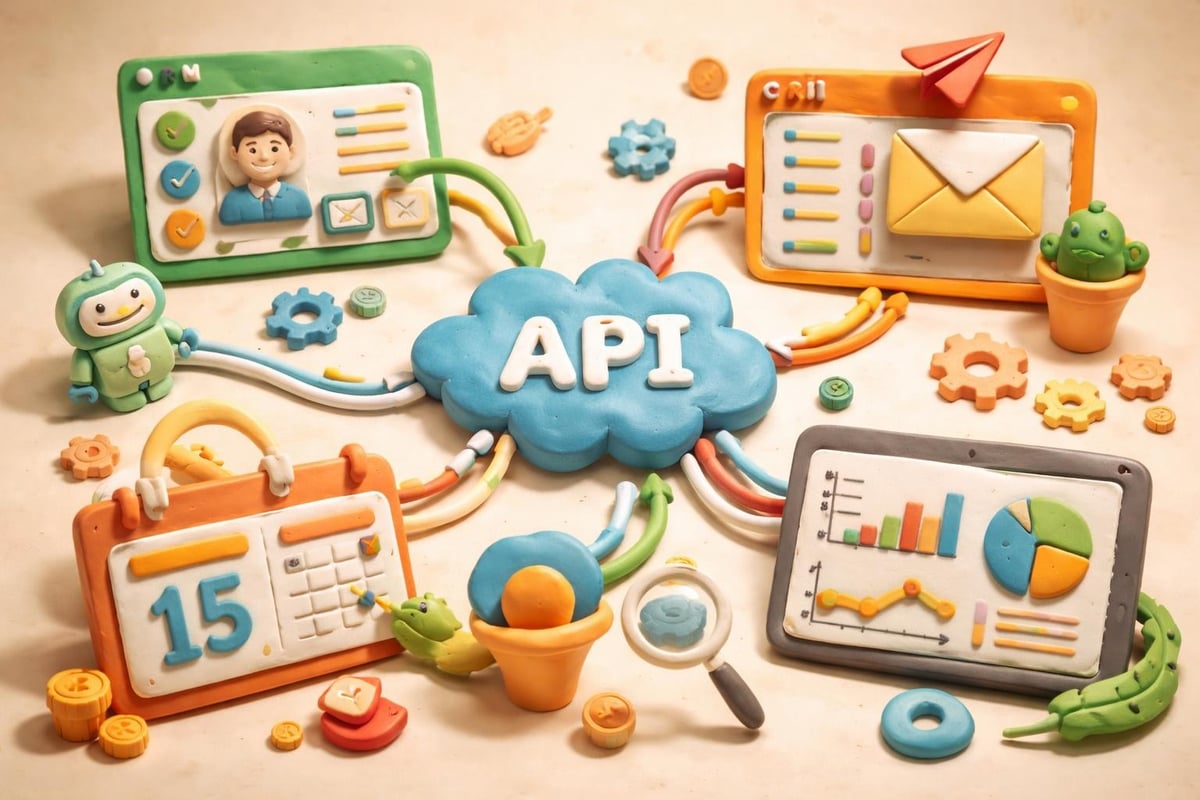
CRM integration creates the most immediate impact. When automation platforms sync with customer relationship management systems, every interaction updates the central database. Sales teams see exactly which emails prospects opened, which pages they visited, and what content they downloaded. This visibility eliminates the common disconnect between marketing activities and sales conversations.
| Integration Type | Business Impact | Implementation Complexity |
|---|---|---|
| CRM Sync | Unified customer data, better sales handoffs | Medium |
| Calendar Systems | Automated appointment booking, reduced no-shows | Low |
| Payment Processing | Automated invoicing, payment reminders | Medium |
| Analytics Platforms | Cross-channel performance tracking | High |
| Social Media APIs | Scheduled posting, engagement monitoring | Low |
Payment and invoicing integrations reduce friction in the buying process. Automated invoice generation, payment reminders, and receipt delivery remove manual accounting tasks while improving cash flow. For service businesses, this automation often pays for the entire marketing platform through faster collections alone.
Companies implementing AI-enhanced business process automation report significant efficiency gains across multiple departments. The technology extends beyond basic email sequences into intelligent routing, predictive scheduling, and adaptive messaging.
AI-Driven Automation Capabilities
Artificial intelligence elevates automation marketing from simple if-then logic to adaptive, learning systems. Traditional automation follows rigid rules: if someone downloads Guide A, send Email B after two days. AI-powered systems analyze patterns across thousands of interactions to determine optimal send times, best-performing subject lines, and most effective content variations for different customer segments.
Voice AI agents represent the frontier of customer interaction automation. These systems handle inbound calls, answer common questions, qualify leads, and schedule appointments without human intervention. For businesses receiving high call volumes, voice automation ensures no opportunity goes unanswered while freeing staff to handle complex situations requiring human judgment.
Chatbots powered by large language models conduct natural conversations on websites, social media, and messaging platforms. Unlike scripted chatbots that frustrate users with limited responses, modern AI assistants understand context, answer follow-up questions, and escalate to humans when appropriate. They operate 24/7, providing instant engagement that dramatically improves lead capture rates.
AI Marketing Automation Applications
- Predictive lead scoring based on historical conversion data
- Dynamic content personalization that adapts to individual preferences
- Optimal send-time prediction for maximum engagement
- Automated A/B testing that identifies winning variations
- Sentiment analysis of customer communications
- Churn prediction triggering retention campaigns
The efficiency of workflow automation demonstrates measurable improvements in execution time and error reduction. Small businesses implementing these systems report processing leads 60-80% faster with significantly higher accuracy rates.
Businesses exploring these capabilities benefit from understanding AI usage in practical marketing contexts. The technology has matured beyond experimental into reliable, production-ready solutions.
Automation for Local Service Businesses
Service providers face unique challenges that automation marketing specifically addresses. Unlike e-commerce businesses with standardized products, local services require consultation, scheduling, and ongoing communication. Manual coordination of these elements creates bottlenecks that limit growth.
Automated appointment systems transform this constraint. When prospects can book consultations directly from your website, see real-time availability, and receive automatic confirmations and reminders, scheduling friction disappears. No-show rates typically drop 40-60% with automated reminder sequences sent via email and text.
Review generation represents another high-value automation for local businesses. After service completion, automated sequences request feedback, direct satisfied customers to review platforms, and alert management to potential issues before they become public complaints. This systematic approach to reputation management ensures consistent review flow rather than sporadic requests.
| Automation Type | Time Saved Monthly | Lead Conversion Impact |
|---|---|---|
| Appointment Booking | 15-20 hours | +25-35% |
| Follow-up Sequences | 20-30 hours | +40-50% |
| Review Requests | 5-10 hours | Indirect (reputation) |
| Lead Qualification | 10-15 hours | +30-45% |
Businesses focused on local SEO understand that consistent customer engagement signals strengthen search visibility. Automation marketing ensures every customer receives timely communication, generating the activity metrics that search engines interpret as business health.
The combination of local visibility strategies and intelligent follow-up creates compound growth. More search visibility generates more leads, while automation ensures higher conversion rates from that traffic. This multiplier effect explains why businesses implementing both strategies consistently outperform competitors investing in only one area.
Measuring Automation Marketing Performance
Implementing automation without measurement creates invisible systems that may or may not drive results. The specific metrics that matter depend on business goals, but certain KPIs consistently indicate automation health.
Email engagement rates show whether your messaging resonates. Open rates above 20% and click rates above 3% suggest relevant content and good list hygiene. Declining engagement indicates message fatigue, poor segmentation, or deliverability issues requiring attention.
Lead velocity measures how quickly prospects move through your funnel. Automation should accelerate this progression. If automated workflows show longer time-to-conversion than manual processes, the automation needs refinement. Faster movement with maintained or improved conversion rates proves automation effectiveness.
Critical Automation Metrics
- Open rate trends by sequence and segment
- Click-through rates on calls-to-action
- Conversion rates at each funnel stage
- Time from lead capture to first contact
- Average deal size for automated vs. manual leads
- Customer lifetime value by acquisition source
- Unsubscribe and complaint rates
Revenue attribution connects marketing activities to actual sales. Multi-touch attribution models show which automated touchpoints contributed to conversions. This data informs budget allocation and workflow optimization. Understanding that leads engaging with three specific emails convert at twice the rate of others allows you to emphasize those messages.
The insights from marketing automation trends highlight the increasing sophistication of measurement capabilities. Modern platforms track customer journeys across channels, devices, and time periods to provide comprehensive performance visibility.

Common Implementation Challenges and Solutions
Despite clear benefits, businesses frequently struggle with automation marketing adoption. Understanding typical obstacles helps avoid them. The most common failure point occurs when companies implement technology without process redesign. Simply automating broken processes accelerates problems rather than solving them.
Content creation presents another barrier. Effective automation requires substantial upfront content development. Email sequences, text messages, social posts, and landing page copy all need creation before automation begins. Many businesses underestimate this requirement and launch with insufficient content variety, causing message fatigue.
Data quality determines automation effectiveness. Systems built on incomplete or inaccurate customer data send irrelevant messages to wrong people at inappropriate times. The adage "garbage in, garbage out" applies directly to marketing automation. Invest in data cleanup before automation launch.
Overcoming Automation Obstacles
- Start small with one high-impact workflow rather than attempting comprehensive automation immediately
- Document current processes before building automated versions
- Create content libraries sufficient for 90-day sequences
- Audit and clean data quarterly to maintain accuracy
- Test extensively before launching workflows to live audiences
- Monitor closely in the first 30 days to catch issues quickly
- Iterate based on performance rather than set-and-forget approaches
Technical complexity intimidates many small business owners. Modern platforms have simplified dramatically, but learning curves remain. Consider whether building in-house expertise or partnering with specialists makes more sense for your situation. The decision depends on team capacity, technical aptitude, and growth timeline.
Guidance from resources covering automation in digital marketing provides practical frameworks for implementation. The key lies in matching automation complexity to organizational readiness rather than adopting features because they exist.
Platform Selection and Stack Architecture
The marketing automation landscape includes hundreds of platforms with overlapping capabilities and distinct specializations. Selection criteria should prioritize business requirements over feature lists. The most powerful platform delivers no value if your team cannot effectively use it.
Ease of use versus sophistication creates the fundamental tradeoff. Enterprise platforms like Marketo or Pardot offer extensive capabilities but require dedicated administrators and significant training. Mid-market solutions like HubSpot or ActiveCampaign balance power with accessibility. Specialized tools like Mailchimp or ConvertKit serve specific use cases well but may limit growth.
Integration ecosystem matters as much as native features. A platform integrating seamlessly with your existing CRM, payment processor, and appointment system delivers more value than a feature-rich tool requiring custom development for basic connections. API availability and pre-built integrations should factor heavily in selection.
| Platform Tier | Best For | Typical Monthly Cost | Learning Curve |
|---|---|---|---|
| Entry-Level | Single workflow automation | $20-100 | Low |
| Mid-Market | Multi-channel campaigns | $200-800 | Medium |
| Enterprise | Complex segmentation, scoring | $1,500+ | High |
| Specialized | Specific industries or channels | $50-500 | Low-Medium |
Cost structure extends beyond monthly subscriptions. Implementation, training, content creation, and ongoing management represent significant investments. Calculate total cost of ownership over 12-24 months rather than focusing only on platform fees.
Businesses should evaluate whether B2B digital agency partnerships accelerate results compared to internal development. The answer depends on internal capabilities, competitive urgency, and opportunity cost of learning versus outsourcing.
Advanced Strategies for Maximum Impact
Once basic automation operates smoothly, advanced strategies unlock additional value. Multi-channel orchestration coordinates messaging across email, SMS, social media, and direct mail. Rather than isolated channel-specific campaigns, orchestrated approaches ensure consistent messaging and optimal channel selection based on customer preferences and response patterns.
Predictive analytics enable proactive automation. By analyzing historical patterns, systems identify leads likely to convert soon or customers at churn risk. Automated interventions target these segments with appropriate messaging before human teams could manually identify the opportunity or threat.
Dynamic content personalization adapts messaging to individual recipients based on their profile data, behavior history, and predictive models. Two people receiving the same email see different subject lines, images, calls-to-action, and offers based on what data suggests will resonate. This approach dramatically improves engagement compared to one-size-fits-all messaging.
Advanced Automation Techniques
- Progressive profiling that gradually collects information across multiple interactions
- Abandoned cart recovery sequences with incentive escalation
- Win-back campaigns triggered by engagement decline
- Cross-sell and upsell automation based on purchase history
- Event-triggered campaigns responding to external signals
- Account-based marketing workflows for high-value prospects
The insights from marketing automation best practices emphasize the importance of dynamic lead nurturing and continuous optimization. Static campaigns quickly become stale, while adaptive systems improve through machine learning and regular human refinement.
Businesses serving specialized markets can implement industry-specific automation. For example, martial arts marketing automation addresses unique challenges like trial class follow-up, belt promotion recognition, and membership renewal. Customized approaches outperform generic templates.
Compliance and Best Practices
Automation marketing operates within legal and ethical boundaries that protect consumers and maintain channel effectiveness. CAN-SPAM compliance requires including physical addresses in emails, honoring unsubscribe requests within 10 days, and avoiding deceptive subject lines. Violations carry substantial penalties and damage sender reputation.
GDPR affects any business with European customers, requiring explicit consent before marketing communications and providing easy data access and deletion. California's CPRA extends similar protections to California residents. Even businesses operating primarily locally should understand these frameworks as regulations continue expanding.
Beyond legal requirements, best practices protect deliverability and brand reputation. Maintaining list hygiene by removing inactive subscribers, avoiding purchased lists, and implementing double opt-in processes keeps engagement high and spam complaints low. Email service providers monitor these metrics, and poor performance triggers filtering or account suspension.
Automation Compliance Checklist
- Clear opt-in processes documenting consent
- Visible unsubscribe links in every email
- Physical address inclusion in email footers
- Suppression list management preventing resubscription
- Privacy policy explaining data use
- Regular list cleaning removing inactive contacts
- Secure data storage meeting industry standards
Transparency builds trust. Explaining why someone received a message and how to control communication preferences demonstrates respect for customer attention. This approach yields better long-term results than aggressive tactics that maximize short-term engagement at the cost of relationship quality.
Professional guidance from specialists in AI automation ensures implementations follow current best practices while preparing for emerging requirements. The regulatory landscape continues evolving, making ongoing compliance monitoring essential.
Automation marketing transforms how businesses engage prospects, convert leads, and retain customers by systematically executing proven workflows that previously required constant manual attention. The strategic advantage comes not just from efficiency gains, but from the consistency and speed that automated systems deliver at scale. Whether you're looking to improve lead follow-up, reduce appointment no-shows, or create sophisticated multi-channel nurture campaigns, Pioneer Marketing builds custom automation solutions that connect your traffic to measurable revenue growth while reducing the manual workload that limits business expansion.