Advertising and business results should be joined at the hip, but in a lot of small companies they barely wave at each other. Money goes out, ads run, and nobody can say which dollar produced which customer. For service businesses on the Colorado Front Range, the question isn’t whether to advertise. It’s how to tie every ad dollar to an outcome you can measure.
Understanding the Strategic Connection Between Advertising and Business Objectives
Every advertising dollar should have a job. Treat advertising as a bolt-on and you get wasted budget, muddled messaging, and campaigns that move nothing that matters.
Successful advertising and business alignment requires three foundational elements:
- Clear definition of business objectives (revenue targets, market share goals, customer acquisition costs)
- Understanding of customer lifetime value and acceptable acquisition costs
- Integration between advertising performance data and business financial metrics
Make those connections and advertising stops being an expense and starts being an investment. The best operators track every ad interaction from first impression to closed sale and beyond.
Mapping Advertising Channels to Business Growth Stages
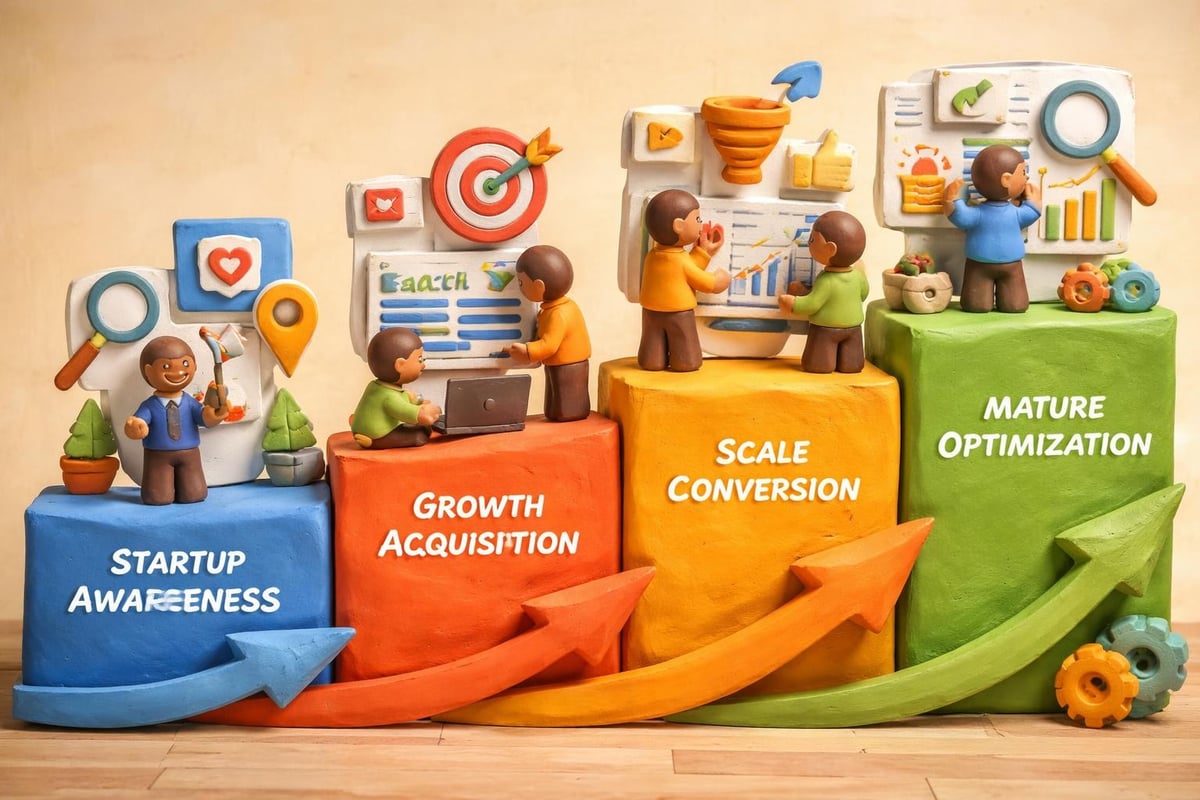
Different channels fit different growth stages. A startup chasing awareness needs different tactics than an established shop tuning its acquisition costs.
| Growth Stage | Primary Business Goal | Most Effective Advertising Channels | Key Metrics |
|---|---|---|---|
| Startup | Brand awareness, initial customers | Social media, local search, content marketing | Impressions, reach, first-time customers |
| Growth | Scale customer acquisition | Paid search, retargeting, targeted social ads | Cost per acquisition, conversion rate, ROI |
| Maturity | Market share expansion, retention | Multi-channel campaigns, customer marketing | Market share, customer lifetime value, retention rate |
| Optimization | Efficiency, profitability | Data-driven channel mix, automation | ROAS, profit per customer, efficiency ratios |
Figure out where you sit in that framework before allocating budget. Copying a competitor’s tactics without their context is a classic way to burn money.
Building Advertising Systems That Support Business Scalability
Scalable advertising and business systems share DNA: repeatable processes, decisions made on data, and infrastructure that grows without piling on manual work.
For service businesses, scaling usually breaks at lead management. The ads generate inquiries fine, but nobody qualifies, nurtures, or converts them fast enough. That caps growth no matter how much you spend.
The Infrastructure Required for Advertising-Driven Growth
Essential components include:
- CRM and lead tracking systems that capture source attribution
- Automated follow-up sequences that engage prospects immediately
- Performance dashboards connecting advertising spend to revenue
- Conversion-optimized landing pages designed for specific campaigns
- Call tracking and recording for phone-driven businesses
With those pieces connected, you can see which ad investments actually return profit. Without them, even good campaigns leak leads through the cracks.
Companies that implement comprehensive digital marketing and strategy frameworks see dramatically better returns. The difference isn’t spending more. It’s connecting spend to outcomes with better systems.
Measuring What Matters: Business Metrics Beyond Advertising Vanity Numbers
The ad industry loves metrics that don’t pay bills. Impressions, reach, and engagement matter far less than revenue, margin, and customer lifetime value.
Critical business-focused advertising metrics:
- Customer acquisition cost (CAC) compared to customer lifetime value (LTV)
- Revenue per advertising dollar across channels and campaigns
- Time to payback on customer acquisition costs
- Contribution margin by customer source
- Net promoter score by acquisition channel
These numbers tell you whether advertising and business goals are actually aligned. A campaign with a million impressions and zero profitable customers failed. A modest one producing high-value customers at sane cost succeeded.
Attribution Challenges in Modern Advertising
Customers rarely convert on first exposure anymore. They research on three devices, read reviews, and touch your brand five times before buying. That makes attribution hard and essential.
| Attribution Model | Business Use Case | Strengths | Limitations |
|---|---|---|---|
| First-touch | Top-of-funnel awareness campaigns | Shows initial discovery sources | Ignores nurture effectiveness |
| Last-touch | Direct response, conversion optimization | Clear conversion attribution | Undervalues awareness efforts |
| Multi-touch | Full-funnel campaigns | Comprehensive view of journey | Complex implementation |
| Time-decay | Long sales cycles | Weights recent interactions | May overvalue closing tactics |
Most small businesses should start with simple last-touch attribution and graduate to multi-touch as they get sophisticated. Actionable beats perfect.

Local Market Domination Through Targeted Advertising Strategies
If you serve a geographic area, local targeting is your unfair advantage. Skip the national fight against unlimited budgets and own your own backyard.
Local advertising advantages for small businesses:
- Lower competition and advertising costs in geographically restricted campaigns
- Higher relevance scores leading to better ad performance
- Stronger community connections and brand recognition
- Ability to reference local landmarks, events, and cultural touchpoints
A roofing company in Colorado Springs does far better targeting “roof repair Colorado Springs” than broad national terms. Higher intent, lower competition, stronger relevance.
Platform Selection for Local Business Advertising
Platforms serve local needs differently. Put your money where your customers’ attention actually lives.
Google Search Ads are still the gold standard for high-intent local searches. Someone typing “emergency plumber near me” is buying today. Businesses investing in local SEO and search advertising get seen at exactly that moment.
Facebook and Instagram advertising builds awareness and nurtures consideration. The demographic and radius targeting lets you define an audience down to the zip code.
Google Business Profile optimization is perpetual free advertising: local pack and Maps visibility without per-click costs. Pair it with paid ads for full local coverage.
Automation and AI: The Future of Advertising and Business Efficiency
AI and automation are the biggest efficiency shift advertising has seen in decades. Small businesses now get capabilities that used to require an enterprise analytics team.
AI-powered advertising improvements include:
- Automated bid optimization adjusting in real-time based on conversion likelihood
- Dynamic ad creative that personalizes messaging to individual viewer characteristics
- Predictive analytics identifying highest-value customer prospects
- Automated audience expansion finding similar profiles to best customers
- Natural language generation creating ad variations at scale
Beyond the ad platforms, AI streamlines what happens after the click: automated lead qualification, intelligent scheduling, and follow-up sequences that never forget.
Implementing Marketing Automation Without Losing the Human Touch
Good automation enhances human relationships instead of replacing them. Machines handle the repetitive and the instant. People handle the judgment and the trust.
Example: a prospect submits a form from a paid campaign. Automation sends the confirmation, schedules the follow-up task, starts the nurture sequence, and pings your sales person, all in seconds. Instant response wins deals.
Businesses implementing AI automation strategies report real gains in lead-to-customer conversion. The trick is building systems that feel helpful, not robotic.

Budget Allocation Strategies That Maximize Business Returns
Budget allocation makes or breaks advertising and business returns. The most common mistake is spreading money so thin that no channel ever reaches critical mass.
Effective budget allocation principles:
- Start with one or two channels and master them before expanding
- Allocate at least 20% of budget to testing and optimization
- Maintain separate budgets for awareness versus conversion campaigns
- Scale investment in proportion to proven returns, not arbitrary percentages
- Reserve budget for seasonal opportunities and competitive responses
A sensible split for a service business: 60% to high-intent search, 25% to retargeting, 10% to testing new channels, 5% to seasonal pushes. Predictable lead flow plus room to explore.
The Build-Measure-Learn Cycle in Advertising Investment
Treat campaigns as experiments. Set a hypothesis, test it, measure honestly, and roll the lesson into the next round.
| Phase | Activities | Decision Points | Timeframe |
|---|---|---|---|
| Build | Campaign setup, creative development, targeting definition | Channel selection, budget commitment | 1-2 weeks |
| Measure | Data collection, performance tracking, attribution analysis | Statistical significance, early indicators | 2-4 weeks |
| Learn | Analyze results, identify patterns, document insights | Scale, optimize, pivot, or stop | Ongoing |
| Apply | Implement learnings, adjust strategy, redistribute budget | Next test priorities | 1 week |
Test small, prove it, then scale. That sequence prevents expensive faceplants and finds winners faster than launching big and praying.
Compliance, Ethics, and Long-Term Business Sustainability
Ethics and compliance matter more every year as platforms tighten rules and consumers demand transparency. Regulated industries like financial services, healthcare, and legal face extra layers.
Key compliance considerations:
- Industry-specific advertising restrictions and prohibited claims
- Data privacy regulations affecting targeting and tracking
- Platform-specific policies that may exceed legal requirements
- Disclosure requirements for testimonials, endorsements, and results claims
- Geographic variations in advertising regulations
Violations bring account suspensions, legal penalties, and reputation damage that dwarf any short-term gain. Working with experienced digital advertisers who know your industry’s compliance rules avoids expensive mistakes.
Building Trust Through Transparent Advertising Practices
Beyond staying legal, honesty is good business. Transparent pricing and realistic promises may generate fewer clicks, but they produce better customers who stick around.
Prioritize lifetime value over the quick transaction. Qualify prospects properly and be willing to pass on bad fits.
Integrating Advertising With Complete Customer Lifecycle Management
Advertising doesn’t stop working at the first sale. Retention, expansion, and referrals are all marketing jobs too.
Complete lifecycle advertising strategies include:
- Acquisition campaigns bringing new customers into the business
- Onboarding sequences ensuring successful early experiences
- Retention marketing maintaining engagement and preventing churn
- Expansion advertising promoting additional services to existing customers
- Referral programs leveraging satisfied customers for new business
Most businesses overspend on acquisition and ignore retention, even though keeping a customer costs a fraction of finding one, and happy customers are the most credible ad channel you’ll ever have.
For businesses running paid advertising campaigns, conversion-focused landing pages matter enormously. A page matched to the ad’s message can double or triple conversion versus a generic website page.
Creating Advertising Feedback Loops That Improve Business Operations
Ad data is business intelligence, not just marketing trivia. Winning ad language sharpens your sales pitch. Conversion patterns by service tell you where to invest operationally. Geographic performance hints at expansion.
Treat the data that way and the advantages spread through the whole company: sales pitches improve, product gaps surface in search queries, and support anticipates questions.
That’s when advertising stops being a department and becomes part of how the business thinks.
Align advertising and business objectives properly and the advantage compounds: infrastructure, measurement, automation, and lifecycle management working as one system. Pioneer Marketing specializes in building exactly that for Colorado Front Range businesses through local SEO, paid ads management, and AI-powered automation. If you want better leads, lower acquisition costs, or predictable growth, that’s the work we do.