


Modern businesses face a fundamental challenge: generating consistent, qualified leads without wasting time or money. The difference between companies that thrive and those that struggle often comes down to how well they integrate their digital marketing and strategy into a unified system. Rather than treating tactics as isolated activities, successful organizations build frameworks that connect audience insights, channel execution, and performance measurement into a cohesive growth engine. For small and mid-sized businesses especially, this integration determines whether marketing becomes a predictable revenue driver or an expensive guessing game.
Understanding the Foundation of Effective Digital Marketing
Digital marketing and strategy begin with clarity about who you serve and what problems you solve. Many businesses jump directly into tactics-launching ads, posting on social media, or redesigning websites-without establishing the strategic foundation that makes those efforts effective. The American Marketing Association emphasizes setting SMART goals and understanding target audiences as essential first steps in any marketing initiative.
Defining Your Target Audience with Precision
The most effective digital marketing and strategy approaches start with detailed audience segmentation. This goes beyond basic demographics to include behavioral patterns, pain points, purchase triggers, and channel preferences. Service-based businesses need to understand not just who their customers are, but when they search for solutions, what language they use, and what objections prevent them from taking action.
Key audience factors to document:
- Geographic service areas and local market conditions
- Decision-making timeline from awareness to purchase
- Budget constraints and pricing sensitivity
- Preferred communication channels and content formats
- Common questions and objections in the buying process
This research directly informs every downstream decision, from keyword targeting in search campaigns to messaging in automated email sequences. Without this foundation, even well-executed tactics miss their mark.
Building a Multi-Channel Marketing System
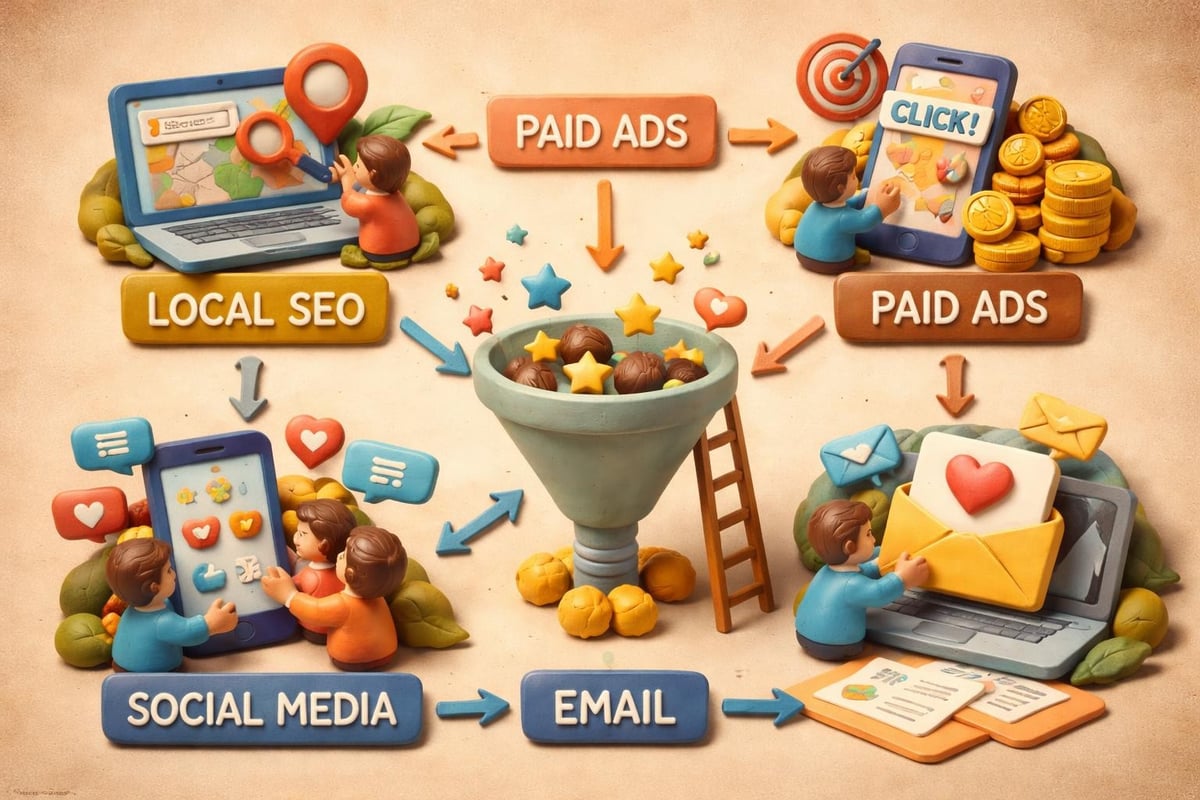
Effective digital marketing and strategy requires selecting the right combination of channels based on where your audience actually spends time and how they prefer to engage. For local service businesses across the Colorado Front Range, this typically means prioritizing channels that capture high-intent searches and build community presence.
Local Search and Organic Visibility
Local search optimization forms the backbone of digital marketing and strategy for businesses serving specific geographic areas. When potential customers search for services "near me" or with city-specific terms, appearing in Google's local pack and organic results generates consistent, high-quality leads without ongoing ad spend. Building this visibility requires optimizing your Google Business Profile, earning quality backlinks, and maintaining consistent business information across directories.
The most successful approach combines technical SEO fundamentals with content that addresses local customer questions. Understanding how digital marketing services integrate helps businesses see beyond isolated tactics to build comprehensive visibility.
| Channel | Best For | Timeline to Results | Cost Structure |
|---|---|---|---|
| Local SEO | Long-term visibility | 3-6 months | Fixed monthly |
| Google Ads | Immediate lead generation | 1-2 weeks | Variable (CPC) |
| Meta Ads | Brand awareness & retargeting | 2-4 weeks | Variable (CPM/CPC) |
| Email/SMS | Customer retention | Ongoing | Per-contact pricing |
Paid Advertising for Immediate Results
While organic strategies build long-term assets, paid advertising delivers immediate visibility and lead flow. The key to effective digital marketing and strategy with paid channels lies in tight audience targeting, compelling ad creative, and relentless conversion tracking. Google Ads captures high-intent searches, while Meta platforms excel at building awareness and retargeting website visitors who haven't yet converted.
For businesses in regulated industries or complex service categories, navigating advertising compliance and policy restrictions becomes critical. Campaigns that violate platform policies get suspended, wasting budget and interrupting lead flow.
Creating Content That Converts Visitors to Leads
Digital marketing and strategy succeed or fail based on whether your content moves people toward a decision. This means going beyond generic blog posts and social updates to create assets designed for specific stages in the customer journey. Top-of-funnel content answers broad questions and builds awareness. Middle-of-funnel resources help prospects evaluate options and understand your approach. Bottom-of-funnel content addresses final objections and facilitates conversions.
Optimizing Landing Pages for Campaign Performance
Every paid campaign needs dedicated landing pages that match the visitor's intent and remove distractions. A visitor clicking an ad about roof repair shouldn't land on your generic homepage-they need a focused page that speaks to their specific problem, shows relevant credentials, and provides clear next steps. According to research from digital marketing best practices, personalization significantly impacts conversion rates.
Essential landing page elements:
- Headline matching the ad or search query
- Clear value proposition within first screen
- Trust signals (reviews, certifications, case studies)
- Single, prominent call-to-action
- Mobile-optimized design and fast load times
- Conversion tracking pixels properly implemented
Businesses that invest in professional landing page development typically see 30-50% higher conversion rates compared to sending traffic to generic website pages.

Implementing Marketing Automation and CRM Systems
The most significant advancement in digital marketing and strategy over the past five years has been the accessibility of sophisticated automation tools for small businesses. What once required enterprise-level budgets and technical teams can now be implemented affordably, creating systems that capture leads, maintain engagement, and track attribution from first click to closed sale.
Automating Follow-Up to Eliminate Missed Opportunities
Most small businesses lose 30-50% of potential revenue through poor follow-up timing and inconsistent communication. A prospect submits a form, but the follow-up email arrives three days later-by which time they've already called a competitor. Marketing automation solves this by triggering immediate responses, scheduling follow-up sequences, and ensuring no lead falls through the cracks.
Effective systems integrate multiple channels:
- Automated email sequences nurturing prospects based on their behavior
- SMS campaigns with 98% open rates for time-sensitive messages
- Appointment booking links reducing phone tag and friction
- CRM integration tracking every interaction and attributing revenue
For companies seeking to implement these capabilities, partnering with specialists like Get To Page One Ltd for website infrastructure and tracking setup ensures the technical foundation supports automation requirements. The combination of properly configured websites and intelligent automation creates a competitive advantage most local competitors lack.
Measuring Performance and Optimizing for ROI
Digital marketing and strategy require continuous measurement and refinement. The metrics that matter depend on your business model, but most service businesses should track lead volume, lead quality, cost per acquisition, and customer lifetime value. These metrics reveal whether your marketing generates profitable growth or just expensive activity.
Building Attribution Models That Track Full Customer Journeys
Modern customers rarely convert on their first interaction. They might see a Facebook ad, visit your website, leave without converting, later search for your company name, read reviews, and finally call or submit a form. Understanding these multi-touch journeys requires attribution modeling that connects each touchpoint to eventual revenue.
| Metric | What It Measures | Why It Matters | Target Range |
|---|---|---|---|
| Cost Per Lead | Marketing spend / leads generated | Efficiency of acquisition | Industry-dependent |
| Conversion Rate | Leads / total visitors | Website effectiveness | 2-5% for most industries |
| Customer Acquisition Cost | Total marketing spend / new customers | Profitability threshold | <33% of LTV |
| Return on Ad Spend | Revenue / ad spend | Campaign profitability | 3:1 minimum |
Businesses exploring how marketing drives measurable growth benefit from understanding that different channels contribute to revenue in different ways. Local SEO might generate cheaper leads over time, while paid ads provide volume control and immediate results.
Adapting Strategy Based on Data and Market Changes
The most effective digital marketing and strategy approaches treat execution as hypothesis testing rather than fixed implementation. You launch campaigns with assumptions about what will work, then use data to validate or invalidate those assumptions. This experimental mindset, combined with rapid iteration, separates high-performing marketing systems from stagnant ones.
Learning from Digital Marketing Case Studies
Studying how other businesses have successfully implemented digital marketing and strategy provides valuable pattern recognition. The Digital Marketing Institute’s collection of case studies demonstrates how organizations across industries have tackled similar challenges with creative solutions.
Common themes emerge from successful campaigns:
- Deep audience research informing channel selection and messaging
- Integration across channels rather than siloed campaigns
- Aggressive testing of ad creative, landing pages, and offers
- Focus on conversion optimization, not just traffic generation
- Clear attribution connecting marketing spend to revenue
Looking at successful digital marketing implementations reveals that creativity matters less than systematic execution and continuous improvement. The companies achieving exceptional results rarely rely on viral moments-they build reliable systems that generate predictable outcomes.

Integrating AI and Automation for Competitive Advantage
Artificial intelligence has transformed digital marketing and strategy by enabling personalization and automation at scale. Small businesses can now deploy chatbots that qualify leads, voice agents that handle appointment scheduling, and predictive analytics that identify high-value prospects. These capabilities were science fiction five years ago-today they're competitive necessities.
Implementing AI-Powered Lead Qualification
Not all leads deserve the same level of attention. AI systems can analyze incoming leads based on completeness of information, behavioral signals, and fit with ideal customer profiles, then route high-quality prospects to sales representatives while nurturing lower-priority leads through automated sequences. This intelligent triaging ensures your team focuses energy where it generates the highest return.
AI capabilities transforming small business marketing:
- Chatbots providing instant responses and capturing lead information 24/7
- Voice agents handling appointment booking and basic customer service
- Predictive scoring identifying which leads are most likely to convert
- Dynamic content personalization based on visitor behavior and demographics
- Automated bid optimization in paid advertising campaigns
Businesses investing in AI-driven marketing automation report significant reductions in manual work and improvements in lead response times. The technology handles repetitive tasks while humans focus on relationship building and strategic decisions.
Aligning Sales and Marketing for Revenue Growth
Even the most sophisticated digital marketing and strategy fails if the handoff between marketing and sales breaks down. Marketing generates leads, but sales teams dismiss them as low-quality. Sales complains about insufficient lead volume while marketing questions why conversion rates remain low. This misalignment wastes budget and frustrates everyone involved.
Creating Shared Definitions and Feedback Loops
The solution starts with clearly defining lead stages and qualification criteria. What constitutes a marketing-qualified lead versus a sales-qualified lead? What information must be captured before sales engagement? What response time standards apply? Documenting these agreements and building them into your CRM creates accountability and reveals where processes need refinement.
Regular feedback sessions between marketing and sales teams surface patterns. Are leads from specific channels consistently higher quality? Do certain ad messages attract better prospects? Is the website qualifying questions filtering effectively? According to digital marketing best practices from CMSWire, integrating digital efforts with overall business goals dramatically improves outcomes.
Scaling What Works and Eliminating What Doesn't
Digital marketing and strategy maturity shows in a business's ability to identify winning campaigns and scale them aggressively while quickly cutting underperforming efforts. This requires both analytical discipline and organizational willingness to act on data rather than opinion or sunk cost fallacy.
Testing Frameworks for Continuous Improvement
Structured testing reveals what actually drives results versus what seems like it should work. A/B testing compares two versions of ads, landing pages, or email subject lines to identify winners. Multivariate testing examines multiple variables simultaneously for more complex optimization. The key is testing one variable at a time with sufficient sample size to achieve statistical significance.
- Identify the variable to test (headline, image, call-to-action, offer)
- Create variations that differ in only that single element
- Split traffic evenly between control and test versions
- Run until statistical significance (typically 100+ conversions per variation)
- Implement the winner and identify the next test
Businesses focused on local service business marketing strategies benefit particularly from testing service area targeting, local messaging variations, and competitor positioning.
Building Infrastructure That Supports Growth
As digital marketing and strategy efforts scale, infrastructure becomes critical. Can your website handle increased traffic without slowing down? Does your CRM segment and tag leads automatically for proper follow-up? Are your tracking systems capturing data accurately for attribution modeling? These operational questions determine whether growth creates momentum or chaos.
The most successful small businesses treat marketing infrastructure as seriously as their service delivery systems. They invest in reliable platforms, maintain clean data, document processes, and train team members on proper usage. This operational excellence compounds over time, creating competitive advantages that competitors struggle to replicate.
Leveraging Local Market Opportunities
For businesses serving specific geographic areas, digital marketing and strategy must account for local market dynamics. Seasonal demand fluctuations, competitive intensity by service area, local events and economic conditions all impact campaign performance. Local SEO strategies that work in one city may need adjustment for different markets.
Smart local businesses also recognize that dominating search results in their primary service area generates better returns than spreading budget thinly across wider regions. Concentrated effort building authority for "Colorado Springs + service" searches typically outperforms generic statewide targeting, especially for businesses with limited budgets.
Digital marketing and strategy work when they connect the right tactics to clear business objectives, measure what matters, and continuously optimize based on performance data. For small and mid-sized businesses ready to build predictable lead flow and measurable revenue growth, Pioneer Marketing specializes in creating integrated systems that combine local search visibility, paid advertising, and intelligent automation. Whether you need better local rankings, qualified leads from search campaigns, or automated follow-up that converts more prospects, our Colorado Springs team delivers strategies that produce measurable results without requiring you to become a marketing expert.


