


Digital marketing represents the practice of promoting products, services, or brands through online channels to reach and engage potential customers. As businesses increasingly shift their focus to digital platforms, understanding how to explain digital marketing in clear, actionable terms becomes essential for entrepreneurs, marketing professionals, and business owners looking to grow their companies. The digital landscape offers unprecedented opportunities to connect with target audiences, measure campaign performance, and optimize marketing investments based on real-time data. This comprehensive guide breaks down the core components, strategies, and practical applications that make digital marketing one of the most powerful business growth tools available today.
What Digital Marketing Really Means
When we explain digital marketing to business owners, we start with the fundamental distinction between traditional and digital channels. Digital marketing encompasses all marketing efforts that use electronic devices or the internet to connect with current and prospective customers. This includes websites, search engines, social media platforms, email, mobile applications, and online advertising networks.
The defining characteristic of digital marketing lies in its measurability. Unlike traditional marketing methods such as billboards or print advertisements, digital campaigns provide detailed analytics about who sees your content, how they interact with it, and whether they take desired actions. This data-driven approach allows businesses to track return on investment with precision that traditional channels cannot match.
The Evolution of Marketing Channels
Marketing has transformed dramatically over the past two decades. Advertising spending data demonstrates this shift clearly, with digital channels now commanding the majority of marketing budgets across industries. The reasons for this migration include lower barriers to entry, superior targeting capabilities, and the ability to adjust campaigns in real time based on performance metrics.
Small and mid-sized businesses particularly benefit from digital marketing's accessibility. A local service provider in Colorado Springs can now compete for visibility alongside larger competitors through strategic local SEO, targeted advertising, and automated customer engagement systems that previously required substantial marketing departments.
Core Digital Marketing Channels
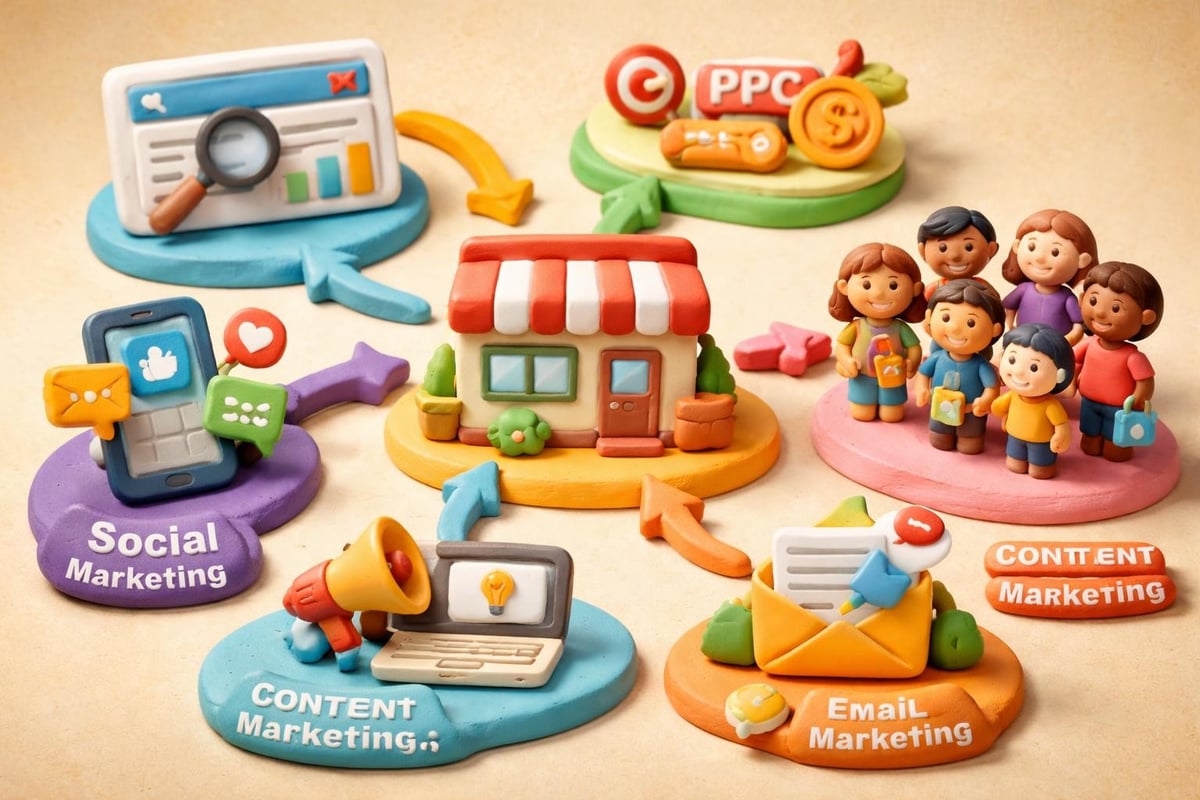
To properly explain digital marketing, we must examine the primary channels where businesses connect with audiences. Each channel serves specific purposes within an overall marketing strategy.
Search Engine Optimization (SEO)
Search Engine Optimization focuses on improving website visibility in organic (non-paid) search engine results. When potential customers search for products or services you offer, SEO determines whether your business appears on the first page of results or gets buried on page five where few users venture.
SEO breaks down into several components:
- On-page optimization: Content quality, keyword integration, meta tags, internal linking, and page speed
- Off-page optimization: Backlinks from reputable websites, brand mentions, and domain authority building
- Technical SEO: Site architecture, mobile responsiveness, security protocols, and crawlability
- Local SEO: Google Business Profile optimization, local citations, and location-based ranking factors
For businesses serving specific geographic areas, local SEO strategies become particularly important. When someone searches "plumber near me" or "Colorado Springs marketing agency," local SEO determines which businesses appear in the map pack and top organic results.
Pay-Per-Click Advertising (PPC)
PPC advertising allows businesses to purchase visibility on search engines, social media platforms, and websites across the internet. Unlike organic marketing that requires time to build momentum, paid advertising generates immediate visibility and traffic.
Google Ads represents the dominant search advertising platform, displaying sponsored results above organic listings when users search relevant keywords. Advertisers bid on keywords and pay only when someone clicks their advertisement. This performance-based model ensures marketing dollars directly correlate with website visits.
Meta Ads (Facebook and Instagram) offer different targeting capabilities based on user demographics, interests, behaviors, and connections. These platforms excel at building brand awareness and reaching audiences who may not be actively searching for your services but fit your ideal customer profile.
The complexity of paid advertising campaigns requires ongoing optimization. Successful campaigns involve keyword research, ad copy testing, bid management, audience refinement, and conversion tracking that connects advertising spend to actual revenue generation.
Content Marketing
Content marketing involves creating and distributing valuable, relevant content to attract and engage a clearly defined audience. Rather than directly pitching products or services, content marketing provides useful information that builds trust and positions businesses as industry authorities.
Common content formats include:
- Blog articles addressing customer questions and industry topics
- Video tutorials demonstrating product usage or service benefits
- Infographics visualizing complex data or processes
- Case studies showcasing customer success stories
- Whitepapers and ebooks offering in-depth research or guides
- Podcasts discussing industry trends and expert interviews
Effective content marketing supports other digital marketing channels. Blog posts improve SEO performance, videos engage social media audiences, and case studies provide credibility that converts prospects into customers.
Social Media Marketing
Social media platforms serve dual purposes in digital marketing strategies. They function as distribution channels for content and advertising while also providing direct communication pathways between businesses and customers.
Different platforms attract distinct audiences and require tailored approaches:
| Platform | Primary Audience | Best For | Content Types |
|---|---|---|---|
| Ages 25-54 | Community building, local business promotion | Videos, images, events, live streams | |
| Ages 18-34 | Visual storytelling, brand personality | Photos, stories, reels, IGTV | |
| Professional audiences | B2B marketing, thought leadership | Articles, company updates, professional content | |
| Twitter/X | News-focused users | Real-time engagement, customer service | Short updates, conversations, trending topics |
The key to successful social media marketing lies in consistency, authenticity, and engagement rather than purely promotional content. Businesses that participate in conversations, respond to comments, and provide value beyond sales messages build stronger audience connections.
Email Marketing
Email remains one of the most effective digital marketing channels for direct customer communication and nurturing. Building an email subscriber list provides a marketing asset you control, unlike social media followers who exist on rented platforms subject to algorithm changes.
Email marketing automation enables sophisticated campaign sequences based on subscriber behaviors and preferences. A new subscriber might receive a welcome series introducing your business, while someone who abandoned a shopping cart receives reminders with incentive offers to complete their purchase.
Modern email marketing integrates with customer relationship management (CRM) systems to personalize messages based on purchase history, browsing behavior, and engagement patterns. This personalization dramatically improves open rates, click-through rates, and conversion performance compared to generic mass emails.
How Digital Marketing Channels Work Together
The real power of digital marketing emerges when channels function as an integrated system rather than isolated tactics. To effectively explain digital marketing strategy, we must examine how different channels support and amplify each other.

The Customer Journey Across Channels
Modern customers rarely convert through a single interaction. The typical path to purchase involves multiple touchpoints across various channels:
Awareness Stage: A potential customer discovers your business through organic search results, social media content, or paid advertisement. At this stage, they recognize a problem or need but may not be ready to purchase.
Consideration Stage: The prospect researches solutions, reads blog articles, watches product videos, and compares options. Content marketing and SEO become particularly valuable here, providing information that positions your business as a trusted resource.
Decision Stage: Ready to purchase, the customer evaluates specific providers. Case studies, customer reviews, detailed product information, and special offers influence final decisions. Retargeting ads remind previous website visitors about your services while email sequences nurture leads toward conversion.
Retention Stage: After purchase, email marketing, social media engagement, and valuable content maintain the relationship. Satisfied customers become repeat buyers and referral sources when nurtured properly.
Attribution and Measurement
Understanding which marketing channels drive results requires proper tracking and attribution models. Digital marketing provides granular data about campaign performance, but interpreting this data correctly poses challenges.
First-touch attribution credits the initial channel that introduced a customer to your business. Last-touch attribution assigns credit to the final interaction before conversion. Multi-touch attribution distributes credit across all touchpoints in the customer journey, providing a more complete picture of how channels work together.
Businesses implementing comprehensive tracking through Google Analytics, CRM systems, and call tracking software gain insights that improve marketing investment decisions. This measurement capability represents a fundamental advantage when we explain digital marketing compared to traditional channels.
Digital Marketing for Small and Local Businesses
While enterprise companies employ large teams and substantial budgets, small businesses can compete effectively through focused digital marketing strategies. Understanding how digital marketing applies to small business contexts helps entrepreneurs maximize limited resources.
Local Search Dominance
For businesses serving specific geographic areas, local search optimization delivers highly qualified traffic. When someone searches "emergency plumber Colorado Springs" at 2 AM, appearing at the top of results generates valuable leads that national competitors cannot capture.
Google Business Profile optimization forms the foundation of local digital marketing. A properly configured profile displays business hours, location, photos, reviews, and services directly in Google search results and Maps. Regular posts, review management, and accurate business information significantly improve local visibility.
Local Service Ads provide another avenue for service providers in eligible categories. These pay-per-lead advertisements appear above traditional paid search results, featuring Google's green checkmark badge that signals verified businesses meeting specific licensing and insurance requirements.
Budget-Conscious Campaign Strategies
Small businesses need not compete dollar-for-dollar with larger competitors. Strategic approaches maximize impact within budget constraints:
- Focus on long-tail keywords with lower competition and higher intent
- Build authority through consistent content creation rather than expensive advertising
- Leverage marketing automation to scale personalized communication
- Prioritize conversion rate optimization to maximize value from existing traffic
- Implement retargeting campaigns that re-engage previous website visitors at lower costs
Many small businesses discover that combining local SEO with automated lead nurturing creates sustainable lead generation systems that compound over time rather than requiring constant advertising spend.
Automation and AI in Modern Digital Marketing
The digital marketing landscape continues evolving rapidly, with automation and artificial intelligence transforming how businesses execute campaigns and engage customers. To fully explain digital marketing in 2026, we must address these technological advances.
Marketing Automation Platforms
Marketing automation systems handle repetitive tasks and trigger personalized communications based on customer behaviors. These platforms connect data across channels, track customer interactions, and execute multi-step campaigns without manual intervention.
Key automation capabilities include:
- Lead scoring that prioritizes prospects based on engagement and fit
- Automated email sequences triggered by specific actions or timelines
- SMS messaging for appointment reminders and time-sensitive offers
- Social media post scheduling and performance tracking
- Personalized website content based on visitor segments
Businesses using automation report significant time savings and improved conversion rates. A prospect who downloads a guide receives an automated nurture sequence over several weeks, gradually building familiarity and trust until they're ready for sales conversations.
AI-Powered Marketing Tools
Artificial intelligence enhances digital marketing through pattern recognition, predictive analytics, and natural language processing capabilities that humans cannot match at scale. AI applications in marketing continue expanding rapidly.
Chatbots and voice agents provide 24/7 customer service, answer common questions, qualify leads, and schedule appointments without human involvement. These AI systems improve response times while reducing operational costs.
Predictive analytics identify which leads are most likely to convert, which customers risk churning, and which products to recommend based on purchase patterns. This intelligence allows businesses to allocate resources more effectively and personalize outreach with greater precision.
Content optimization tools analyze top-performing content, suggest improvements for underperforming pages, and even generate initial content drafts that marketers refine. These capabilities accelerate content production while maintaining quality standards.
For businesses evaluating these advanced capabilities, a Free AI Growth Audit can identify specific opportunities where automation and AI would generate the highest return on investment, showing exactly where current systems leave revenue on the table.
Metrics That Matter in Digital Marketing
Data distinguishes digital marketing from traditional channels, but tracking meaningful metrics requires focus. Vanity metrics like page views or social media followers provide limited insight unless they connect to business outcomes.
Revenue-Focused Analytics
Smart businesses track metrics that directly correlate with revenue generation:
Conversion Rate: The percentage of visitors who take desired actions (purchase, lead form submission, phone call). Improving conversion rates increases revenue without additional traffic acquisition costs.
Customer Acquisition Cost (CAC): Total marketing spend divided by new customers acquired. This metric determines whether marketing investments generate sustainable returns.
Customer Lifetime Value (LTV): Projected revenue from a customer over the entire relationship. When LTV substantially exceeds CAC, businesses can profitably scale marketing efforts.
Return on Ad Spend (ROAS): Revenue generated per dollar spent on advertising. Most successful campaigns achieve 3x-5x ROAS or higher, though acceptable benchmarks vary by industry and business model.
Channel-Specific Performance Indicators
Different digital marketing channels require specialized metrics for optimization:
| Channel | Primary Metrics | Success Indicators |
|---|---|---|
| SEO | Organic traffic, keyword rankings, backlinks | Increasing qualified traffic, first-page rankings for target keywords |
| PPC | Click-through rate, cost per click, conversion rate | Decreasing CPC over time, conversion rate above 3% |
| Open rate, click rate, unsubscribe rate | Open rates 20-30%, click rates 2-5% | |
| Social Media | Engagement rate, reach, follower growth | Engagement rate above 1%, consistent follower growth |
| Content | Time on page, bounce rate, shares | Average time above 2 minutes, bounce rate below 60% |
Regular reporting on these metrics enables continuous improvement. The businesses that outperform competitors consistently analyze data, identify patterns, and adjust strategies based on evidence rather than assumptions.
Building Your Digital Marketing Strategy
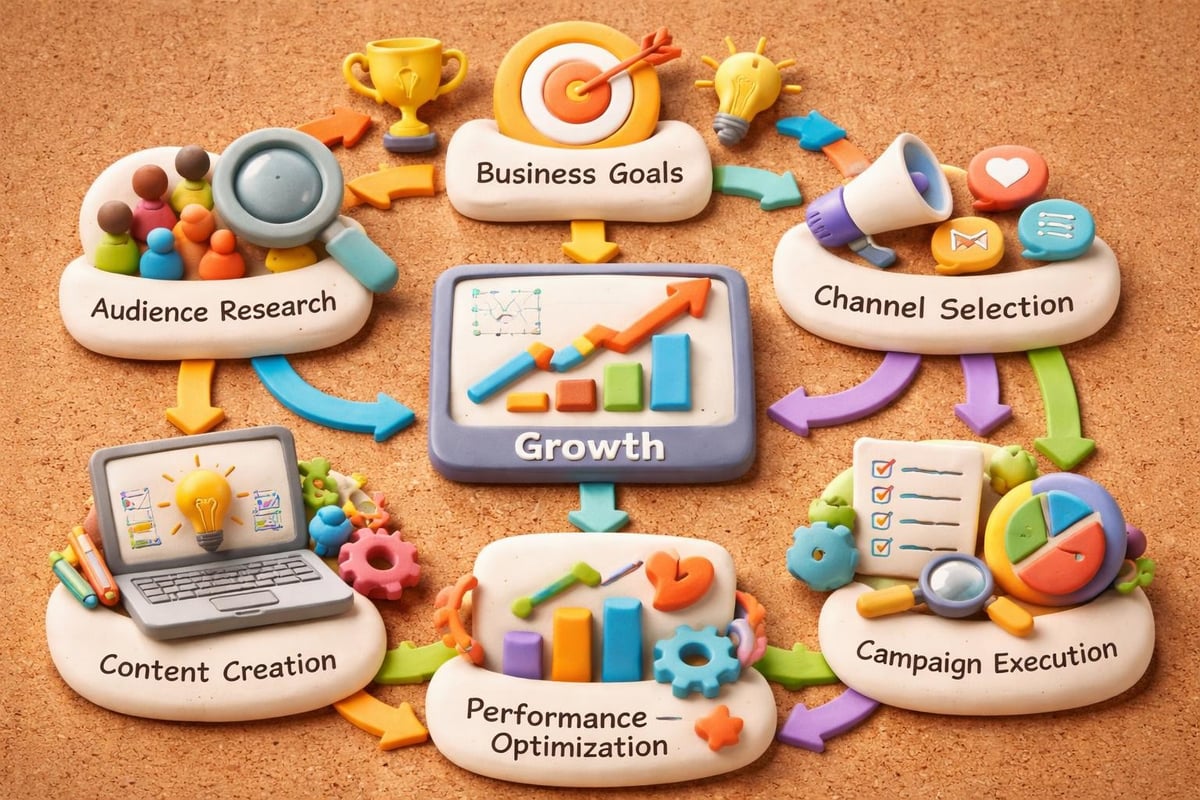
Creating an effective digital marketing approach requires structured planning that aligns channels with business goals. Random tactics without strategic direction waste resources and produce inconsistent results.
Strategic Planning Framework
Successful strategies follow a clear development process:
- Define business objectives: Revenue targets, market expansion goals, customer acquisition numbers
- Identify target audiences: Detailed customer personas including demographics, challenges, behaviors, and preferences
- Audit current performance: Assess existing website traffic, conversion rates, and marketing channel effectiveness
- Select priority channels: Choose 2-3 channels aligned with audience behavior and business capabilities
- Develop content calendar: Plan content creation, publication schedule, and promotional tactics
- Implement tracking systems: Set up analytics, conversion tracking, and attribution reporting
- Execute campaigns: Launch initiatives according to plan with consistent monitoring
- Analyze and optimize: Review performance data monthly, identify improvements, and adjust tactics
This framework prevents the common mistake of implementing tactics without strategy. Businesses that skip planning often chase trends, spread resources too thin across channels, and struggle to measure what actually drives results.
Competitive Analysis
Understanding competitor digital marketing efforts provides valuable intelligence. Analyze what competitors do well and where gaps exist in market coverage.
Keyword gap analysis identifies search terms competitors rank for that you don't, revealing content opportunities. Backlink analysis shows which websites link to competitor content, suggesting potential partnership or content promotion targets. Ad intelligence tools reveal competitor advertising copy, landing pages, and estimated budgets.
Rather than copying competitor tactics directly, use competitive intelligence to identify opportunities they've missed or areas where differentiation creates advantages. The businesses that dominate markets often succeed by solving customer problems competitors overlook.
Common Digital Marketing Challenges
Even well-planned digital marketing initiatives encounter obstacles. Recognizing common challenges helps businesses prepare solutions and maintain momentum when difficulties arise.
Staying Current with Platform Changes
Digital platforms constantly update algorithms, features, and policies. Google releases thousands of search algorithm updates annually. Facebook and Instagram modify their advertising policies regularly. These changes can dramatically impact campaign performance overnight.
Solution: Focus on fundamentals that transcend platform changes. Quality content, authentic audience engagement, and value delivery remain constant regardless of algorithm updates. Diversify across multiple channels to reduce dependence on any single platform.
Generating Consistent Content
Content creation demands significant time and expertise. Many businesses struggle maintaining publication schedules while managing daily operations.
Solution: Develop content systems that repurpose materials across formats. A single customer interview becomes a blog post, social media updates, email newsletter content, and video clips. Batch content creation during dedicated time blocks rather than attempting daily production.
Connecting Marketing to Revenue
Attribution challenges make it difficult to prove marketing ROI, particularly when customer journeys span weeks or months across multiple touchpoints.
Solution: Implement comprehensive tracking from first website visit through final purchase. Use CRM systems that record every customer interaction, phone call tracking for offline conversions, and multi-touch attribution models that credit all contributing channels.
Resource Constraints
Small businesses often lack dedicated marketing staff or expertise across all digital channels. This limitation creates execution gaps and missed opportunities.
Solution: Prioritize channels based on where target audiences spend time and which tactics align with internal capabilities. Growth continues when businesses focus deeply on one or two channels rather than spreading thin across all possibilities. Partner with specialized agencies for technical capabilities beyond internal expertise.
Regulatory Considerations and Best Practices
Digital marketing operates within legal frameworks that protect consumer privacy and ensure fair business practices. Understanding compliance requirements prevents costly violations and builds customer trust.
Privacy Regulations
GDPR (General Data Protection Regulation) and CCPA (California Consumer Privacy Act) establish strict requirements for collecting, storing, and using customer data. Even businesses outside Europe or California must comply when serving customers in those jurisdictions.
Key compliance requirements include:
- Obtaining explicit consent before collecting personal information
- Providing clear privacy policies explaining data usage
- Enabling users to access, correct, or delete their data
- Implementing security measures protecting customer information
- Reporting data breaches within specified timeframes
Advertising Standards
Paid advertising platforms enforce specific policies regarding prohibited content, targeting restrictions, and claim substantiation. Violations result in account suspensions or permanent bans that severely disrupt marketing operations.
Industries like healthcare, financial services, and legal professions face additional advertising restrictions. Businesses in regulated sectors must work with marketing partners who understand compliance requirements and navigate approval processes effectively.
Ethical Marketing Practices
Beyond legal requirements, ethical considerations build long-term customer relationships. Transparency about data collection, honest advertising claims, and respectful communication foster trust that competitive advantages cannot replicate.
Avoiding manipulative tactics like fake scarcity, misleading headlines, or hidden subscription terms may sacrifice short-term conversions but creates sustainable businesses with loyal customer bases and positive reputations.
Future Trends Shaping Digital Marketing
The digital marketing landscape continues evolving as technology advances and consumer behaviors shift. Businesses that anticipate trends position themselves advantageously while competitors react to changes after the fact.
Voice Search Optimization
Smart speakers and voice assistants change how people search for information. Voice queries tend to be longer, more conversational, and question-based compared to typed searches. Optimizing for voice search requires content that directly answers specific questions in natural language.
Video Dominance
Video content consumption continues growing across all demographics. Short-form video on platforms like TikTok, Instagram Reels, and YouTube Shorts captures attention that text-based content cannot match. Businesses incorporating video into content strategies improve engagement and reach.
Privacy-First Marketing
As third-party cookies phase out and privacy regulations tighten, marketers must develop strategies less dependent on tracking individual users across the web. First-party data collection through direct customer relationships becomes increasingly valuable.
Personalization at Scale
Customers expect personalized experiences that reflect their preferences and previous interactions. AI and automation make it possible to deliver customization to thousands of customers simultaneously, creating experiences that feel individually tailored despite serving large audiences.
Digital marketing represents a fundamental shift in how businesses connect with customers, combining multiple channels and technologies into measurable systems that drive predictable growth. Understanding the core components, strategic frameworks, and optimization approaches allows businesses to compete effectively regardless of size or budget. Whether you're just beginning to explore digital marketing or looking to improve existing efforts, focusing on channels that align with your audience, implementing proper tracking, and continuously optimizing based on data creates sustainable competitive advantages. Pioneer Marketing helps Colorado Front Range businesses implement these proven strategies through local SEO, intelligent automation, and data-driven campaigns that connect marketing activity directly to revenue growth.


