SEO is not just something web agencies sell. It is also how the good ones fill their own pipeline. Web agency SEO is its own discipline: you have to prove technical skill, demonstrate expertise, and stand out against hundreds of firms selling the same services. Get it right and you stop depending on referrals and ad spend for every new client.
Understanding the Unique SEO Challenges for Web Agencies
Agencies have a peculiar SEO problem. Unlike a store or a plumber, you are competing against hundreds of nearly identical firms for the same commercial keywords, and every prospect is judging your own site as a work sample.
Competition varies wildly by location and specialty. Broad terms like ‘digital marketing agency’ pull huge volume and convert terribly. Targeted phrases like ‘Colorado Springs SEO agency‘ or ‘local SEO for service businesses’ bring fewer visitors who are far more likely to hire you.
Keyword Strategy Beyond the Obvious
Most agencies target only service keywords. That is a mistake. A solid web agency SEO strategy spreads across intent levels:
- Commercial intent: “hire SEO agency,” “best PPC management company”
- Educational intent: “how to improve local search rankings,” “what is technical SEO”
- Problem-aware: “why isn’t my website ranking,” “how to get more leads from Google”
- Comparison terms: “SEO vs PPC,” “in-house marketing vs agency”
The layered approach catches prospects at every stage. The person reading your educational content today might be a qualified lead in three months.
Research on search engine result page evolution shows Google constantly adjusts how it displays results based on user intent. Build content that satisfies both the researchers and the ready-to-buy.
Technical Foundation for Agency Websites
Web agency SEO starts with the technical basics. Your website is your credibility signal. If it loads slow or breaks on mobile, prospects draw conclusions about your work before reading a word.
| Technical Element | Why It Matters | Target Benchmark |
|---|---|---|
| Page Speed | Affects rankings and user experience | Under 2.5 seconds LCP |
| Mobile Responsiveness | Majority of searches happen mobile-first | 100% mobile usability score |
| Core Web Vitals | Direct ranking factor since 2021 | Pass all three metrics |
| SSL Security | Table stakes for trust and rankings | HTTPS on all pages |
| Structured Data | Enhanced search appearance | Schema for services, reviews, organization |

Speed also converts. Decision-makers research agencies from their phones between meetings. According to best practices outlined by industry experts, clean architecture and logical navigation improve both rankings and engagement.
Schema Markup for Enhanced Visibility
Proper structured data helps search engines understand your services, credentials, and results. The essentials for agencies:
- Organization Schema: Establishes your business entity, logo, and contact information
- Service Schema: Details each offering with descriptions and pricing
- Review Schema: Displays star ratings in search results
- Article Schema: Marks up blog content for featured snippet opportunities
- FAQ Schema: Captures quick-answer boxes in SERPs
The payoff is not just rankings. Rich results make your listings bigger and more informative than the competitors’, which lifts click-through rates.
Content Strategy That Demonstrates Authority
Generic posts about ‘top marketing trends’ will not differentiate you. Your content needs to prove specialized knowledge and give the reader something they can use.
Service businesses want proof, not theory. Case studies, real data, and tactical guides beat surface-level advice every time. Research on SEO and content quality backs this up: optimization plus substance outperforms either one alone.
Building Topic Clusters Around Core Services
Skip the scattered blog posts. Organize content into topic clusters: one pillar page per broad subject, supporting articles drilling into specifics.
Example cluster for local SEO:
- Pillar: Complete Guide to Local Search Optimization
- Supporting: Google Business Profile Optimization Checklist
- Supporting: NAP Consistency and Citation Building
- Supporting: Review Generation Systems for Service Businesses
- Supporting: Local Link Building Strategies
- Supporting: Tracking Local SEO Performance
The structure shows search engines the depth of your expertise and keeps visitors reading. Internal links between cluster articles pass authority and stretch sessions.
For agencies serving a defined region like the Colorado Front Range, local SEO strategies are the great equalizer. Owning local commercial intent lets a small shop beat national firms where it counts.
Link Building Without Looking Desperate
Backlinks still matter, and traditional outreach still feels like begging. Better to earn links with things people actually want to reference.
Tactics That Work in 2026
Create linkable assets: Original research, industry surveys, or comprehensive tools attract links organically. A free SEO audit tool or ROI calculator provides value while earning mentions from industry publications.
Strategic partnerships: Collaborate with complementary businesses like web developers, graphic designers, or business consultants. Co-created content benefits both parties and generates natural link exchanges.
Digital PR: Share newsworthy insights with journalists covering marketing, small business, or technology. Data-driven stories about advertising trends, local business growth, or AI adoption earn media coverage with valuable backlinks.
Studies on URI redirection patterns highlight why clean link architecture matters as you grow. Broken links, redirect chains, and sloppy migrations hurt rankings and users alike.
| Link Source | Domain Authority Value | Difficulty to Acquire | Conversion Potential |
|---|---|---|---|
| Industry Publications | High | Medium | Low |
| Local Business Directories | Medium | Low | Medium |
| Client Websites | Medium | Low | High |
| Educational Institutions | Very High | High | Low |
| Relevant Blogs | Medium | Medium | Medium |

Optimizing for Commercial Intent Keywords
Commercial keywords need different treatment than informational content. Someone searching ‘SEO agency near me’ is evaluating providers right now.
Commercial pages need specific elements:
- Clear value propositions above the fold
- Social proof through client testimonials and results
- Transparent pricing or investment ranges
- Strong calls to action with low friction
- Trust signals like certifications, awards, or recognitions
Balance persuasion with information. Agencies focused on commercial SEO understand that ranking alone does not grow anything. The page has to convert visitors into conversations.
Geographic Targeting for Service Areas
If you serve multiple areas, build a dedicated page for each one. Not thin, copy-pasted pages: each needs real content about that market, its competition, and its business climate.
A Colorado Springs agency might build separate pages for Colorado Springs, Denver, Boulder, and Fort Collins, each showing local market knowledge and regional client work.
Leveraging Client Work for SEO Benefits
Every client project presents opportunities to strengthen your web agency SEO. Strategic approaches include:
- Case studies with keyword optimization: Detail the challenge, solution, and measurable results while naturally incorporating target keywords
- Client testimonials with schema markup: Video or written reviews boost trust signals and can appear in search results
- Portfolio showcases: Visual examples of website designs, campaigns, or automation systems demonstrate capabilities
- Guest posting on client sites: When appropriate, contribute expert content to client blogs with attribution links
If you handle specialized work like Google Ads for regulated industries, document it. Specialized expertise attracts prospects with the same problem and is a genuine differentiator in a crowded market.
Integration with Paid Advertising
Web agency SEO and paid search reinforce each other. Organic takes months; ads deliver visibility and test data today.
Benefits of combining approaches:
- Test messaging and offers through ads before committing to long-term content
- Capture both paid and organic positions for high-value keywords
- Retarget organic visitors who didn’t convert on first visit
- Use paid data to identify converting keywords worth organic investment
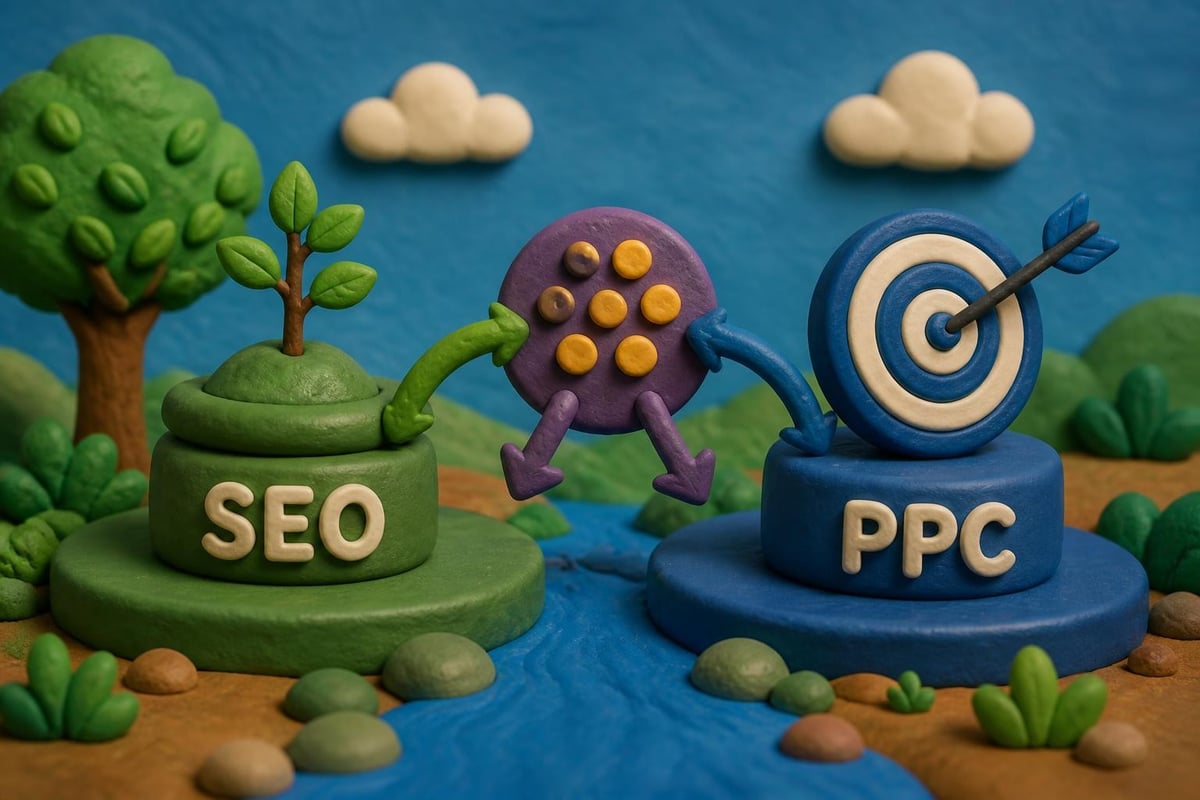
That mirrors how good agencies serve clients. effective digital marketing strategies connect every traffic source to unified conversion tracking instead of treating SEO and PPC as rival channels.
Tracking Performance Beyond Rankings
Measure what connects to revenue, not vanity numbers. Rankings are a means to an end.
Essential KPIs for Agency SEO
Traffic quality over quantity: A 20% increase in organic sessions means nothing if bounce rates exceed 80% and no one converts. Segment traffic by intent and behavior patterns.
Conversion paths: How many organic visitors become leads? What’s the typical journey from first visit to contact form submission? Multi-touch attribution reveals which content assets assist conversions even when they don’t get last-click credit.
Commercial keyword visibility: Track rankings specifically for keywords with buyer intent. Movement on “how to do SEO” matters less than progress on “hire SEO agency in [city].”
Topical authority scores: Tools now measure how comprehensively you cover topics compared to competitors. Higher topical authority correlates with better rankings across related queries.
Using comprehensive SEO tools streamlines monitoring and competitive analysis. Regular audits catch technical issues and content gaps before they cost you rankings.
Avoiding Black-Hat Tactics and Penalties
When competition heats up, shortcuts get tempting. Research on black-hat SEO in fraudulent schemes shows how badly manipulative tactics end. Google catches them with increasing accuracy.
High-risk tactics to avoid:
- Buying links from link farms or PBNs
- Keyword stuffing in content or meta tags
- Cloaking content differently for search engines versus users
- Scraping or spinning content from other sources
- Creating doorway pages targeting slight keyword variations
A penalty can gut an agency’s online presence. Recovery takes months of cleanup, disavowals, and reconsideration requests, with no guarantee you get back in.
Ethical web agency SEO is slower, and it compounds. White-hat growth does not evaporate with the next algorithm update.
Building Authority Through Thought Leadership
Claiming expertise is easy. Prospects want to see it: visible knowledge sharing, industry contribution, work in public.
Effective thought leadership channels:
- Original research: Survey your market, analyze trends, publish data that journalists and competitors will cite
- Speaking engagements: Present at industry conferences, local business groups, or virtual events
- Podcast appearances: Share expertise on relevant shows targeting your ideal client profile
- Tool creation: Free calculators, auditors, or templates that provide immediate value
- Community building: Host workshops, webinars, or local networking events
These activities feed SEO indirectly: brand searches, earned coverage, natural links. Someone hears you speak, Googles your name, and your topical authority ticks up.
According to research on mastering SEO fundamentals, consistent publication with steady promotion builds authority faster than sporadic heroic campaigns.
Creating Conversion-Focused Service Pages
Service pages are your highest-value real estate. They have to rank for commercial keywords and convert the clicks.
Essential Elements of High-Converting Service Pages
Lead with the prospect’s problem. ‘Increase Your Local Visibility and Generate More Qualified Leads’ beats ‘Our SEO Services’ every time.
Include specific sections:
- Problem statement that prospects recognize
- Your unique solution approach
- Process overview with clear steps
- Results and proof points
- Pricing or investment transparency
- Relevant case studies
- Strong, specific call to action
For agencies offering Local SEO and Google Business Profile optimization, spell out exactly what is included, the timeline, and typical results. Transparency builds trust and filters out bad-fit prospects before they book a call.
Use visual hierarchy to point people at the next step: whitespace, contrasting buttons, clear direction.
Maintaining SEO Performance During Growth
Scaling breaks things. The SEO process that works with five clients falls apart at fifty unless you build systems.
Documentation prevents knowledge loss: Create standard operating procedures for on-page optimization, content creation, technical audits, and link building. New team members can execute consistently without reinventing processes.
Quality control at scale: Implement editorial calendars, content briefs, and review workflows. One poorly researched blog post can damage topical authority across related keywords.
Technical debt management: Schedule regular audits for site speed, mobile usability, broken links, and crawl errors. Small issues compound into major problems when ignored during rapid growth periods.
For growing agencies, AI-driven automation handles the repetitive work: keyword tracking, rank monitoring, basic reporting. Save the humans for creative angles, relationships, and hard problems.
Measuring ROI from SEO Investments
Principals need real ROI math to keep funding SEO. Unlike paid ads, organic returns compound, and the early months look expensive.
| Timeframe | Expected Results | Investment Level | ROI Multiplier |
|---|---|---|---|
| 0-3 months | Foundation building, minimal traffic gains | High (technical fixes, content creation) | Negative |
| 4-6 months | Ranking improvements, increasing visibility | Medium (ongoing content) | 1-2x |
| 7-12 months | Consistent lead flow, authority establishment | Medium (maintenance, links) | 3-5x |
| 12+ months | Compounding returns, reduced acquisition costs | Low (updates, monitoring) | 5-10x+ |
Run the lifetime value math. If an average client is worth $50,000 and SEO costs $2,000 a month, one new client every two months is a 12x return.
Watch branded search volume too. More people searching your agency’s name means the brand is working.
Advanced Strategies for Competitive Markets
In saturated markets, standard web agency SEO produces standard results. Differentiation takes angles your competitors have not exploited.
Niche specialization creates authority: Rather than competing broadly as a “digital marketing agency,” focus deeply on specific industries. Become the recognized expert for dental practices, legal firms, or home services companies. This specificity allows for more targeted content, clearer positioning, and reduced competition.
Proprietary methodologies build uniqueness: Develop and name your own frameworks, processes, or systems. “The Revenue Acceleration Framework” or “Predictable Pipeline Method” creates intellectual property competitors can’t replicate. These branded systems become searchable assets themselves.
Local market domination: For agencies serving specific regions, thoroughly own local search visibility. Create comprehensive guides about doing business in your city, market analyses of local industries, and thought leadership around regional economic trends. This geographic specificity builds barriers competitors can’t easily cross.
Done strategically, web agency SEO stops being a cost center and starts being your best salesperson. Commercial rankings, topical authority, and visible expertise compound in a way ad spend never will. If you want a predictable pipeline from organic search and smart automation, Pioneer Marketing builds data-driven systems for Colorado Front Range businesses that tie visibility to revenue.