Hiring an seo web agency is one of the bigger marketing calls you will make. The right partner turns your website into a steady source of qualified leads. The wrong one burns your budget and a year of momentum. This guide covers what good agencies actually do, which questions expose the pretenders, and how to build a partnership that pays for itself.
What an SEO Web Agency Actually Does
An seo web agency is the technical and strategic partner behind your search visibility. The work combines keyword research, technical optimization, content strategy, and link building so your site ranks for the searches your customers actually make.
Core Technical Services
Everything starts with technical optimization. Agencies audit site architecture, page speed, mobile responsiveness, and crawlability so search engines can index and rank your content. They hunt down broken links, duplicate content, and structural problems holding pages back.
Key technical deliverables include:
- XML sitemap optimization and submission
- Schema markup implementation
- Core Web Vitals improvement
- Site speed optimization
- Mobile-first indexing preparation
- HTTPS security protocols
Beyond the fundamentals, good agencies wire up tracking that ties website performance to business results. Proper analytics show which keywords bring traffic, how visitors move through the site, and where the conversion opportunities sit. Evidence beats guesswork.

Strategic Content and Keyword Planning
Strong agencies treat content as a strategic asset, not filler. Keyword research identifies terms with real buyer intent, then content gets built to match the customer journey, weighing search volume, competition, and commercial value.
Content planning maps keywords to specific pages: service pages, location pages, educational resources. An agency skilled in SEO content marketing strategy balances informational content that attracts researchers with transactional pages that convert buyers.
| Content Type | Purpose | Typical Keywords | Conversion Role |
|---|---|---|---|
| Service Pages | Direct conversion | “service + location” | High |
| Educational Guides | Awareness building | “how to,” “what is” | Low |
| Comparison Articles | Consideration stage | “vs,” “best,” “top” | Medium |
| Local Landing Pages | Geographic targeting | “near me,” city names | High |
Evaluating Agency Expertise and Track Record
The single most important selection factor: demonstrated results with businesses like yours. Generic promises mean nothing next to specific case studies and verifiable numbers in your industry.
Questions That Reveal True Capability
Ask pointed questions. Skip the vague “page one rankings” pitch and demand specifics on methodology, reporting frequency, and how they define success beyond vanity metrics.
- What specific SEO strategies have worked for businesses in our industry?
- How do you handle algorithm updates and ranking fluctuations?
- What tools and platforms do you use for keyword research and tracking?
- Can you provide client references in our geographic market?
- How do you coordinate SEO with paid advertising and other marketing channels?
Experienced agencies answer these questions in detail and in plain English. The ones offering only generalities usually lack the depth for a competitive market. Good partners explain their process so you understand it, not so you feel impressed and confused.
Red Flags and Warning Signs
Some signals reliably predict a bad engagement. Guaranteed rankings top the list: nobody controls Google’s algorithm, so nobody can honestly promise a position.
Additional warning signs include:
- Unwillingness to explain their link building methods
- Lack of transparent reporting or dashboard access
- Generic proposals without industry-specific insights
- Extremely low pricing compared to market standards
- No discussion of potential risks or challenges
- Inability to explain how they stay current with algorithm changes
Agencies using private blog networks, purchased links, or keyword stuffing can show quick gains followed by a penalty that flattens your traffic. Recovering from that costs far more than doing it right the first time. Vet hard.
Local SEO Capabilities for Regional Businesses
If you serve a specific area, local SEO expertise is the whole game. An agency that knows local search understands what actually moves the map pack, Maps results, and location-based organic rankings.
Google Business Profile Optimization
Local visibility starts with your Google Business Profile: categories, attributes, service areas, and a steady rhythm of reviews, photos, and posts that tell Google the business is alive and active.
Effective local SEO strategies also cover citation consistency, local links from community organizations, and location-specific content. Winning “near me” searches takes different tactics than general organic SEO.
Service-area businesses covering multiple towns need location pages that are genuinely distinct, not one template with the city name swapped. That balance between scale and uniqueness decides whether multi-location SEO works or triggers quality problems.

Integration With Paid Advertising and Marketing Automation
The best agencies treat SEO as one part of a bigger machine, coordinating it with paid ads, email, and conversion optimization so every visitor is worth more.
Coordinated Paid and Organic Strategies
Paid and organic should trade notes. Keywords that convert in Google Ads become organic content targets. High-performing organic pages shape ad copy and landing pages. The feedback loop improves both channels.
The integration gets technical too. An agency might build conversion-focused landing pages for ads while optimizing them for organic, though choosing the right approach means knowing when a page should index and when it should stay hidden.
It also pays when your seo web agency understands marketing automation and lead nurturing. Traffic is step one. Follow-up decides whether it becomes revenue, and CRM integration shows which keywords produce actual customers instead of form fills.
Measuring ROI and Setting Realistic Expectations
You are buying revenue, not rankings. Professional agencies set KPIs tied to business outcomes and report against them.
Metrics That Actually Matter
Traffic growth is nice. It means nothing without business impact. Expect reporting on organic lead volume, conversion rates, and acquisition cost compared to your other channels.
| Metric | Business Impact | Tracking Method |
|---|---|---|
| Organic Leads Generated | Direct revenue potential | CRM attribution |
| Cost Per Acquisition | Marketing efficiency | Revenue / organic traffic cost |
| Organic Revenue Contribution | Channel performance | CRM + analytics integration |
| Keyword Rankings (Qualified Terms) | Visibility for buyer-intent searches | Rank tracking tools |
| Local Pack Appearances | Geographic market penetration | Local rank tracking |
Honest agencies also preach patience. Technical fixes can produce quick wins, but building authority for competitive keywords usually takes 4-6 months of consistent work. Expect compounding growth, not overnight miracles.
Timeline and Investment Considerations
Budgets scale with competition. A roofer in a crowded metro needs more investment and a longer runway than a niche B2B firm with three competitors.
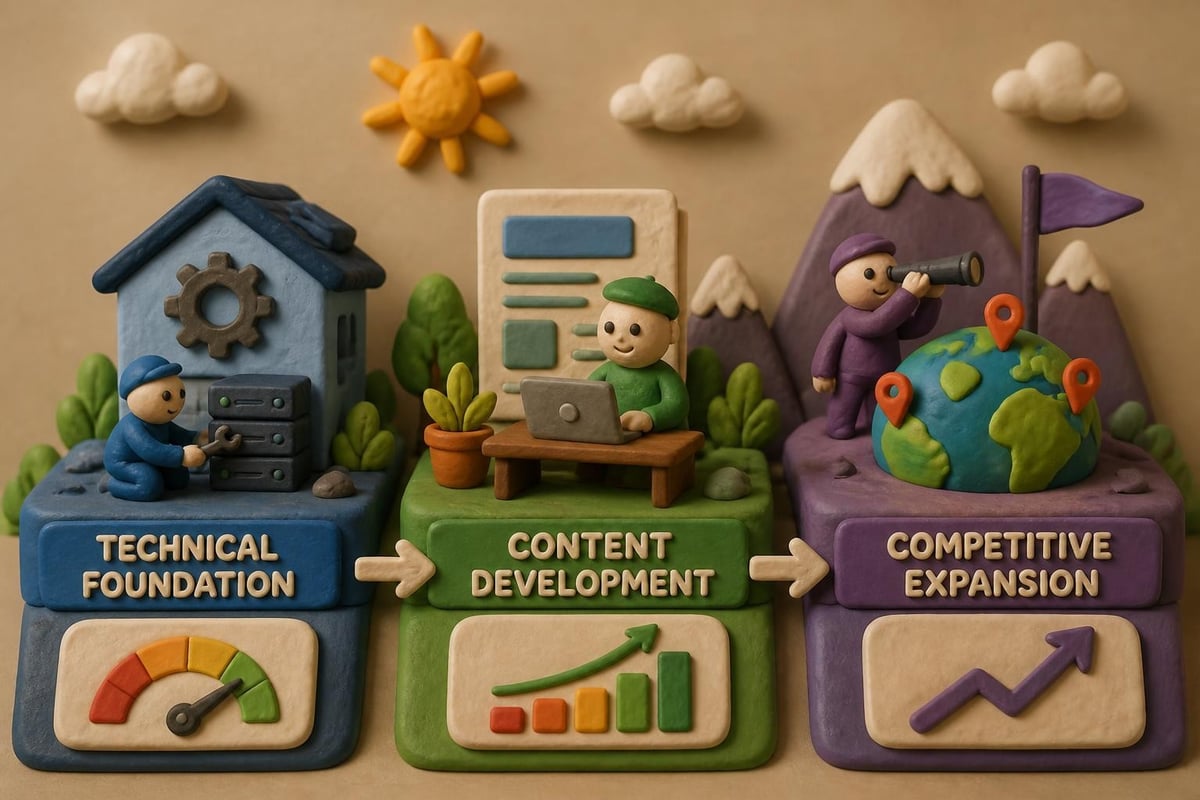
Typical investment phases include:
- Foundation (Months 1-3): Technical audit, keyword research, foundational optimization
- Content Development (Months 3-6): Strategic content creation, link acquisition, citation building
- Expansion (Months 6-12): Topical authority building, competitive content, advanced link strategies
- Optimization (Months 12+): Refinement based on performance data, emerging opportunities
Knowing the phases keeps you from judging performance prematurely. The best partners are also frank about how AI is changing how agencies deliver value while staying committed to white-hat work that survives algorithm updates.
Technical SEO Foundations That Support Growth
Technical excellence is the infrastructure everything else stands on. An seo web agency that fixes the foundation first gets far more out of every piece of content and every link.
Site Architecture and Information Hierarchy
Good site structure helps users and crawlers alike. Important pages should sit within three clicks of the homepage, with internal links distributing authority deliberately.
URL structure, breadcrumbs, and internal linking control how authority flows through the site. Skilled agencies keep priority pages well supported and avoid orphaned pages, excessive depth, and diluted authority.
Core Web Vitals matter too: speed, visual stability, and interactivity affect rankings and conversions both. Work on mastering SEO fundamentals keeps paying off past rankings, in user satisfaction and sales.
Mobile Optimization and Technical Standards
Mobile is no longer optional. Most visitors arrive on phones, so agencies audit mobile usability, speed on cellular networks, and touch-target sizing.
Past basic responsiveness, sophisticated shops handle structured data for richer mobile results and, where it fits, progressive web app functionality. Better mobile visibility plus better mobile experience equals more conversions.
Content Strategy Beyond Blog Posts
Real content strategy goes well beyond a weekly blog post. It builds an ecosystem that covers every stage of the buying decision.
Strategic Content Types and Their Purposes
Each format has a job. Service pages close bottom-funnel searchers. Educational resources catch early researchers. Comparison content helps people mid-decision weigh their options.
Agencies map content to journey stages, find gaps where competitors rank and you do not, and prioritize by traffic potential and business value. That beats random topic selection every time.
AI speeds up content production and raises the bar at the same time. Studies on the transition to Answer Engine Optimization show search shifting toward direct answers and AI summaries, which makes genuine depth and expertise the differentiator.
Link Building and Authority Development
Backlinks remain one of the strongest ranking signals. Ethical agencies earn them through content, digital PR, and industry relationships, never by buying them.
Quality beats quantity by miles. One link from a respected industry publication outweighs dozens of junk directory listings. The best agencies build assets worth linking to: original research, thorough guides, useful tools.
Choosing Between Specialist and Full-Service Agencies
You will also choose between an SEO-only specialist and a full-service agency. Each makes sense in different situations.
When Specialist Agencies Make Sense
Pure specialists usually go deeper on technical work, link building, and organic strategy. If SEO is your primary acquisition channel in a brutal market, that depth can justify the focus.
Specialists tend to track algorithm changes closely and run sharper tools. The tradeoff: you become the coordinator. Separate vendors for SEO, ads, and web development means you manage the integration yourself.
Advantages of Integrated Marketing Agencies
Full-service agencies coordinate SEO with paid, social, email, and conversion optimization under one strategy. Nothing conflicts, and nobody has to referee between vendors.
Pioneer Marketing (full disclosure: that’s us) works this way, combining local SEO with Google Ads management, landing pages, and marketing automation so organic and paid feed one lead system. That model suits small and mid-sized businesses without an internal marketing team.
The right answer depends on your complexity, budget, and in-house capability. Strong internal teams can manage specialists. Everyone else usually does better with one integrated provider.
Reporting, Communication, and Partnership Quality
Communication quality decides partnership success as much as technical skill. Clear reporting and proactive updates separate real partners from vendors going through the motions.
Essential Reporting Components
Good reports connect activity to outcomes. No data dumps: key metrics, what changed, why it matters, and what happens next.
Effective SEO reports include:
- Organic traffic trends with year-over-year and month-over-month comparisons
- Keyword ranking improvements for priority terms
- Conversion metrics showing lead or revenue contribution
- Technical health scores and improvement recommendations
- Content performance analysis highlighting top pages
- Competitive intelligence tracking industry position changes
The best agencies attach recommendations to the numbers: which algorithm update touched your industry, what opportunity just opened, what to adjust this month.
Communication Cadence and Accessibility
Monthly review calls keep strategy aligned with the business, and a good agency stays reachable between them for anything time-sensitive.
Watch how they handle bad news. Setbacks happen. An agency that explains a ranking drop honestly and brings a fix is worth ten that hide behind jargon.
Adapting to Algorithm Updates and Industry Changes
Algorithms shift constantly: several major updates a year, small ones almost daily. An seo web agency proves its worth by adapting, protecting your rankings through volatility, and grabbing new opportunities early.
Staying Current With Search Evolution
Search itself is changing shape. AI answers, featured snippets, and knowledge panels mean optimizing for more than blue links: snippet capture, People Also Ask, and AI summaries all matter now.
Research on Google SERP evolution shows how dramatically result pages keep changing. Agencies that track those shifts keep clients visible while competitors optimize for a version of Google that no longer exists.
The same flexibility covers voice search, visual search, and local service ads. New surfaces keep appearing, and the fundamentals still have to stay solid underneath.
Risk Management and Recovery Planning
Updates sometimes knock even clean sites around. Experienced agencies have recovery protocols: investigate the cause, correct, and communicate honestly about timelines.
Smart risk management means diversified traffic sources, no over-reliance on one keyword, and conservative link practices. Research on website optimization and content quality keeps confirming the same thing: real value wins long-term, manipulation does not.
Industry-Specific SEO Considerations
Industries come with their own quirks, and an seo web agency with wins in your sector brings shortcuts you will not get from a generalist.
Service-Based Business Optimization
Service businesses care about local visibility, lead quality, and conversion, not raw traffic. That means Business Profile work, citations, and service-area targeting.
Add call tracking, form optimization, and nurture systems and the website starts producing customers. The link between digital marketing and small business growth shows how SEO, ads, and automation combine into a lead engine.
E-Commerce and Multi-Location Challenges
E-commerce brings its own puzzles: product page optimization, faceted navigation, keeping thousands of pages fast and non-duplicative, plus product schema for shopping features.
Multi-location businesses face the same scalability problem. Experienced agencies build repeatable processes that hold quality at scale instead of tripping quality filters.
The right seo web agency gives you visibility, qualified traffic, and a lead system that keeps producing. Look for technical depth, honest communication, and genuine understanding of your market. If you want that for a Front Range business, Pioneer Marketing pairs local SEO expertise with AI-driven automation and full digital marketing services built for small and mid-sized companies that want growth they can measure.